Date Created: 10.10.2026
Last Modified: 10.10.2026
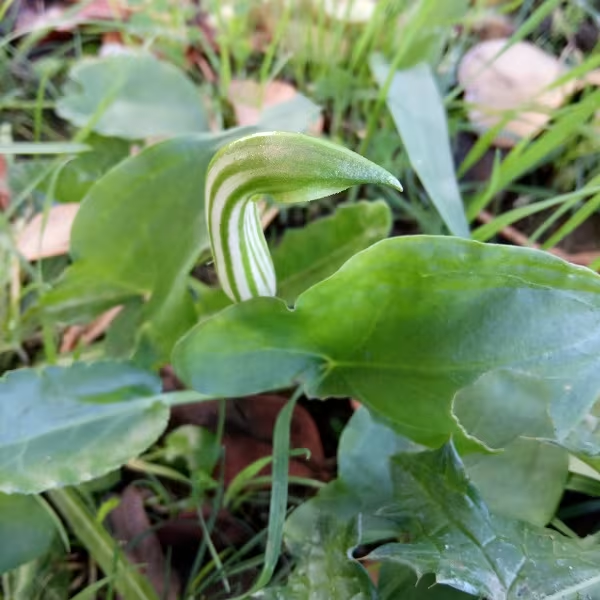
Arisarum vulgare, commonly known as friar’s cowl, is a small perennial of the arum family, Araceae, recognised by its tubular, hooded inflorescence and the curved fleshy structure projecting from its opening. The Royal Botanic Gardens, Kew’s POWO database accepts this species as a tuberous geophyte native from the Mediterranean region to western Transcaucasia, including Cyprus. Its conspicuous hood surrounds a cluster of tiny flowers rather than constituting a single flower.
Common Cypriot Names
The formal Modern Greek rendering is Αρίσαρο το κοινό [Arisaro To Kino], meaning “common arisarum”. The Cyprus Department of Forests, in its leaflet Η χλωρίδα των δασών της Κύπρου (“The Flora of the Forests of Cyprus”) gives the Cypriot vernacular name Χόρτον της κουφής [Horton Tis Koufis], meaning “weed of the viper snake”, due to its appearance.
Common English Names
- Friar’s cowl, recorded by the Royal Horticultural Society.
- Common arisarum, recorded in the French agricultural research institute INRA.
- Larus, also recorded as an English name in the same INRA account.
Etymology of Arisarum vulgare
The etymology of the genus name Arisarum derives from the Ancient Greek ἀρίσαρον [arisaron], a plant name used by Dioscorides, as explained in the International Aroid Society’s botanical account of the genus. The specific epithet vulgare is the neuter form of the Latin vulgaris, meaning “common”, “ordinary” or “usual”, as recorded in Asturnatura’s etymology account. It is a descriptive Latin epithet, not an assessment of the plant’s present conservation status or abundance at every locality.
Synonyms
The following names are explicitly classified as homotypic synonyms by Kew’s POWO database. They are arranged from newest to oldest. The nomenclatural qualifications are retained because several names are illegitimate, superfluous or not validly published.
- Arisarum incurvatum Holmboe (1914), nom. illeg.
- Arisarum arisarum (L.) Huth (1893), not validly published.
- Arisarum serpentrium Raf. (1837), nom. illeg. superfl.
- Balmisa vulgaris (O.Targ.Tozz.) Lag. (1816), nom. superfl.
- Arum calyptrale Salisb. (1796), nom. illeg. superfl.
- Arum incurvatum Lam. (1779), nom. illeg.
- Arum arisarum L. (1753).
Key Characteristics for Diagnostic Identification
Source qualification: Meikle’s original diagnostic key could not be inspected directly for this account, so the following features are not represented as a transcription or paraphrase of his key. They are supported by the botanical descriptions of the International Aroid Society, the Royal Horticultural Society and INRA researchers J. Gasquez and J. Lonchamp.
Kew’s distribution accounts identify this as the only species of Arisarum native to Cyprus. Neither A. proboscideum, A. simorrhinum nor the hybrid A. × aspergillum has a native Cyprus distribution in those accounts. Accordingly, identification here depends on recognising the combined features of the local plant, rather than separating several native Cypriot species of the genus.
- Spathe Shape: Look for a narrow tubular lower portion topped by a hood, with an opening beneath the hood. The International Aroid Society describes the tube as having joined margins and the upper blade as arched over an open mouth. This architecture is more informative than the plant’s small size alone.
- Spathe Colour and Striping: The RHS describes the typical subspecies as having white-green spathes striped with brown or purple. The colours should be assessed together with the tubular hood: a green or purple structure without this distinctive shape is insufficient for identification.
- Spadix: Inside the hood is a fleshy flower-bearing axis, the spadix. The International Aroid Society distinguishes its fertile lower region from its naked upper appendix. In the RHS account of the typical subspecies, the spadix is described as blackish-brown. It must not be mistaken for a petal, pistil or separate flower.
- Leaves: The RHS describes long-stalked, heart-shaped or arrow-shaped leaves in the genus, with arrow-shaped leaves in its account of the typical subspecies. INRA likewise records heart-shaped blades with two basal lobes and long petioles. Leaf shape alone is not decisive; it should be checked against the hooded inflorescence.
- Female Flowers: INRA records a small group of female flowers positioned on one side at the bottom of the spathe. These minute reproductive structures, rather than the enclosing hood, are the actual female flowers.
- Male Flowers: INRA describes the male flowers as reduced to scattered stamens. The International Aroid Society places the male zone immediately above the female zone. Thus, the fertile axis carries separate male and female flowers in different positions, rather than conspicuous flowers with ordinary petals.
- Underground Growth: Kew classifies the plant as a tuberous geophyte, meaning that its persistent organs are below ground. This supports identification when examined in cultivated material, but digging up wild plants is unnecessary for routine recognition.
Additional Identification Characteristics
The RHS subspecies account describes a small plant reaching approximately 15 cm and spathes up to 5 cm long. These are useful supporting observations, but should not be treated as absolute exclusion limits: INRA’s species-level account describes plants reaching 20–30 cm. The practical conclusion is to prioritise the tubular hood, striping, spadix and basal leaf form, using height only as supplementary evidence.
Botanical Structure and Floral Details of Arisarum vulgare
Fruit and Seeds
The INRA botanical account by Gasquez and Lonchamp describes the fruits as berries containing two to eight seeds. This distinguishes the fruiting stage from the earlier hooded inflorescence. Seed-bearing berries demonstrate sexual reproduction, although the same account identifies underground vegetative propagation as an important means by which established plants persist and spread.
Geographical Distribution and Habitat of Arisarum vulgare
According to Kew’s POWO database, the native range encompasses much of the Mediterranean, including southern Europe, North Africa and the eastern Mediterranean, extending to western Transcaucasia. Cyprus lies within this native range. Habitat information must nevertheless be interpreted geographically: observations from Spain or North Africa do not automatically establish the plant’s substrates, elevation limits or flowering season in Cyprus.
Distribution in Cyprus
A plant record created by the Cyprus Tourism Organisation and preserved by the Cyprus University of Technology describes occurrence in sandy places across the island. More specific botanical evidence comes from C. S. Christodoulou, R. Hand and C. Charalambous, whose 2014 Akamas study lists the plant within a phrygana community on a serpentine slope. A separate 2015 chromosome report documents material from Orkontas in the Lefkosia district. These records establish occurrence in both western Cyprus and an inland locality, without implying that every suitable-looking site supports the species.
Flowering Period in Cyprus
The Cyprus Tourism Organisation’s archived plant description, preserved by the Cyprus University of Technology, gives the flowering period as December to May. This is a Cyprus-specific published period. It describes the seasonal window in which flowering may occur across the island, rather than guaranteeing that individual plants or every population remain in flower throughout all six months.
Is Arisarum vulgare Suitable for Gardens?
Yes, as a small ornamental grown for its unusual inflorescences, provided its toxicity is taken into account. The Royal Horticultural Society recommends well-drained soil that becomes dry in summer and identifies rock gardens and containers as suitable settings. It lists propagation by seed or division. This cultivation guidance supports using nursery-propagated material rather than removing plants from natural populations.
International online listings do advertise seeds under this species name, including a listing by Pure Asia Seeds, but a sales listing alone does not verify seed identity, viability or lawful delivery to Cyprus. Before ordering, check the requirements published by the Cyprus Department of Agriculture, which provides information on prohibited imports, phytosanitary certificates, postal consignments and plant passports. Commercial availability must not be interpreted as permission to collect wild plants or as an exemption from plant-health requirements.
Toxicity and Safety
This plant should not be eaten or used as a homemade remedy. The Royal Horticultural Society identifies it as harmful if eaten by people or pets and as a skin and eye irritant, recommending protective equipment when handling it. INRA’s species account additionally identifies toxic leaves and fruits and describes the leaves and tubers as emetic, meaning capable of provoking vomiting.
Experimental Evidence of Liver Toxicity
The concern extends beyond general warnings about the arum family. In a 1999 toxicity study published in Toxicology Letters, researchers investigated bgugaine, a pyrrolidine alkaloid extracted from the tubers, and demonstrated toxicity in rat liver-cell models and a human-derived liver-cell line. In a separate 2000 irniine study in Toxicon, N. Rakba and colleagues, affiliated with the INSERM liver-research unit at Hôpital Pontchaillou in Rennes, investigated another tuber alkaloid, irniine. They found liver-cell toxicity, oxidative stress, DNA damage and cell death in experimental rat-cell cultures.
These experiments do not establish a precise poisonous dose for a person eating the plant, nor do they prove that every exposure produces the same effects. They do provide direct evidence that compounds isolated from its tubers can damage liver cells. Traditional use is therefore not sufficient evidence of safety, and handling advice should not be confused with permission to ingest or apply plant preparations.
Medicinal Properties
Traditional Use and Its Evidential Limits
Traditional medicinal use is documented, but must be distinguished from demonstrated clinical benefit. Zineb Bouafia and colleagues, researchers from the University of M’sila and collaborating institutions including the University of Messina, describe Algerian traditional applications for eczema, wounds and burns in their 2025 research paper in Phytotherapy Research. Their description establishes an ethnomedical practice; it does not establish that untreated plant material is a safe or effective human medicine.
Wound-Healing Research
In the same study, the researchers tested ointments containing an ultrasound-assisted aqueous extract in a Wistar rat wound model. The 5% formulation improved wound contraction relative to untreated and petroleum-jelly groups, whereas the lower concentrations did not show statistically significant effects. No acute dermal toxicity was observed under the experimental conditions. These findings concern a particular prepared extract tested in animals; they do not demonstrate clinical effectiveness in people, safety of ingestion, or safety of applying fresh leaves or crushed tubers to wounds. The study supports further pharmaceutical investigation, not self-treatment.
Fascinating Insights About “Arisarum vulgare”
An Insect Trap With a Rapid Escape
Botanists J. Koach and J. Galil of Tel Aviv University examined the reproductive mechanism both in the field and in the university’s botanical garden. Their 1986 breeding study in the Israel Journal of Botany found that the inflorescence chamber behaves differently from the better-known traps of Arum. The trap is not compulsory: temporarily captured insects could escape in less than an hour once they located the exit. The resemblance between the two genera therefore conceals an important difference in reproductive biology.
A Cyprus Population With Eight Chromosome Sets
In their 2015 cytological report, Samaropoulou, Bareka and Kamari recorded 2n = 56 in material of the typical subspecies from Orkontas, interpreting it as octoploid, with eight chromosome sets. They also noted agreement with an earlier count from another Cyprus population. This is a laboratory-observed feature of the sampled material, not something that can be diagnosed from a field photograph.
Part of an Akamas Serpentine Plant Community
The 2014 ecological study by Christodoulou, Hand and Charalambous records the species among the plants accompanying the endemic Tulipa akamasica on a serpentine slope. This provides a documented ecological association with a distinctive Cypriot habitat. It does not mean that the arisarum is itself a Cyprus endemic or restricted to serpentine: Kew records a much wider native distribution, and other Cyprus records establish occurrence beyond that particular Akamas community.