Date Created: 09.05.2026
Last Modified: 11.05.2026
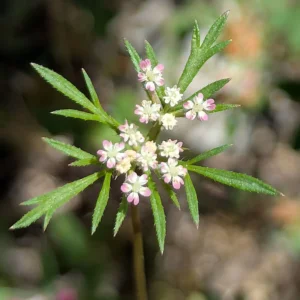
Daucus involucratus, commonly known as the Involucrate Carrot, is a slender, dwarf annual herb belonging to the Apiaceae family. Native to the eastern Mediterranean, this species is adapted to the arid, rocky landscapes of Cyprus, where it is easily identified by its unique, oversized floral bracts.
Common Cypriot Names
The formal botanical translation in Modern Greek is Δαύκος ο ελλοβόκαρπος [Dafkos o ellovokarpos].
Common English Names
- Involucrate Carrot
- Small Involucrate Carrot
Etymology of Daucus involucratus
The etymology of the genus name "Daucus" derives from the Ancient Greek "δαῦκος" [daukos], a term used by ancient botanists like Dioscorides to refer to various wild umbellifers. The specific epithet "involucratus" is the Latin term for "provided with an envelope or involucre," which refers directly to the prominent ring of leaf-like bracts surrounding the base of the flower clusters.
Synonyms
No homotypic synonyms are listed for this taxon under current botanical authorities for the Cyprus region.
Key Characteristics for Diagnostic Identification
According to the definitive botanical keys established by Robert Desmond Meikle in his comprehensive Flora of Cyprus (Volume 1, 1977), this species is distinguished from other taxa of the genus in Cyprus by the below morphological features:
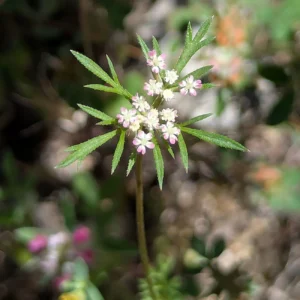
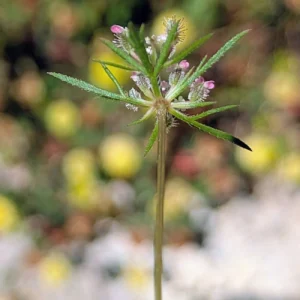
- Involucre Bracts: The primary diagnostic feature is the presence of 3–6 large, leaf-like bracts that are distinctly longer than the rays of the umbel. In Daucus carota, D. glaber, and D. broteri, the bracts are numerous and often pinnately divided, but they are typically shorter than or equal to the rays. In D. guttatus, the bracts are linear-lanceolate but do not achieve the conspicuous, leaf-mimicking length seen in this species. Daucus pumilus differs significantly by having very short, linear, and inconspicuous bracts.
- Umbel Ray Count: This species is characterized by having very few rays, typically only 2–5 primary rays per umbel. This is a major SOS identifier, as D. carota and D. glaber possess 20–40 or more rays, D. aureus has 10–40 rays, and D. broteri usually has 10–20 rays. While D. pumilus also has a low ray count (2–5), it is a prostrate plant found only on coastal sands, whereas this species is erect and found in rocky inland soils.
- Flower Color and Petals: The petals are white but frequently suffused with pink or purple, especially on the outer flowers of the umbellet. This distinguishes it from Daucus aureus, which is the only Cyprus species with consistently yellow flowers. Furthermore, unlike D. carota and D. guttatus, which often feature a single, dark purple sterile flower in the very center of the umbel, this species usually lacks that central dark spot.
- Fruit Spine Morphology: The mericarps (seeds) are covered in glochiadate spines (hooked at the tip), but the spines are relatively long and arranged in distinct, non-overlapping rows due to the small number of flowers. In Daucus guttatus, the fruiting umbel contracts into a tight, "bird's nest" shape where the spines become densely entangled; in D. involucratus, the umbel remains relatively open and flat even in fruit.
- Leaf Segment Shape: The leaves are 2-3 pinnatisect with ultimate segments that are filiform (needle-like) and very short. This differs from D. carota and D. durieua, which have broader, lanceolate or ovate leaf segments. The Involucrate Carrot has segments that are less than 1mm wide, a survival adaptation for low-elevation heat not shared by the more robust species.
Additional Identification Characteristics
Botanists such as Meikle note that the dwarf annual habit of the Involucrate Carrot is a key field indicator; the plant rarely exceeds 30 cm in height, whereas Daucus carota frequently reaches over 1 meter. The **pedicels** (individual flower stalks) are also notably unequal in length within each umbellet, a trait more pronounced here than in D. broteri.
Geographical Distribution and Habitat of Daucus involucratus
The Involucrate Carrot is natively distributed throughout the eastern Mediterranean basin, including Greece, the Aegean Islands, Turkey, and the Levant. It is highly specialized for thermophilous (heat-loving) plant communities, typically colonizing thin soils over limestone, dry grassy banks, and the edges of phrygana shrublands.
Distribution in Cyprus
This species is widespread across the island and is 100% verified in the Akamas Peninsula, the Limassol district, the Amathus ruins, and the Xylophagou area. It is particularly common on the limestone plateaus of the southern coast.
Elevation Range in Cyprus
In Cyprus, this taxon is strictly a lowland to mid-elevation plant, occurring from sea level up to approximately 600 meters. It is not found in the high-altitude forests of the Troodos mountains.
Flowering Period in Cyprus
The flowering window is relatively brief, occurring from March to May, with the most vibrant displays seen in mid-April.
Conservation Status in Cyprus
The Red Data Book of the Flora of Cyprus classifies this species as Least Concern (LC). While it is common, its habitat in coastal lowlands is increasingly threatened by urban development and tourism infrastructure.
Is Daucus involucratus Suitable for Gardens?
This plant is not typically grown in gardens as it is a short-lived annual with a "weedy" appearance. Furthermore, commercial seed availability is virtually non-existent in the international market, and Cyprus law strictly prohibits the collection of wild seeds for commercial use without specific permits from the Department of Environment.
Toxicity and Safety
While the Involucrate Carrot is not broadly toxic, it belongs to a family (Apiaceae) known for furanocoumarins. According to studies on wild Mediterranean umbellifers, skin contact with the sap followed by exposure to sunlight can cause phytophotodermatitis, resulting in blisters or rashes. Expert botanists warn that it can be visually confused with Poison Hemlock (Conium maculatum) by untrained foragers, which can be fatal if ingested.
Medicinal Properties
Ethnobotanical Context
There is limited specific pharmacological research on this exact taxon, but ethnographic studies in the Levant (e.g., by Ali-Shtayeh et al.) indicate that wild Daucus species have been used in traditional medicine as diuretics and to treat digestive upset. However, these uses are not clinically validated for D. involucratus specifically.
Fascinating Insights About "Daucus involucratus"
The Shield Effect
The unusually large bracts are believed by some researchers to act as mechanical protection for the developing seeds against grazing insects. By extending beyond the rays, they create a physical barrier that makes the tender young umbel harder to access.
Pollinator Specificity
Observations in Mediterranean phrygana suggest that the Involucrate Carrot is a vital early-season food source for specialist solitary bees. Unlike the generalist Daucus carota, the smaller, concentrated nectar source of this species attracts smaller insect taxa adapted to rocky, wind-swept environments.