Date Created: 03.09.2022
Last Modified: 03.10.2026
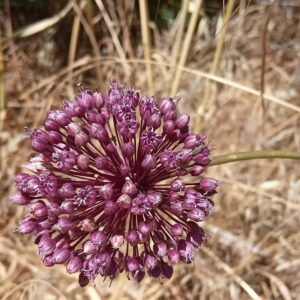
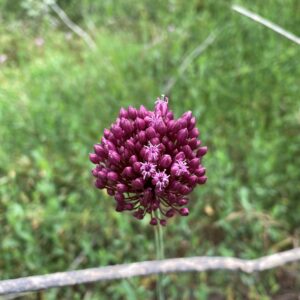
Allium ampeloprasum L., commonly called wild leek, is a perennial bulbous plant of the Amaryllidaceae family. Kew’s Plants of the World Online recognises it as an accepted species native to Cyprus and other parts of the Mediterranean region. Its erect flowering stalk bears a rounded head of small flowers. It belongs to a botanically complex group closely related to cultivated leeks and elephant garlic; wild plants should be distinguished from named garden forms.
Common Cypriot Names
A Modern Greek rendering of the scientific name is Άλλιο το αμπελόπρασο [Alliotoampelopraso]. Cypriot names include Σκουράθθα [skouratha], Σκουράττα [skouratta], Αγριοσκουράθθα [agrioskouraththa] and Αγριόπρασο [agriopraso]. The Cyprus Food Museum records “σκουράθθα” and “αρκόπρασον”, citing Kantzilaris’s 2007 book on Kaimakli, while Dr Kyriaki Zannettou-Panteli records “αγριοσκουράθθα” and “αγριόπρασο” in The Medicinal Plants of Cyprus “Αγριόπρασο” and αρκόπρασον [arkoprason] mean “wild leek”. The additional local name Αρκόσκορτος [arkoskortos], also expressed as σκόρτος άρκος [skortosarkos], can be understood as “wild garlic”: Polignosi’s Cypriot dictionary defines “άρκος” as “wild”, and its entry for “σκόρτος” identifies garlic. However, the attribution of this additional name to the present species has not been independently verified here; it is also recorded for Allium neapolitanum and should not be treated as a species-specific identification. A reliable historical etymology for “σκουράθθα” and “σκουράττα” has not been established.
Common English Names
The National Botanic Garden of Wales and North Carolina State University Extension document the following English names. Several refer particularly to cultivated forms or to broader historical treatments of the species complex; they are not interchangeable labels for every wild population.
- Wild leek
- Broadleaf wild leek; broad-leaved wild leek
- Levant garlic
- Great-headed garlic
- Great-headed leek
- Vine leek
- Blue leek
- Elephant garlic — principally a cultivated form.
- Pearl onion — used for a cultivated form in some horticultural classifications.
Etymology of Allium ampeloprasum
The etymology of the genus name Allium comes from the classical Latin name for garlic. The epithet ampeloprasum combines the Ancient Greek ἄμπελος [ampelos], meaning “vine”, and πράσον [prason], meaning “leek”, giving “vine leek” or “leek of the vineyard”. The National Botanic Garden of Wales documents these botanical name derivations. Proposed earlier origins of the Latin word are not sufficiently established to present here as facts.
Synonyms
Plants of the World Online lists the following homotypic synonyms, presented from newest to oldest. Its entry expressly marks the 1932 name as not validly published.
- Allium porrum subsp. euampeloprasum Breistr. (1947).
- Allium ampeloprasum subsp. euampeloprasum Hayek (1932) — not validly published.
- Allium porrum var. ampeloprasum (L.) Mirb. (1804).
- Porrum ampeloprasum (L.) Mill. (1768).
Key Characteristics for Diagnostic Identification
Robert Desmond Meikle’s relevant treatment is in Flora of Cyprus, Volume 2 (1985). However, the complete original key and an independently verified inventory of every Cypriot Allium taxon were not available for direct examination during this research. Consequently, the following verified characters are not a complete Meikle-based comparison with every species in Cyprus. They draw on Carlos Aedo’s treatment in Flora iberica and Dale W. McNeal Jr. and T. D. Jacobsen’s treatment in Flora of North America.
- Leaves: Flat, solid blades, sometimes channelled or keeled, contrast with the hollow, semicylindrical leaves described for A. sphaerocephalon. Flat leaves alone are insufficient.
- Inflorescence: A dense, spherical or hemispherical umbel. Similar rounded heads occur in other species, so this feature needs floral confirmation.
- Inner Staminal Filaments: Three-pointed, with two sterile lateral branches longer than the central anther-bearing branch. In Aedo’s description of A. sphaerocephalon, the central branch is generally longer than the lateral branches.
- Outer Staminal Filaments: Simple in Aedo’s description, whereas A. commutatum generally has three-pointed outer filaments, although some simple ones can occur.
- Tepal Surface: Usually papillose on the backs and margins; nearly smooth examples occur, so smoothness does not exclude the species.
- Flower Shape: McNeal and Jacobsen describe urn-shaped flowers, with the tepals held erect rather than widely spreading.
- Stamen Projection: Stamens may equal or exceed the perianth. Projection alone is not decisive.
- Aerial Bulbils: Usually absent, but present in some variants. Bulbils do not automatically exclude this species.
Additional Identification Characteristics
Meikle’s 1985 treatment cannot cover all subsequently described Cypriot taxa. Gianpietro Giusso del Galdo, Cristian Brullo, Salvatore Brullo and Cristina Salmeri described A. kyrenium in 2015. Their paper characterises its species group by two unequal, elongated spathe valves, a loose inflorescence and flowers pendent at anthesis, providing useful contrasts with the dense rounded head described above. It also discusses A. cyprium, A. lefkarense and A. marathasicum, described in 1993.
In their 2015 revision of the Allium cupani group, Brullo, Pavone and Salmeri treat Meikle’s A. cupani subsp. cyprium as A. meikleanum. Their description gives filiform, subcylindrical leaves, a one-sided inflorescence of 4–12 flowers and short, simple staminal filaments. These differ from the flat leaves, dense head and three-pointed inner filaments of the plant examined here. This taxonomic change must be considered when applying older literature.
Botanical Structure and Floral Details of Allium ampeloprasum
Bulbs and Vegetative Propagation
In their Flora of North America description, McNeal and Jacobsen describe variable bulbs, sometimes accompanied by smaller yellowish or light-brown bulbels. These underground structures should not be confused with aerial bulbils in the flower head. The leaves can begin withering from their tips by flowering time.
Reproductive Structures
The flowers have six tepals and six stamens. McNeal and Jacobsen’s botanical account describes yellow or purple anthers, yellow pollen and an ovary without a crest. These details supplement identification but do not individually distinguish the species from every other Cypriot member of the genus.
Geographical Distribution and Habitat of Allium ampeloprasum
Kew’s native distribution records extend across the Mediterranean region and into western and central Asia, including Cyprus, Greece, Türkiye, the Levant and parts of North Africa. Chris Kik and colleagues, working with the Centre for Genetic Resources at Wageningen University & Research and collaborating institutions, describe the species as associated with disturbed habitats, including cultivated and abandoned fields.
Distribution in Cyprus
In The Medicinal Plants of Cyprus, Dr Zannettou-Panteli describes the species as occurring throughout Cyprus in cultivated and fallow ground, beside roads and on rocky or sandy soils. More recent sampling documented in Georgios Lazarou’s 2025 Cyprus University of Technology thesis includes roadsides, abandoned fields, field margins and coastal phrygana. These sources support a broad distribution without implying presence at every locality.
Elevation Range in Cyprus
Lazarou’s collection records in Table 1 list sampled plants at 5–967 metres. His 2025 undergraduate thesis was supervised by Dr Nikolaos Nikoloudakis. These elevations represent a documented sampling range, not the established minimum and maximum for Cyprus. Zannettou-Panteli’s older account gives an upper figure of 3,000 feet, approximately 914 metres. The newer 967-metre record means that the older figure should not be treated as an absolute limit.
Flowering Period in Cyprus
Dr Zannettou-Panteli’s Cypriot account reports flowering from May to July. This is a published local flowering window; dates given for cultivated plants or populations in other countries should not replace it.
Conservation Status in Cyprus
A species-specific national category could not be verified directly from the complete Red Data Book of the Flora of Cyprus, edited by Tsintides, Christodoulou, Delipetrou and Georghiou (2007). Therefore, no Cypriot category is assigned here. Kew reproduces an IUCN classification of Least Concern, but this must not be relabelled as a verified assessment of the Cypriot population.
Is Allium ampeloprasum Suitable for Gardens?
Yes, the species and its cultivated forms can be grown for their flowers or edible produce. North Carolina State University Extension recommends full sun and well-drained soil. The Royal Horticultural Society lists the cultivar ‘Elephant’ and commercial bulb suppliers. However, elephant-garlic bulbs and ordinary leek seed are not proof of availability of authentic wild Cypriot material; obtain clearly identified, propagated stock.
Commercial availability does not authorise wild collection. Section 33(1)(b) of Cyprus’s Forests Law prohibits unauthorised collecting, uprooting or cutting of flora in state forests. Imported planting material must also meet the applicable EU plant-health requirements. The European Commission explains phytosanitary controls for plant imports from outside the EU; check the requirements for the particular seed or bulb shipment before ordering.
Toxicity and Safety
Human Consumption and Handling
Cypriot researchers Athena Della, Demetra Paraskeva-Hadjichambi and Andreas Ch. Hadjichambis documented the plant in their 2006 study of edible plants in the Paphos and Larnaca countryside. This establishes traditional food use, not universal safety. North Carolina State University Extension’s safety account reports that large quantities can cause vomiting or digestive problems and that contact dermatitis can occur in some people. Traditional edibility does not establish the safety of concentrated extracts.
Dogs, Cats and Horses
The ASPCA Animal Poison Control service lists Allium ampeloprasum as toxic to dogs, cats and horses. It identifies N-propyl disulfide and describes vomiting, weakness and destruction of red blood cells, including haemolytic and Heinz-body anaemia. Keep bulbs, leaves and food containing them away from these animals. Suspected ingestion requires prompt veterinary advice.
Medicinal Properties
Clinical Research on a Prepared Leaf Extract
A 2023 clinical study by Mohammadreza Bordbar and colleagues at Shiraz University of Medical Sciences and collaborating centres investigated a prepared leaf extract in 97 children hospitalised with chemotherapy-associated febrile neutropenia. The randomised, double-blind, placebo-controlled trial tested the extract alongside supportive care. The researchers reported faster neutrophil recovery in the intervention group. The herbarium voucher was PM 778.
Limits of the Clinical Evidence
The trial’s methods and results concern a single centre and a particular preparation, not wild Cypriot plants eaten as food. Although no adverse effects were reported, the study cannot establish safety for every patient or preparation. Its reported difference in mean hospital stay did not reach statistical significance. The findings do not establish a cancer treatment or justify replacing oncology care with the plant.
Fascinating Insights About “Allium ampeloprasum”
A Wild Relative with Value for Crop Breeding
In their research on collecting and conserving leek crop relatives, Chris Kik and colleagues identify this species, together with A. bourgeaui and A. commutatum, as wild relatives of cultivated leek. Their research explains why conserving these populations matters: wild relatives provide genetic material that may help crop improvement, including research on resistance to pests and diseases. Potential breeding value is distinct from an already demonstrated improvement in a commercial variety.
One Species Can Have Different Reproductive Strategies
During their Greek collecting expedition, Kik and colleagues observed both sexual and asexual reproductive types. They associated this variation provisionally with differences in ploidy. This helps explain why a flowering population does not necessarily provide abundant viable seed and why conserving a collection can require more than gathering seed heads. Their observations concern Greek populations, not a demonstrated rule for every Cypriot population.
Elephant Garlic and Garden Leek Need Different Taxonomic Labels
The RHS places elephant garlic ‘Elephant’ under this species, whereas POWO accepts Allium porrum L. separately for cultivated leek. Older books and horticultural sources often use a broader classification. Consequently, a source discussing “leek” under Allium ampeloprasum does not necessarily describe the same plant form as a wild specimen growing in Cyprus.