Date Created: 03.09.2022
Last Modified: 24.04.2026
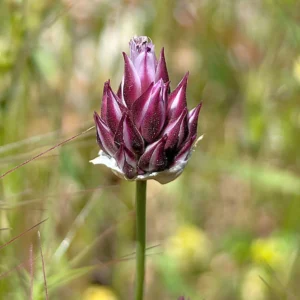
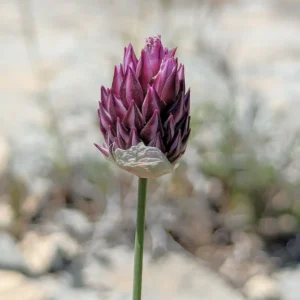
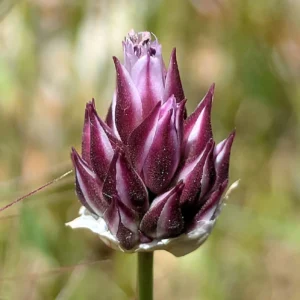
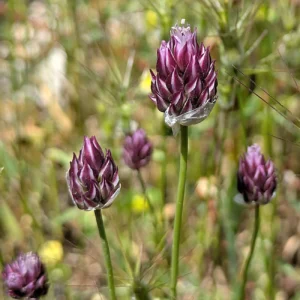
Allium junceum, known as the Rush-leaved Garlic, is a charming bulbous perennial native to the eastern Mediterranean. This species is celebrated for its dense, reddish-purple floral heads and its preference for rocky, coastal habitats. It belongs to the Amaryllidaceae family and represents a significant component of the native Cypriot flora.
Common Cypriot Names
The formal Greek name is Άλλιο το βουρλοειδές [Allio to vourloeides], which translates directly from the Latin. Locally, it is called αγριόσκορδο [agrioskordo] or σκορδολλούδιν [skordolloudin]. These names, meaning "wild garlic" and "little garlic" respectively, refer to its pungent aroma and small, clustered bulbs that mimic miniature versions of the cultivated variety.
Common English Names
- Rush-leaved Garlic
- Rush-like Onion
Etymology of Allium junceum
The etymology of the genus name, "Allium", derives from the Ancient Greek "ἄλεον" [aleon], which means "to avoid", possibly referring to the avoidance of its strong smell, or the Celtic "all", meaning "pungent". "Junceum" is Latin for "resembling a rush", derived from "juncus", referring to the slender, cylindrical, hollow leaves that look like those of a rush.
Synonyms
- Stemodoxis juncea (Sm.) Raf. (1837)
Key Characteristics for Diagnostic Identification
According to the definitive botanical keys established by Robert Desmond Meikle in his comprehensive Flora of Cyprus (Volume 2, 1985), this species is distinguished from other taxa of the genus in Cyprus by the below morphological features:
- Leaf Structure: The leaves of Allium junceum are fistulose (hollow). This character distinguishes it from the flat-leaved Cypriot species: A. neapolitanum, A. nigrum, A. orientale, A. trifoliatum, and A. zebdanense.
- Filament Morphology: The inner filaments are tridentate (3-cuspidate). This SOS feature separates it from A. cupani, A. cyprium, A. marathasicum, A. autumnale, A. paniculatum, A. coppoleri, A. meteoricum, A. myrianthum, A. rubrovittatum, and A. callimischon, all of which possess simple or otherwise shaped filaments.
- Stamen Position: The stamens are included or only slightly exserted from the perianth. This distinguishes it from A. ampeloprasum, A. sphaerocephalon, A. amethystinum, A. atroviolaceum, and A. commutatum, which all have prominently exserted stamens that extend well beyond the petals.
- Spathe and Umbel: The spathe is short, 2-lobed, and persistent, and the pedicels are very short (often under 4mm). These features distinguish it from A. curtum and A. willeanum, which have different spathe persistence and significantly longer pedicels.
Additional Identification Characteristics
Secondary identification often relies on the bulb tunics. Unlike the fibrous tunics found in A. dictyoprasum (not in Cyprus), Allium junceum maintains smooth, membranous inner tunics. Modern cytological studies also point to its specific diploid chromosome number (2n=16) as a definitive marker to separate it from polyploid complexes within the Mediterranean region.
Botanical Structure and Floral Details of Allium junceum
The Bulb and Stem
The plant grows from a small ovoid bulb, typically 1–2 cm in diameter. The stem is erect, slender, and smooth, usually reaching heights of 15–40 cm, providing a sturdy support for the heavy inflorescence.
The Flowers
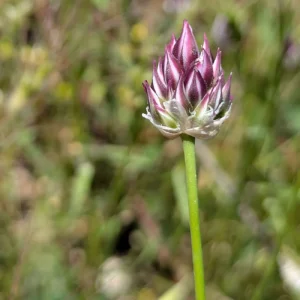
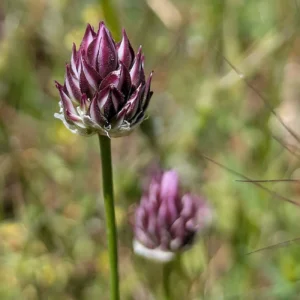
The inflorescence is a dense, spherical umbel. Each flower is campanulate (bell-shaped) with tepals that are deep reddish-purple with a darker mid-vein. This color density is a key aesthetic and diagnostic marker for the species in the field.
Geographical Distribution and Habitat of Allium junceum
Allium junceum is restricted to the Eastern Mediterranean, primarily found in Cyprus, southwestern Turkey, and the East Aegean Islands. It is a specialist of the Mediterranean maquis and garigue, often found clinging to rocky crevices or growing in thin soils over limestone.
Distribution in Cyprus
In Cyprus, it is found in the Akamas Peninsula, the Kyrenia Range, and parts of the Limassol district. It prefers open, sunny locations where it does not have to compete with dense, tall vegetation.
Elevation Range in Cyprus
The species is typically found at altitudes ranging from sea level up to 875 meters. It is rarely found in the higher alpine zones of the Troodos mountains.
Flowering Period in Cyprus
In the Cypriot climate, Allium junceum flowers from March to May. The timing is highly dependent on spring rainfall, with drier years resulting in an earlier and shorter blooming period.
Conservation Status in Cyprus
The Red Data Book of the Flora of Cyprus lists this species as relatively secure, but it is sensitive to habitat loss. Coastal development and heavy grazing remain the primary threats to its localized populations.
Is Allium junceum Suitable for Gardens?
This species is excellent for rock gardens due to its drought tolerance. However, seeds are difficult to source commercially. In Cyprus, removing bulbs or seeds from the wild is regulated under environmental protection laws to prevent population decline.
Toxicity and Safety
Like most members of the garlic family, this plant contains thiosulphates. According to research by Dr. Gwendolyn Murphy in Veterinary Medicine & Science, these compounds are highly toxic to dogs and cats, causing red blood cell damage. While humans can consume small amounts, excessive ingestion may cause gastrointestinal distress or interfere with blood-clotting medications.
Medicinal Properties
Antimicrobial Properties
Studies on the genus by the Journal of Ethnopharmacology suggest that wild alliums contain allicin-like compounds. These provide natural antimicrobial and antifungal defense. However, no specific clinical trials have been conducted on this particular species to prove its efficacy as a standardized human medicine.
Traditional Uses
Historically, Mediterranean villagers used crushed bulbs of wild garlic species to treat minor skin infections and respiratory ailments. This use is based on local folklore rather than modern medical consensus, and professional medical advice should always be sought before attempting any herbal treatment.
Fascinating Insights About Allium junceum
Adaptation to Aridity
Research published in the Israel Journal of Plant Sciences highlights that the fistulose (hollow) leaf structure is an evolutionary adaptation. By being hollow, the leaves maximize surface area for photosynthesis while minimizing water loss, allowing the plant to thrive in the harsh, sun-drenched environments of Cyprus.
Pollinator Specificity
A study on Eastern Mediterranean bulbs indicates that the dense, purple umbels of Allium junceum are specifically attractive to small solitary bees and hoverflies. These insects are more effective at navigating the tightly packed flowers than larger bees, ensuring a high rate of cross-pollination and genetic diversity within the species.
Cryptic Diversity
According to cytogenetic research by Tzanoudakis, this species exhibits "cryptic diversity," meaning that while plants look identical to the naked eye, they may have chromosomal differences. This suggests that the species is currently undergoing active speciation on the island of Cyprus, making it a subject of great interest for evolutionary biologists.