Allium orientale, a member of the Amaryllidaceae family, is commonly known as the Oriental Onion. There are no common synonyms for this species in the botanical records of the region. This bulbous perennial is a specialized feature of the Cypriot landscape, appearing early in the year to herald the arrival of spring in specific coastal and lowland areas.
Cypriot Names
Άλλιο το ανατολικό, Αγριοκρόμμυο.
Common English Names
The primary English name is the Oriental Onion, reflecting its broader distribution across the Levant and Near East. It is also known as the White-flowered Garlic. In the local context, this Oriental Onion is recognized by its large, dense flower heads that stand out against the rocky terrain of the eastern coast.
Etymology of Allium orientale
The etymology of the genus name,"Allium" is of unknown origin, as nothing close to this word exists in Latin or Ancient Greek. It is speculated that it derives from Celtic "all", meaning "pungent, burning, hot", referring to the taste. The species name "orientale" means "eastern" in Latin, referring to its native range.
Key Characteristics for Diagnostic Identification of Allium orientale
According to Meikle, Allium orientale can be identified by these specific morphological features:
- Inflorescence Shape: It features a dense, hemispherical or globose umbel, usually 3–6 cm in diameter, crowded with numerous flowers.
- Tepal Color and Shape: The flowers are typically white or pale pink, with tepals that are broadly elliptical and obtuse at the apex.
- Leaf Morphology: It usually possesses 2–5 basal leaves that are broadly linear and often have undulate (wavy) margins.
- Bulb Structure: The bulb is solitary and ovoid, covered in blackish or dark brown membranous tunics.
- Stamen Position: The stamens are slightly shorter than or equal to the tepals, with simple filaments.
- Scape Height: The flowering stem is robust and typically reaches a height of 20–50 cm, standing tall above the vegetation.
Botanical Structure and Adaptations
Growth Habit and Stature
This geophytic perennial emerges from its bulb during the winter, taking advantage of early moisture. Allium orientale generally grows in solitary clumps rather than dense colonies. Its upright posture allows it to compete for light in the rocky slopes of its specific native habitat before taller vegetation emerges.
Foliage Characteristics
The leaves are broad for an onion, sometimes reaching 2 cm in width. They are smooth and somewhat fleshy, often spreading horizontally. This growth pattern helps the Oriental Onion capture maximum sunlight in the early season, ensuring the bulb stores enough energy before the summer heat arrives.
Floral Features and Appearance
The blossoms are star-shaped and held on individual stalks within the umbel. The white petals often feature a faint green or pinkish midvein. These flowers are highly attractive to early-season pollinators that emerge in the warmer pockets of the island's eastern districts during the late winter.
Bulb and Underground Organs
The bulb is the survival engine of the plant, anchored deep to avoid the worst of the summer heat. It is protected by dark, papery layers that prevent desiccation. During the long period of summer dormancy, the bulb remains inactive until the winter rains trigger new growth.
Geographical Distribution and Ecological Niche
Mediterranean and Global Range
Allium orientale is found throughout the eastern Mediterranean, including Turkey, Syria, Lebanon, and Israel. It is a classic component of the Irano-Turanian transition zones. It thrives in open sun and is highly adapted to the seasonal rainfall patterns typical of the eastern Levant region.
Distribution Across Cyprus
In Cyprus, the Oriental Onion is notably restricted to the eastern portion of the island. It is primarily found in the Famagusta district and parts of the Larnaca district. This localized distribution makes it a special find for botanists exploring the arid, rocky terrains of eastern Cyprus.
Altitude and Habitat Preference
This plant is typically found from sea level up to about 300 meters in its eastern range. It favors well-drained, often limestone-based soils in uncultivated fields and garrigue. Because it is drought-tolerant, it thrives in the relatively drier climate characteristic of the island's eastern coastline.
Is Allium orientale Suitable For Gardens?
When considering "Is Allium orientale Suitable For Gardens?", it is excellent for xeric or Mediterranean-style gardens in dry areas. It is low-maintenance and provides a dramatic floral display. However, the foliage withers quickly after flowering, so it should be planted among later-blooming, drought-resistant perennials.
Life Cycle and Survival
Seasonal Blooming
Unlike many other wild onions, Allium orientale begins its blooming cycle very early, starting from February in Cyprus. This early flowering allows it to set seed before the intense spring heat dries the soil. By the time summer begins, the above-ground parts have completely disappeared.
Environmental Stress Tolerance
Allium orientale is highly adapted to the extreme summer droughts of eastern Cyprus. Its bulb can withstand months of total aridity without damage. The thick leaves are also capable of storing a small amount of water to buffer against fluctuations in early spring rainfall.
Exciting Facts About Allium orientale
The Wild Garlic Scent
Like most members of its genus, the Oriental Onion contains sulfurous compounds that produce a strong garlic aroma when crushed. This scent acts as a powerful deterrent against herbivores, protecting the plant from being eaten by grazing animals in the sparse eastern landscapes.
Geometric Umbel Symmetry
The flower head of this species is a masterclass in natural geometry. Each individual flower is positioned to create a perfectly rounded dome. This structure ensures that no matter which direction a pollinator approaches from, it has an easy landing platform to access the nectar.
A Restricted Local Treasure
Because the Oriental Onion is limited to the eastern parts of the island, it is a key species for local biodiversity. Its presence indicates a healthy, undisturbed Mediterranean steppe or garrigue ecosystem. Protecting these eastern habitats is vital for the continued survival of this early-blooming bulb.
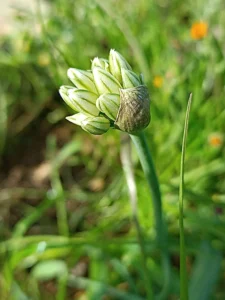
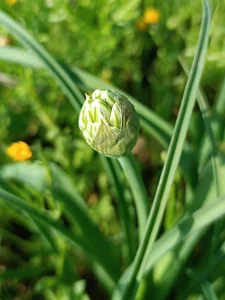
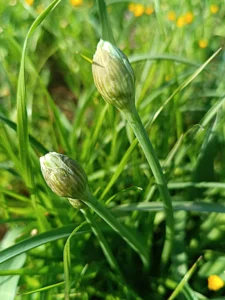
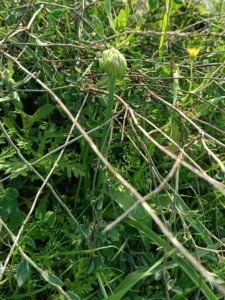
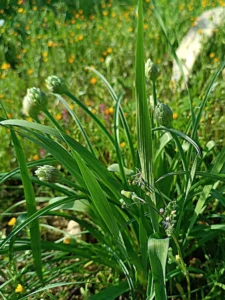
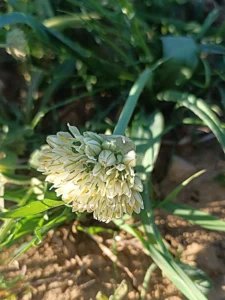
Image Credits: Bambos Panayi