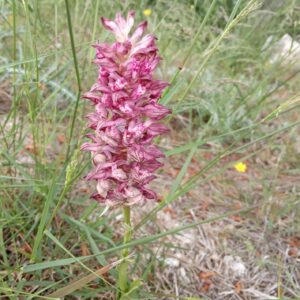
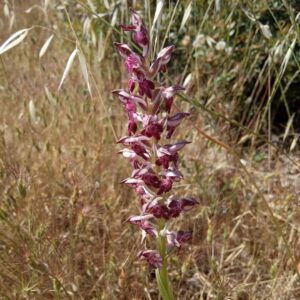
Anacamptis coriophora subsp. fragrans is a slender, elegant terrestrial orchid celebrated for its distinct, vanilla-like aroma. A member of the Orchidaceae family, it is a quintessential component of the Cypriot spring landscape. This orchid is easily recognized by its dense spike of brownish-red flowers and its preference for the sun-drenched, damp meadows of the Mediterranean.
Cypriot names
Ανακάμπτις η κοριοφόρος υποείδος η εύοσμη, Μυροσκέλα
Common English Names
In the United Kingdom and much of Europe, this plant is known simply as the Fragrant Bug Orchid. In Cyprus, it is occasionally referred to as the Fragrant Lizard Orchid by local enthusiasts, though it is taxonomically distinct from the true lizard orchids. These names emphasize the sensory experience of encountering the plant, focusing on its unique scent and intricate floral shape.
Synonyms
There are many synonyms for Anacamptis coriophora subspecies fragrans. Those are:
Orchis coriophora subsp. fragrans (Pollini) E. G. Camus
Orchis fragrans Pollini
Anacamptis fragrans (Pollini) R. M. Bateman
Anteriorchis fragrans (Pollini) Szlach.
Anteriorchis coriophora subsp. fragrans (Pollini) P. Jacquet
Herorchis coriophora subsp. fragrans (Pollini) D. Tyteca & E. Klein
Etymology of Anacamptis coriophora subspecies fragrans
The etymology of the genus "Anacamptis" derives from the Ancient Greek verb "ἀνακάμπτω" [anakámpto], which means "bend backwards" and refers to the pollinia of the orchid bending backwards. "Coriophora" derives from Ancient Greek "κορεός + φέρω" [bug + bear], meaning "bearing a bug" which is an insect with a flattened body and emits an unpleasant odour; the epithet is a reference to its flowers and their rather unpleasant odour of this otherwise very attractive orchid species. However, the subspecies Latin name "fragrans" [fragrant] suggests that this particular subgroup of bug orchids has a more pleasant smell.
Taxonomy and Scientific Classification
Taxonomically, this orchid has undergone several changes, having previously been classified under the genus Orchis. Recent genetic studies moved it to Anacamptis based on its specific spur and tuber structures. It is closely related to the Pyramidal Orchid, yet it maintains a distinct niche by blooming later and occupying wetter habitats than many of its cousins.
Botanical Structure and Growth Habit
Anacamptis coriophora subsp. fragrans is a medium-sized orchid, typically standing between 20 and 50 centimeters tall. It grows from two subterranean, egg-shaped tubers which store the energy required for its annual growth. How to recognize its growth? The stem is sturdy, light green at the base, and often transitions into a purplish hue near the flowering spike.
Foliage and Leaf Arrangement
The leaves of this orchid are unspotted, narrow, and lance-shaped, forming a semi-erect rosette at the base of the stem. Higher up the stalk, the leaves become smaller and sheath-like, clasping the stem tightly. This streamlined foliage allows the plant to channel rainwater directly toward the roots, a vital adaptation for surviving the variable Cypriot spring.
Floral Identification and Color
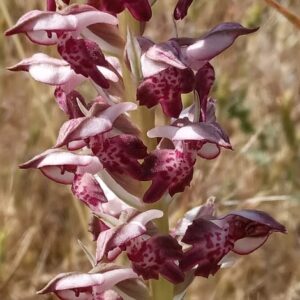
The inflorescence is a dense, cylindrical spike consisting of 15 to 50 small flowers. Each bloom is typically a reddish-brown or "maroon" color, often marked with darker spots on the three-lobed lip. A fascinating fact is that the upper sepals and petals converge to form a "helmet," protecting the pollinia from the elements and ensuring reproductive success.
Habitat and Ecological Preferences
In Cyprus, this orchid is a specialist of "wet flushes," damp meadows, and the edges of reed beds. It thrives in alkaline soils and is frequently found in areas that remain moist well into the spring. How to find its habitat? Look for low-lying ground near streams or coastal marshes where the soil stays soft even as the surrounding hills begin to dry.
Endemism and Geographic Range
While not a strict endemic, Anacamptis coriophora subsp. fragrans is a significant part of the Eastern Mediterranean flora. In Cyprus, it is widely but locally distributed, with prominent populations in the Akamas Peninsula and the Paphos district. It serves as a botanical indicator of healthy, undisturbed wetland ecosystems within the island's diverse landscape.
Symbiotic Fungal Relationships
Like all orchids, Anacamptis coriophora subsp. fragrans relies on a complex relationship with mycorrhizal fungi in the soil. These fungi provide the microscopic seeds with the nutrients they need to germinate. How to ensure its survival? One must protect the soil quality itself, as the absence of these specific fungi means the orchid cannot reproduce, no matter how many seeds it drops.
Reproductive Strategy and Scent
The intoxicating vanilla or "clover-like" scent of this orchid is its primary tool for attracting pollinators. It specifically targets small bees and flies that are drawn to its fragrance and the promise of nectar. A fascinating fact is that the scent is strongest during the warmest part of the day, maximizing its reach when insect activity is at its highest.
Adaptation to Seasonal Drought
By June, the above-ground parts of the orchid wither away as the Cypriot summer drought begins. The plant survives the scorching months as a dormant tuber buried deep in the earth. This underground strategy is essential for enduring the long, rainless period, allowing the orchid to remain protected until the autumn rains reawaken the soil.
Toxicity and Herbivore Defense
While not considered highly toxic to humans, the plant contains compounds that make it unpalatable to most grazing livestock. This chemical defense helps protect the flowering spikes from goats and sheep that roam the Cypriot countryside. However, habitat disturbance from overgrazing remains a threat as it physically tramples the delicate wetland soil.
Cultivation and Gardening Warnings
Many people ask how to grow this orchid in a garden, but the answer is usually: "don't." Due to its strict reliance on specific soil fungi and moisture levels, it is notoriously difficult to cultivate and almost always dies if transplanted. The best way to enjoy Anacamptis coriophora subsp. fragrans is to observe it in its natural, wild habitat.
Human Interaction and Folklore
In some Mediterranean cultures, the tubers of related orchids were historically used to make "salep," a traditional flour. However, in Cyprus, the focus is purely on conservation and photography. The sight of these maroon spikes in a green meadow is a cherished sign for local naturalists that the height of the floral season has arrived.
Scientific Significance and Research
Botanists study Anacamptis coriophora subsp. fragrans to understand the evolution of scent in the orchid family. Research into its chemical volatile organic compounds (VOCs) helps scientists track how different orchid species differentiate themselves to attract specific pollinators. It is a key species for studying plant-insect interactions in the Mediterranean.
Fascinating Floral Mimicry
A fascinating fact is that while many orchids use "deceptive" pollination (tricking insects with no reward), the fragrant bug orchid actually produces small amounts of nectar. This makes it a "rewarding" species, ensuring that pollinators return to other flowers on the same spike, which significantly increases the chances of successful seed production.
Anacamptis coriphora subsp. fragrans in Cyprus
Anacamptis coriophora subspecies fragrans is a rather popular plant in the Cypriot habitat. It is encountered all-around Cyprus except for the areas covering and surrounding the capital city. Anacamptis coriophora subsp. fragrans appears at a maximum altitude of 600 metres, and its flowering period is between March and May.