Date Created: 09.06.2022
Last Modified: 02.05.2026
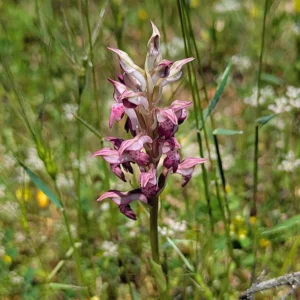
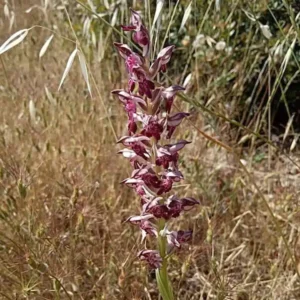
Anacamptis coriophora is a tuberous perennial orchid known for its dense, cylindrical flower spikes. It displays brownish-red to purple-green blooms and is frequently found in seasonally wet habitats. This orchid is a distinctive member of the Cypriot flora, thriving in marshes and damp meadows where moisture persists throughout the spring season. The plant is commonly known as the Bug Orchid.
Common Cypriot Names
The formal Modern Greek name is Ανάκαμπτις η κοριοφόρος [Anacamptis-i-koriophoros]. Locally, it is known as Βρωμορχιδέα [Vromorchidea], meaning "stink-orchid." According to ethnobotanical records by Athena Della, this name refers to the strong odor produced by the flowers, traditionally compared to the scent of bedbugs.
Common English Names
- Bug Orchid
- Bedbug Orchid
- Lesser Bug Orchid
Etymology of Anacamptis coriophora
The etymology of the genus name "Anacamptis" derives from the Ancient Greek "ἀνακάμπτω" [anakampto], meaning "to bend back" or "reflect," referring to the reflexed shape of the pollinia or the labellum. The specific epithet "coriophora" comes from the Greek κόρις [koris], meaning "bug" (specifically a bedbug), and φέρω [phero], meaning "to bear."
Together, the name translates to "bug-bearing," describing the characteristic scent of the flowers that was historically likened to the smell of bedbugs. While many specimens in Cyprus exhibit a pleasant vanilla aroma, the scientific nomenclature remains fixed to this historical observation of the species' olfactory properties.
Synonyms
- Anacamptis coriophora subsp. fragrans (1997)
- Anacamptis cassidea (1823)
- Orchis fragrans Pollini (1811)
- Orchis coriophora L. (1753)
Key Characteristics for Diagnostic Identification
According to the botanical keys in Robert Desmond Meikle’s Flora of Cyprus (Volume 2, 1985), this species is distinguished from all other similar taxa on the island by the following features:
- Spike Density vs. Anacamptis laxiflora: The inflorescence is a very dense, many-flowered cylindrical spike. This distinguishes it from A. laxiflora, which has a lax spike with widely spaced flowers.
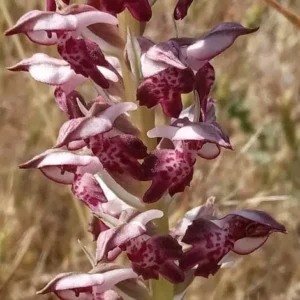
- Galea (Helmet) vs. Anacamptis morio: The sepals and petals converge to form a sharply pointed, forward-projecting helmet. This separates it from A. morio, which possesses a blunt, rounded helmet with green veins.
- Labellum Structure vs. Anacamptis papilionacea: The lip is 3-lobed with strongly reflexed lateral lobes. This feature separates it from A. papilionacea, which has a large, fan-shaped lip.
- Spur Morphology vs. Anacamptis collina: The spur is short, conical, and distinctly down-curved. This distinguishes it from A. collina, which features a broad, saccate, and rounded spur.
- Lip Margins vs. Anacamptis sancta: The middle lobe of the lip is entire (smooth-edged) and longer than the side lobes. This differentiates it from A. sancta, where the lip lobes are deeply jagged and tooth-like (laciniate).
- Bracts vs. Anacamptis pyramidalis: The floral bracts are 1-veined and roughly the same length as the ovary. This is distinct from A. pyramidalis, which has a pyramidal inflorescence and significantly shorter bracts.
Geographical Distribution and Habitat of Anacamptis coriophora
This taxon is native to Europe, North Africa, and Western Asia. It inhabits full sun to partial shade within damp grasslands, marshes, and seasonally wet pastures.
Distribution in Cyprus
In Cyprus, the species is relatively common and widespread but localized to specific niches. It is recorded in the Akamas Peninsula, the Troodos foothills, the Diarizos valley, and the Pentadaktylos range.
Elevation Range and Flowering Period
The species occurs from sea level up to 1,100 metres. The flowering season generally begins in late March and continues through May.
Conservation Status in Cyprus
In the Red Data Book of the Flora of Cyprus (2007), the Bug Orchid is not listed as threatened. While it faces localized pressure from habitat drainage, it is currently categorized as Least Concern (LC) due to its stable distribution across the island.
Is Anacamptis coriophora Suitable for Gardens?
This orchid is not suitable for gardens. It relies on a specific symbiotic relationship with mycorrhizal fungi to survive. Furthermore, all orchids in Cyprus are strictly protected by law; digging them up is illegal and punishable by heavy fines.
Toxicity and Safety
There is no evidence of acute toxicity in humans. However, the tubers contain high levels of mucilage and starch, which may cause minor digestive slowing if consumed. The primary safety concern is the legal status of the plant; the Bug Orchid must be left undisturbed in its natural habitat.
Medicinal Properties
Historical Salep Production
Historically, the tubers were used to produce Salep, a starchy flour used in traditional drinks. In Mediterranean folk medicine, Salep was considered a demulcent and restorative tonic.
Modern Pharmacological Interest
Modern research has investigated the glucomannan and antioxidant content of orchid tubers. Despite potential health applications, the protected status of orchids in Cyprus prohibits any harvesting.
Fascinating Insights About Anacamptis coriophora
Food Deception Strategy
The Bug Orchid is a "food-deceptive" plant. It attracts pollinators with a strong scent - either insect-like or vanilla - but provides no nectar reward.
Mycorrhizal Dependence
Survival depends entirely on invisible soil partners. It requires specific Rhizoctonia-type fungi for its seeds to germinate and for the adult plants to maintain nutrient uptake.
Flood Tolerance
This orchid has evolved a remarkable tolerance for waterlogging. Its tubers can survive in saturated, anaerobic soil for several weeks during the winter, allowing it to occupy marshy niches where other plants would suffer from root rot.