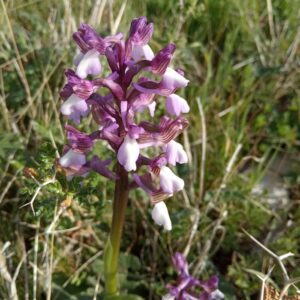
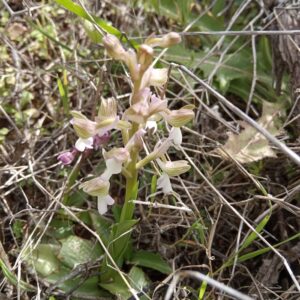
Anacamptis morio subsp. syriaca (Boiss.) H.Kriesch, a member of the Orchidaceae family, is widely known as the Syrian Orchid. This subspecies is frequently identified in historical records by the synonym Orchis syriaca Boiss. & Gaill. This delicate geophyte is a characteristic spring element of the eastern Mediterranean, particularly within the diverse orchid habitats of the Cypriot garrigue.
Cypriot names
Ανακάμπτις η παλιάτσος υποείδος η συριακή
Common English Names
The primary English name is the Syrian Orchid. It is also referred to as the Syrian Green-winged Orchid due to the characteristic green veining on its lateral sepals. This Syrian Orchid is one of the more common early-flowering orchids on the island, often found in large, scattered colonies.
Etymology of Anacamptis morio subspecies syriaca
The etymology of the genus's name "Anacamptis" derives from the Ancient Greek verb "ἀνακάμπτω" [anakámpto], which means "bend backwards" and refers to the pollinia of the orchid bending backwards. The specific epithet "morio" is Latin and means ''clown'' because the striped and spotted flowers of the Early Purple-orchid are said to resemble the appearance generally associated with clowns.
Synonyms
- Orchis syriaca Boiss. & Gaill.
- Orchis morio subsp. syriaca (Boiss.) E.G.Camus
- Anacamptis syriaca (Boiss.) R.M.Bateman, Pridgeon & M.W.Chase
Key Characteristics for Diagnostic Identification
According to R.D. Meikle, the renowned British botanist and former head of the European department at the Royal Botanic Gardens, Kew, in his monumental Flora of Cyprus (1977, 1985), this taxon is distinguished by:
- Inflorescence: A lax (loose) spike containing 3–12 flowers, unlike the denser spikes of the European nominate subspecies.
- Sepals: The lateral sepals are marked with distinct green longitudinal veins and form a protective hood over the column.
- Labellum Shape: The lip is trilobed, typically broader than long, with a pale or whitish center that is often unspotted or only lightly spotted.
- Spur Orientation: The spur is stout, cylindrical, and usually slightly ascending (pointing upwards) or horizontal, and is roughly the same length as the ovary.
- Leaf Arrangement: The leaves are unspotted, linear-lanceolate, and mostly arranged in a basal rosette.
- Height: The plant is relatively slender, typically reaching a height of 10–25 cm.
Botanical Structure and Floral Details of Anacamptis morio subsp. syriaca
Foliage and Vegetative Habit
The leaves of Anacamptis morio subsp. syriaca are a solid, vibrant green, devoid of the spotting seen in many other Orchidaceae species. They emerge in early winter as a tight rosette. By the time the central scape develops, the lower leaves may begin to sprawl, while the upper stem is often sheathed by 1–2 bract-like leaves.
Floral Architecture and Veining
The most striking feature of Anacamptis morio subsp. syriaca is the hood formed by the sepals and petals. Under a hand lens, as suggested by Meikle’s diagnostic keys, the green veins on the inner surface of the lateral sepals are a primary identifier. The labellum varies in color from pale pink to deep magenta, providing a landing platform for pollinators.
Geographical Distribution and Habitat of Anacamptis morio subsp. syriaca
Global Distribution and Range
In a global context, Anacamptis morio subsp. syriaca is centered in the Eastern Mediterranean and the Near East. Its range encompasses Turkey, Syria, Lebanon, Israel, Jordan, and Cyprus. It acts as the eastern representative of the broader Anacamptis morio complex, which spans much of Europe and North Africa.
Distribution in Cyprus
In Cyprus, Anacamptis morio subsp. syriaca is widely distributed across the Paphos, Limassol, and Nicosia districts, as well as the Akamas Peninsula. It thrives from sea level up to approximately 900 meters. The flowering period on the island is relatively early, typically spanning from February to early April.
Is Anacamptis morio subsp. syriaca Suitable for Gardens?
When considering "Is Anacamptis morio subsp. syriaca Suitable for Gardens?", it is important to note that wild orchids are notoriously difficult to cultivate. They rely on complex symbiotic relationships with mycorrhizal fungi in the soil. Furthermore, all wild orchids in Cyprus are protected by law, and their removal from the wild is strictly prohibited.
Fascinating Things About Anacamptis morio subsp. syriaca
Pollination by Deception
A fascinating aspect of Anacamptis morio subsp. syriaca is its "rewardless" nature. Research published in journals like Plant Systematics and Evolution confirms that this species practices food-deceptive pollination. It attracts bees by mimicking the visual and olfactory signals of nectar-producing flowers, but it provides no actual nectar, forcing the insect to move quickly between plants.
The Role of Mycorrhizal Fungi
According to studies on Mediterranean orchids, such as those conducted at the Royal Botanic Gardens, Kew (where Meikle performed much of his research), the seeds of Anacamptis morio subsp. syriaca cannot germinate without a specific fungal partner. This fungus provides the microscopic seed with the nutrients it lacks, a relationship that persists throughout the orchid's life.
The Salep Connection
Historically, the tubers of various orchids, including Anacamptis morio subsp. syriaca, were harvested to produce "Salep," a starchy flour used in drinks and desserts. This practice is now a significant conservation concern. Modern botanical authorities emphasize that such harvesting is unsustainable and has led to the decline of many orchid populations across the Mediterranean.