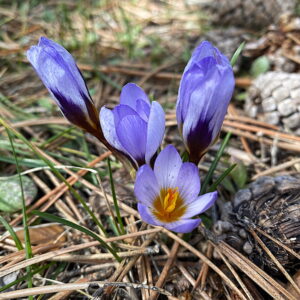
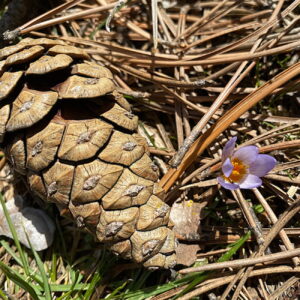
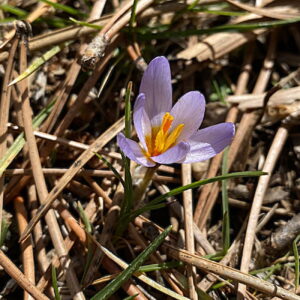
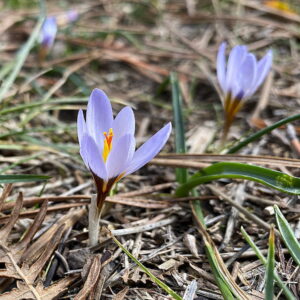
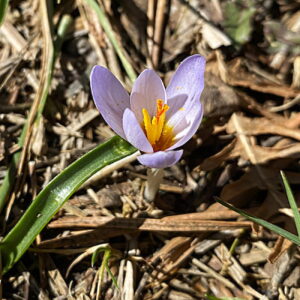
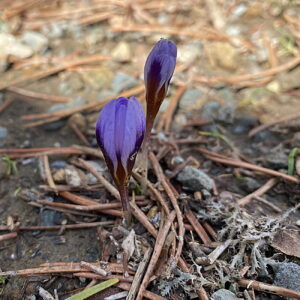
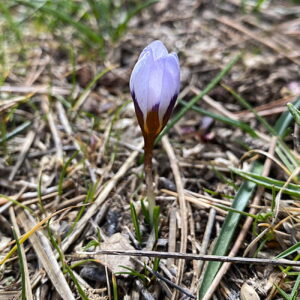
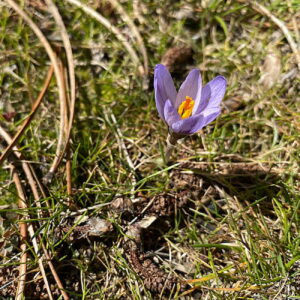
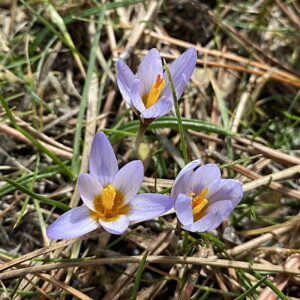
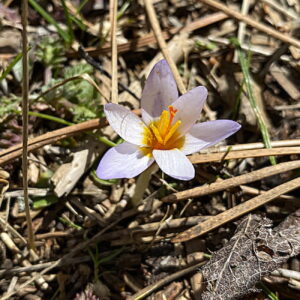
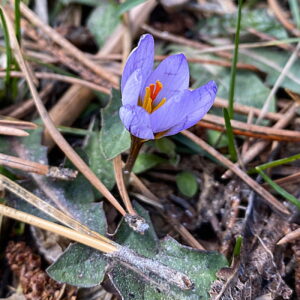
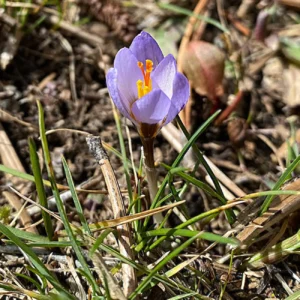
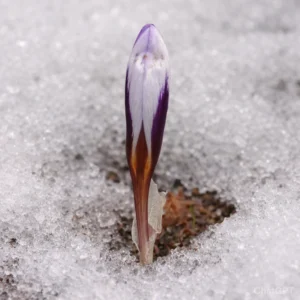
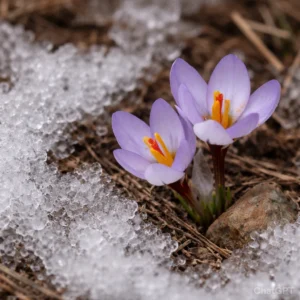
Crocus cyprius, famously known as the Cyprus Crocus, is a petite and breathtaking geophyte that is strictly endemic to the mountain peaks of Cyprus. This rare winter-to-spring bloomer features elegant petals that are primarily lilac-blue or lavender, accented by a deep violet-purple staining at the base of the outer segments and a bright yellow throat. Currently, the species is listed as Vulnerable (VU) in the Red Data Book of the Flora of Cyprus, with its survival tied to the high-altitude igneous rocks of the Troodos range.
Cypriot Names
Κρόκος ο κύπριος, Μανούνια.
Common English Names
In English, the plant is most universally recognized as the Cyprus Crocus. In older local dialects, it is sometimes grouped with other small bulbs under the name "Blue Crocus" to distinguish it from the white-flowered mountain varieties. The name Cyprus Crocus underscores its status as a flagship species for the island’s endemic flora and its unique evolutionary history within the Mediterranean.
Etymology of Crocus cyprius
The genus name Crocus originates from the Greek "κρόκος" (krokos), a word rooted in ancient history for its association with saffron. The species epithet cyprius is Latin for "belonging to Cyprus," denoting its exclusive geographical origin.
In local Cypriot Greek, the term Μανούνια (Manounia) is often used affectionately for these small, ground-hugging flowers that herald the change of seasons.
Synonyms and Taxonomic History
The Cyprus Crocus has a relatively clear taxonomic record, though it belongs to a complex group of Mediterranean crocuses that share similar lilac hues. It was formally described in the early 20th century as a distinct species due to its unique combination of leaf structure and floral markings. Its classification remains a point of pride for local botanists who study the divergence of island endemics.
Key Characteristics vs Other Crocus
To correctly identify the Cyprus Crocus in the wild, you should look for several defining morphological features that separate it from the nearby Crocus hartmannianus:
- Anther Color: The anthers are a striking dark purple or nearly black, which stands out vividly against the yellow throat.
- Petal Shading: The exterior base of the petals has a very distinct, dark purple blotch that is more defined than the feathering seen on other species.
- Filaments: The filaments (the stalks holding the anthers) are typically yellow or orange, providing a three-tone color contrast within the flower.
- Leaves: It usually produces 3-4 narrow, silver-striped leaves that emerge at the same time as the blossoms.
Botanical Structure and Morphology
Resilient Mountain Corm
The Cyprus Crocus relies on a small, globose corm located deep within the rocky soil to survive the extreme temperature fluctuations of the high Troodos. This corm is protected by a tunic of fine, silky fibers that are distinct from the coarse, reticulated tunics of other mountain crocuses. This storage organ is the plant's lifeline during the long, bone-dry summer months.
Compact Foliage Adaptation
The leaves are exceptionally slender and linear, featuring the classic longitudinal white stripe that helps reflect intense mountain sunlight. Because the Cyprus Crocus grows in exposed, windy areas, its foliage remains low to the ground to avoid mechanical damage. This compact growth form is a classic evolutionary response to the high-altitude environment it calls home.
Vibrant Lilac Blossoms
The flowers are solitary or appear in pairs, pushing through the soil or melting snow with remarkable strength. The internal yellow throat acts as a "target" for pollinators, while the lilac-blue petals provide high visibility against the dark volcanic rocks of the Troodos. Each blossom is a masterpiece of miniature engineering, designed for maximum reproductive efficiency in a short window.
Geographical Distribution of Crocus cyprius
As a strict endemic, the Cyprus Crocus is found nowhere else on the planet except for the island of Cyprus. Its distribution is even more restricted than many other endemics, as it is confined almost entirely to the central volcanic core of the Troodos mountain range. This geographical isolation makes it a species of high conservation priority.
Altitude and Common Areas Where Crocus cyprius grows
The Cyprus Crocus is a true high-altitude specialist, typically occurring between 1,050 and 1,950 meters above sea level. You can find it most commonly in the Troodos National Forest Park, particularly around Chionistra (Mount Olympus), Sun Valley, Kalidonia Falls Trail, Livadi Tou Passia BBQ Area, and the Amiantos region. It thrives in the open, rocky clearings of the Pinus nigra and Cedrus brevifolia forests.
Where Can I Find Crocus Cyprius?
An easily accessible place with a vast Crocus Cyprius population is at "Livadi Tou Passia BBQ Area", but make sure it is a sunny day, otherwise the tiny crocuses will most likely be closed:
- Travel with the assistance of Google Maps towards this Google Maps location (34°56'03.8"N 32°53'54.6"E).
- Look for a dirt road close to the marked location
- The dirt-road takes you within seconds to a small picnic area
- The plants grow in the pincic area and especially next to the fence (protected Crocus area)
- Be careful not to step on them - they are tiny!
Snow-Line Habitat
This species is often found right at the edge of receding snowbanks. As the sun warms the dark rocks, the Cyprus Crocus uses the localized heat to trigger its bloom, often while the surrounding ground is still patches of white. This reliance on the melting snow for its early-season water supply makes it particularly sensitive to changing winter patterns.
Conservation Status
Vulnerable Listing
The Cyprus Crocus is officially classified as Vulnerable (VU). While it can be locally abundant in certain spots on Mount Olympus, its total global occupancy area is very small - less than 20 square kilometers. Any major disturbance to the high Troodos ecosystem could have a disproportionately large impact on the total population.
Environmental Threats
The primary threats to the Cyprus Crocus include infrastructure development for tourism and skiing. Because its primary habitat is in a popular recreation area, accidental trampling by off-trail hikers and snow-clearing operations are constant concerns. Global warming also poses a long-term threat by reducing the consistent snow cover it requires.
Legal Protection and Monitoring
The species is protected under the Bern Convention and is listed in Annex II of the Habitats Directive (92/43/EEC). In Cyprus, the Department of Forests manages its habitat within the National Forest Park, ensuring that major developments are assessed for their impact on these rare bulbs. Periodic census counts help scientists ensure the population remains stable.
Habitat and Ecology
Igneous Rock Preferences
The Cyprus Crocus is a "lithophyte," meaning it is often found growing directly in the cracks of igneous (volcanic) rocks or in the scree slopes surrounding them. The dark basalt and gabbro rocks of the Troodos absorb heat during the day, creating a warmer microclimate that supports the plant's rapid growth during the cold spring months.
Specialist Pollinators
Because it blooms so early, the Cyprus Crocus relies on a small group of cold-hardy bees and flies that are active at high altitudes. The dark, heat-absorbing anthers may actually help keep the pollen at a functional temperature for these insects. This symbiotic relationship is a delicate balance that has been refined over thousands of years of isolation.
Is Crocus cyprius Suitable For Gardens?
When asking "Is Crocus cyprius Suitable For Gardens?", the answer is a firm no for two reasons. Legally, it is strictly illegal to dig up or move this protected endemic from its natural site. Practically, the plant requires a "cold-stratification" period - a deep winter freeze - that is only found at the highest peaks, making it impossible to grow in lowland gardens.
Exciting Facts About the Cyprus Crocus
The Purple Heart of Troodos
One of the most exciting visual features of the Cyprus Crocus is the "purple heart" effect created by its dark anthers. While most crocuses have yellow or orange centers, the black-purple center of this species makes it look like a tiny, glowing jewel set into the mountainside. This rare coloration is one of the reasons it is so beloved by photographers.
A Survivor of the Ice Age
Botanists believe the Cyprus Crocus is a "glacial relict." This means that during the last Ice Age, when the climate was much colder, the plant likely lived at lower altitudes. As the world warmed, the species retreated up the mountains to find the cool conditions it prefers, eventually becoming "trapped" on the highest peaks of Cyprus.
Symbolic Significance
The Cyprus Crocus is frequently used as a symbol of the Troodos National Forest Park and appears in numerous educational materials regarding the island's natural heritage. Its image represents the fragility and beauty of the mountain ecosystems. Seeing the first lilac blooms of the Cyprus Crocus is considered by locals to be the official sign that winter is losing its grip.