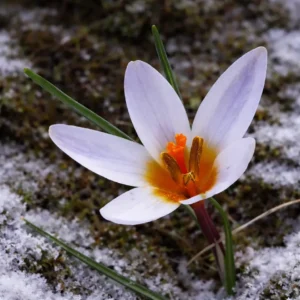
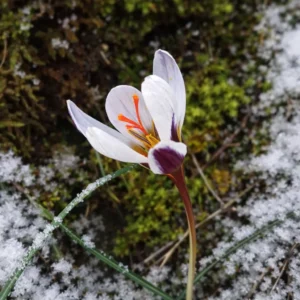
Crocus hartmannianus, a winter-blooming geophyte commonly known as Hartmann's Crocus, is a resilient species that is strictly endemic to Cyprus. This rare flower displays a stunning perianth of white or pale lilac petals, often marked with deep violet stains on the outer segments and a vibrant yellow throat. It is currently categorized as Vulnerable (VU) in the Red Data Book of the Flora of Cyprus, with a specialized population found sporadically at altitudes between 650 and 925 meters.
Cypriot Names
Κρόκος ο χαρτμαννιάνειος, Αρκοσσιυλλί
Common English Names
In English, this plant is primarily known as the Hartmann’s Crocus, a name dedicated to the botanist who first discovered it on the island. Local naturalists sometimes refer to it as the Troodos Crocus due to its mountain-dwelling nature. The name Hartmann’s Crocus serves as a reminder of the island's unique biodiversity and the specific scientific efforts required to document its rare endemics.
Etymology of Crocus veneris
The etymology of the genus' name, "Crocus", derives from the Ancient Greek word "κρόκος" [krokos], which is alleged of a Semitic origin. Latin borrowed this word, which received the meaning of the yolk, obviously due to the yellow color of the centre of this genus's flowers (stamens and pistil). The species name "hartmannianus" honors the German collector Ernest Hartmann, who first came upon the plant in the early 20th century.
Synonyms and Taxonomic History
Historically, Hartmann’s Crocus has shared a close and sometimes confusing relationship with other white-flowered crocuses in the region. It was previously grouped or confused with Crocus veneris, but distinct morphological differences in the corm and anthers eventually established it as a separate species. Such taxonomic refinements are essential for ensuring that conservation efforts are directed toward the correct, genetically distinct populations.
Key Characteristics vs Other Crocus
To identify Hartmann’s Crocus, one must observe specific traits that distinguish it from the more common Crocus veneris and Crocus cyprius:
- Anther Color: Unlike many relatives, its anthers are typically a dark purplish-maroon or blackish, rather than bright yellow.
- Petal Markings: The outer petals are often stained or feathered with violet, creating a contrast against the white base.
- Corm Tunic: The tunic consists of parallel fibers that are quite coarse, a feature that requires careful inspection of the underground part.
- Flowering Window: It is a true winter bloomer, appearing when snow might still be present on the mountains.
Botanical Structure and Morphology
Compact Corm and Protective Tunic
The Hartmann’s Crocus survives the harsh summer heat and winter cold by retreating into a small, rounded corm. This underground storage organ is wrapped in a protective tunic of coarse, parallel fibers that help regulate moisture and protect the delicate tissue from pests. This adaptation is common among geophytes that must wait for specific seasonal triggers to grow.
Slender and Striped Foliage
The leaves of this species are narrow and linear, featuring a characteristic white line running down the center. They typically emerge alongside the flowers or shortly after, providing the necessary energy through photosynthesis to recharge the corm for the following year. The foliage is designed to withstand the biting winds and low temperatures of the Troodos peaks.
Intricate Winter Blooms
The flowers are cup-shaped and emerge directly from the ground on short tubes, minimizing exposure to the elements. The combination of white or lilac petals, a yellow center, and dark anthers makes the Hartmann’s Crocus highly distinct during its brief blooming period. These flowers are highly sensitive to sunlight, opening wide during clear days and closing tightly during overcast weather.
Geographical Distribution
Crocus hartmannianus is an edemic plant of Cyprus
As an endemic species, Hartmann’s Crocus is found nowhere else on Earth but the island of Cyprus. Its range is naturally fragmented, with populations scattered across the Troodos and Pentadaktylos (Kyrenia) mountain ranges. This fragmentation means that the health of each small colony is vital for the long-term survival of the species as a whole.
Altitude and Common Regions
You will most likely encounter this plant on stony hillsides or within sparse pine forests at altitudes ranging from 650 to 925 meters. Significant populations have been recorded in the Paphos forest, the Troodos National Forest Park, Macheras [Machairas], and near Buffavento Castle in the north. It prefers open areas where competition from dense shrubs is limited.
The Role of Elevation
The specific altitude requirements of the Hartmann’s Crocus ensure it receives the necessary winter chilling for its seeds to germinate and its corms to sprout. At lower elevations, the winters are often too mild for this high-altitude specialist. Its reliance on these cooler microclimates makes it a sensitive indicator of climate stability on the island.
A Vulnerable Plant
The Hartmann’s Crocus is officially listed as Vulnerable (VU) in the Red Data Book of the Flora of Cyprus. This classification is based on its limited geographical range and the sporadic nature of its populations. While it is not yet "Endangered" in the strictest sense, any loss of habitat could quickly push the species toward a more critical status.
Habitat and Ecology
Pine Forest Ecosystems
This crocus is a characteristic component of the understory in sparse Pinus brutia forests. It thrives in the dappled sunlight provided by the pine canopy, growing in the rocky, nutrient-poor soil that few other plants can tolerate. The fallen pine needles provide a light mulch that helps retain the moisture needed for its winter growth.
Pollination Strategies
Flowering in mid-winter, the Hartmann’s Crocus provides a critical early nectar and pollen source for the few insects active during the colder months. Bees and flies that emerge during sunny winter intervals are the primary pollinators. This early-bloom strategy ensures the plant does not have to compete with the massive spring flush of other flowers.
Is Crocus hartmannianus Suitable For Gardens?
In Cyprus, it is strictly illegal to pick, uproot, or transplant this endemic species from the wild. Protecting its natural habitat is paramount, and removing a plant from its high-altitude home almost always leads to its death due to the lack of specific soil and climate conditions.
Exciting Facts About the Hartmann's Crocus
The Sixty-Year Disappearance
One of the most thrilling stories in Cypriot botany involves the "rediscovery" of this plant in the northern mountains. After being last seen near Buffavento Castle in 1956, it was not recorded in that region again for exactly sixty years. It was found again on the very same day - January 30 - in 2016 by a group of academics, a coincidence that stunned the local scientific community.
Hidden Resilience
Despite its delicate appearance, the Hartmann’s Crocus can withstand light snow cover. The petals possess a natural resilience that allows them to "freeze" and then thaw out as soon as the sun hits them, continuing their blooming cycle as if nothing happened. This makes them one of the toughest winter survivors in the Cypriot highlands.
A Stamp of Identity
The plant is so iconic to the island's natural heritage that it has been featured on official Cyprus Post stamps. This honor is usually reserved for the most significant endemic species, helping to raise public awareness about the beauty and rarity of the Hartmann’s Crocus. It serves as a botanical ambassador for the island's unique mountain ecosystems.