Hyacinthella millingenii is a charming, bulbous perennial belonging to the Asparagaceae family. This delicate plant is near-endemic to Cyprus, meaning it is found almost exclusively on the island, with only rare occurrences reported in nearby southern Turkey.
Cypriot names
Υακινθέλλα του μίλλινγκεν
Etymology of Hyacinthella millingenii
The etymology of the genus name "Hyacinthella" derives from the Greek Mythological name/plant genus "Υάκινθος" [iakinthos], meaning "hyacinthus", and the Latin suffix "-ella", which means "little one resembling to/belonging to", hence "little hyacinth". The name of the plant ''hyacinthus" was used by Homer; "ὑάκινθος" [iákinthos] according to Greek mythology, was a young man who was accidentally killed by god Zephyr and the plant's flowers supposedly grew up from his blood. According to mythology, it was the god Apollo who named this plant after the dead. Most likely, the epithet of this species, which was initially discovered in Cyprus, "millingenii", was given to the species as a tribute to a man called "Millingen".
Botanical Identification
Compact Growth Form
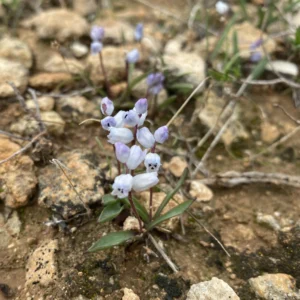
The physical stature of Hyacinthella millingenii is notably small, usually reaching only 5 to 10 centimeters in height. It grows from a small, ovoid bulb buried deep within rocky soil. This low profile protects the plant from the strong winds common in its exposed, hilly habitats.
Foliage and Leaves
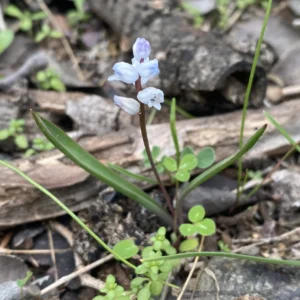
The leaves of Hyacinthella millingenii typically appear in pairs, emerging directly from the base. They are linear, slightly fleshy, and often spread flat against the ground or curve upward. These glaucous, blue-green leaves provide the necessary energy for the plant’s brief but vibrant flowering period.
Floral Characteristics
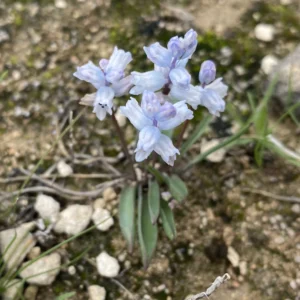
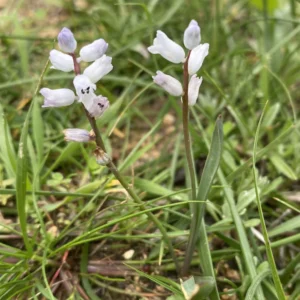
The flowers of Hyacinthella millingenii are bell-shaped and usually a pale, icy blue or nearly white. They are arranged in a short, dense cluster at the top of a leafless stalk. Each tiny bloom features six fused tepals, giving the inflorescence a delicate, architectural appearance.
Habitat and Distribution
The Cypriot Connection
As a near-endemic, Hyacinthella millingenii is a significant part of Cyprus's natural heritage. It is primarily found in the northern and western parts of the island. It favors open, sun-drenched locations, particularly on the limestone terraces of the Pentadaktylos range and the Akamas peninsula.
Preferred Soil Conditions
In the wild, Hyacinthella millingenii thrives in "phrygana" vegetation and rocky pastures. It prefers well-drained, calcareous soils that dry out completely during the summer. It often colonizes thin layers of soil on rocky ledges where larger, more aggressive plants are unable to survive the drainage.
Hyacinthella millingenii in Cyprus
This is the only Hyacinthella species that is found in Cyprus, and it was actually until recently found only in Cyprus; it has been recently discovered in Turkey as well, hence it is a Cyprus near-endemic plant. Hyacinthella millingenii is a tiny plant that blooms with the first cold of the winter in November and it may last until February. It reaches a maximum height of 10 centimetres. Hyacinthella millingenii's flowers may have a combination of white, light blue or slightly lilac color. It prefers moist, rocky hillsides on calcareous ground. It grows all-around Cyprus between an elevation of 50–750 metres.
Life Cycle and Ecology
Survival Strategy
To survive the harsh, dry summers, Hyacinthella millingenii retreats into its underground bulb. This storage organ contains all the nutrients and water needed to survive months of drought. It remains completely inactive until the autumn rains signal that it is time to begin a new growth cycle.
Pollination and Seeding
Tiny insects, particularly small bees and flies, are the primary pollinators of Hyacinthella millingenii. After a successful pollination, the plant produces small capsules containing black seeds. These seeds are dispersed close to the parent plant, often leading to the formation of small, dense colonies.
Conservation and Status
Near-Endemic Vulnerability
Because Hyacinthella millingenii has such a limited geographical range, it is inherently vulnerable to environmental changes. While currently not classified as critically endangered, its reliance on specific Cypriot habitats makes it a species of interest for local conservationists and botanists.
Threats to Habitat
The main threats to Hyacinthella millingenii include habitat loss due to tourism development and intensive overgrazing. Coastal construction in Cyprus can inadvertently destroy small populations. Protecting the integrity of the rocky garrigue landscapes is essential for the long-term survival of this unique blue flower.
Gardening and Cultivation
Rock Garden Suitability
For specialized gardeners, Hyacinthella millingenii is a sought-after species for alpine houses and rock troughs. It requires a "Mediterranean cycle" of cultivation, meaning it needs plenty of water in winter and spring, followed by a strictly dry, warm rest period during the summer months.
Soil and Drainage Needs
When growing Hyacinthella millingenii in pots, a very gritty, free-draining compost is mandatory. Any standing water or excessive organic matter will quickly lead to bulb rot. It is best treated as a miniature treasure, placed where its subtle beauty can be appreciated at eye level.
Propagation Methods
Propagation of Hyacinthella millingenii is usually achieved through seed or the occasional separation of offset bulbs. Growing from seed requires patience, as it may take several years for a seedling to reach flowering size. However, this is the best way to maintain genetic diversity.