Νάρκισσος ο κοινός, Ματσικόριδο, Μιτσικόριδο
Etymology of Narcissus obsoletus
The etymology of the "Narcissus" was named after "Νάρκισσος" [Narkissos, Narcissus in Latin], who in Greek mythology, was distinguished for his beauty. Narcissus is considered one "who prides himself, especially on his outward appearance or his beauty". Hence, the ancient Greeks considered the plant beautiful as such."Obsoletus" in Latin means "ordinary".
Botanical Characteristics
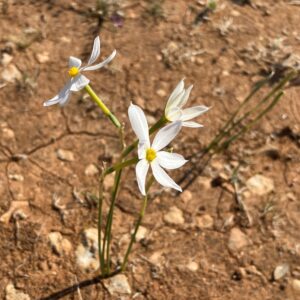
The flowers of Narcissus obsoletus are typically solitary or paired on a slender, leafless scape. They feature six white, star-shaped tepals surrounding a tiny, intense yellow or orange corona. The plant is quite compact, reaching a height of roughly 15 to 30 centimeters, and produces a light, pleasant fragrance.
Leaves and Growth
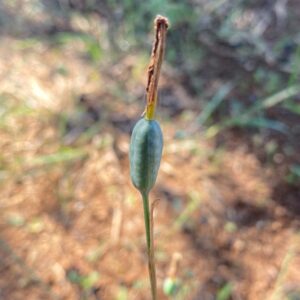
Interestingly, the narrow, cylindrical leaves of Narcissus obsoletus usually emerge after the flowering period has finished. During the dry summer months, the plant remains dormant underground as a small bulb. This survival strategy allows it to thrive in climates with hot, dry summers and mild, wet autumns.
Classification and Scent
Historically, Narcissus obsoletus was often confused with Narcissus serotinus, but modern taxonomy distinguishes it by its unique corona shape and stamen placement. Collectors highly prize the species for its delightful scent. While many daffodils dominate the spring landscape, this plant provides a rare and delicate beauty to the autumn garden.
The Narcissus Genus in Cyprus
At least three Narcissus species are known to exist in the Cypriot nature of which the two belong out there in the wild, a third is a domesticated species (Narcissus jonquilla) that is said to exist in the Kyrenia region.
Narcissus obsoletus in Cyprus
Despite the fact that it can be found in almost all the regions of Cyprus, except for the ones of Troodos and Paralimni, it is, in fact, an uncommonly found plant. It is smaller than its sibling, Narcissus tazetta, as it can reach, on the best occasion, 25 centimetres in height, but considering the drought in Cyprus during autumn, it can even be seen reaching roughly 5 centimetres in height. It grows at a low altitude of up to 175 metres.
Blooming period in Cyprus
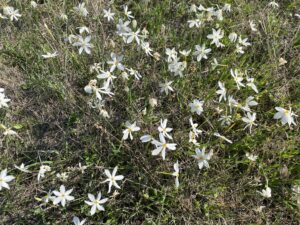
Narcissus obsoletus blooms at least during September and December, while depending on the climate, it may also appear as late as January.