Date Created: 13.04.2026
Last Modified: 13.04.2026
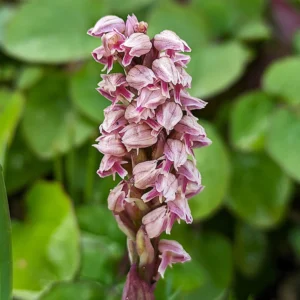
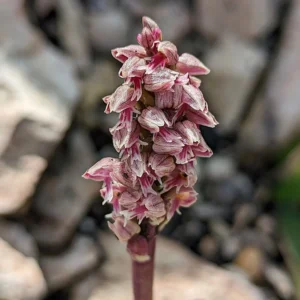
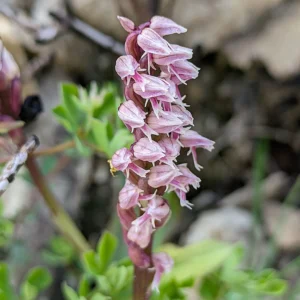
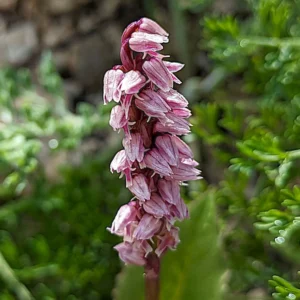
Neotinea maculata, commonly known as the Dense-flowered Orchid, is a slender, terrestrial orchid belonging to the Orchidaceae family. In Cyprus, this species is an indigenous plant typically found in shaded pine forests, maquis, and garrigue environments. A frequent synonym often encountered in historical botanical literature is Orchis intacta, reflecting its previous classification before modern taxonomic revisions.
Cypriot Names
The official Latin name translated into Greek is Νεοτινέα η κηλιδωτή.
Common English Names
- Dense-flowered Orchid
- Spotted Neotinea
- Small-flowered Orchis
Etymology of Neotinea maculata
The etymology of the genus name Neotinea is a tribute to the Sicilian botanist Vincenzo Tineo (1791–1856). The prefix neo- comes from the Ancient Greek νέος [neos], meaning "new," and was added when the genus was re-established to distinguish it from other related groups. The name essentially serves as a "New Tinea" in honor of his contributions to Mediterranean botany.
The specific epithet maculata is derived from the Latin maculatus, meaning "spotted" or "stained." This refers to the leaves of the plant, which are frequently - though not always - covered in small, dark purple or brownish-black spots. This characteristic is a common trait in many terrestrial orchids, serving as a key vegetative marker.
Synonyms
- Orchis intacta Link (1829)
- Aceras maculatum (Burnat) Gren. (1855)
- Orchis maculata L. (1753)
- Neotinea intacta (Link) Rchb. f. (1850)
- Orchis secundiflora Bertol. (1804)
Key Characteristics for Diagnostic Identification
According to the definitive botanical keys established by Robert Desmond Meikle in his comprehensive Flora of Cyprus (Volume Two, 1985), this species is distinguished by several specific morphological features:
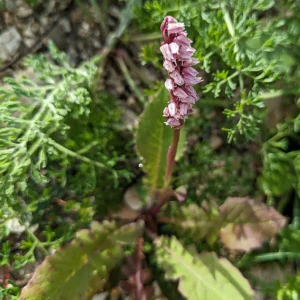
- Inflorescence Density: The flowers are extremely small and packed into a very dense, cylindrical, and often one-sided (secund) spike that typically measures 2–5 cm in length.
- Flower Morphology: The sepals and petals converge to form a tight, pointed "hood" or galeate structure over the column, which is usually greenish-white or pale pink.
- Labellum Shape: The lip (labellum) is deeply three-lobed; the central lobe is linear and longer than the lateral lobes, often appearing slightly notched or bifid at the apex.
- Spur Length: Unlike many Orchis species, the spur is very short, saccate (pouch-like), and downward-pointing, barely reaching 1–2 mm in length.
- Leaf Markings: The basal leaves are oblong-lanceolate and usually feature distinct dark spots, a trait that persists throughout the flowering period.
Botanical Structure and Floral Details of Neotinea maculata
Vegetative Morphology
The plant is relatively diminutive, usually standing between 10 and 30 cm tall. It possesses two small, ovoid tubers beneath the soil surface. The stem is upright, glabrous, and bears 2–6 basal leaves that form a rosette. These leaves are a vibrant green, providing a high contrast for the dark pigmentation of the spots.
Reproductive Organs
The flowers are among the smallest of the Cypriot orchids, often barely reaching 4 mm in size. Because they are so tiny and the hood remains largely closed, the orchid is frequently self-pollinating (autogamous). This reproductive strategy allows it to be highly successful even in environments where insect pollinators are scarce.
Geographical Distribution and Habitat of Neotinea maculata
Distribution in Cyprus
In Cyprus, the species is widespread in suitable habitats across the island. It is particularly common in the Akamas peninsula, the Kyrenia range, and the foothills of the Troodos mountains. It thrives in the filtered light of Pinus brutia forests and the protective shade of Pistacia lentiscus or Juniperus shrubs.
Elevation Range in Cyprus
In the Cypriot landscape, Neotinea maculata is primarily encountered from sea level up to approximately 1,100 meters. While it can be found in lowland coastal scrub, it reaches its highest density in the middle-altitude maquis and pine woodlands where the humidity is slightly higher.
Flowering Period in Cyprus
The flowering period typically occurs from February to April. It is one of the earlier orchids to appear in the Cypriot spring. By late April, as the temperatures rise and the soil dries, the aerial parts of the plant quickly wither, and the orchid retreats to its underground tubers for the summer dormancy.
Conservation Status in Cyprus
According to the Red Data Book of the Flora of Cyprus (2007), this species is not currently listed as threatened, but like all orchids, it is protected under the CITES convention. Its populations are stable, though they remain susceptible to habitat loss from overdevelopment and intensive grazing in coastal areas.
Is Neotinea maculata Suitable for Gardens?
Terrestrial orchids are notoriously difficult to cultivate and should never be removed from the wild. They require a specific symbiotic relationship with mycorrhizal fungi in the soil to survive. Attempting to grow this species in a garden setting is almost always unsuccessful and contributes to the decline of wild populations.
Toxicity and Safety
There are no recorded toxic properties associated with Neotinea maculata. In some Mediterranean cultures, the tubers of related orchid species were historically harvested to produce "salep," a starchy flour. However, due to the small size of this species and its protected status, it has no practical use as food or medicine.
Medicinal Properties
There is no significant record of Neotinea maculata being used in traditional Cypriot medicine. Its value is entirely ecological and aesthetic. In the broader history of herbalism, orchids were often associated with "doctrines of signatures" due to the shape of their tubers, but these uses are not supported by modern clinical science.
Fascinating Things About Neotinea maculata
Autogamy as a Survival Strategy
Authoritative botanical research highlights Neotinea maculata as a master of autogamy. While most orchids have evolved elaborate mechanisms to attract specific pollinators, this species often fertilizes itself before the flower even fully opens. This reproductive backup ensures high seed set in the unpredictable Mediterranean climate.
Mycorrhizal Specificity and Soil Health
Trustworthy ecological studies emphasize that this orchid depends on specific fungal partners for seed germination. The presence of Neotinea maculata is an indicator of healthy, undisturbed soil microbiomes, as the absence of these fungi would prevent the orchid from completing its lifecycle and thriving in forest ecosystems.
Evolutionary Miniature Design
Expert morphological analysis reveals that the "dense-flowered" nature of the spike is a spatial optimization. By producing many miniature flowers instead of a few large ones, the plant increases its chances of reproductive success while minimizing the energy required to build large petals. This evolutionary efficiency allows it to thrive in nutrient-poor forest floors.