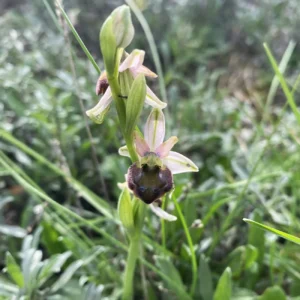
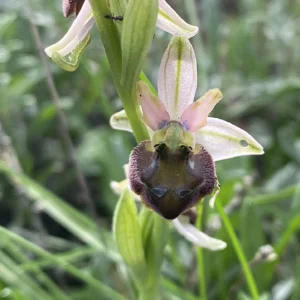
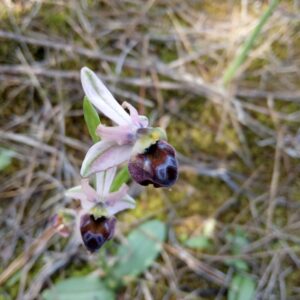
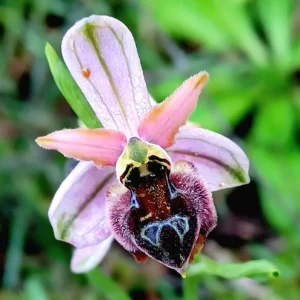
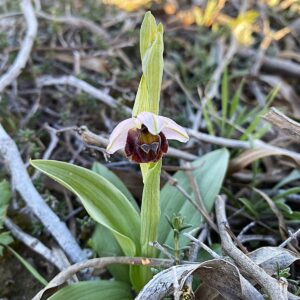
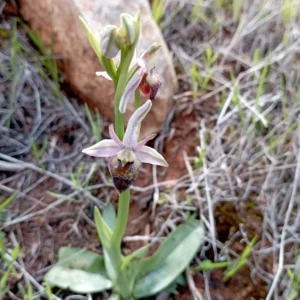
Ophrys argolica subsp. elegans is one of the most visually sophisticated members of the Orchidaceae family found in the Eastern Mediterranean. This terrestrial orchid is celebrated for its striking symmetry and the intricate patterns on its velvety lip. In Cyprus, it is a highly sought-after species by botanists due to its localized distribution and the "elegant" proportions that give the plant its name.
Cypriot names
Μελισσούι, Όφρυς της αργολίδας υποείδος η κομψή
Common English Names
In English, this plant is primarily known as the Elegant Bee Orchid. Because it was previously considered a distinct species by some authors, you may also find it listed in older Cypriot botanical guides as Ophrys elegans. These names emphasize the aesthetic appeal of the flower, which many consider the "aristocrat" of the Cypriot bee orchids.
Etymology of Ophrys argolica subspecies elegans
The etymology of the genus "Ophrys" comes from the ancient Greek word "ὀφρύς" that means "eyebrow" and represents the hairy edge of the flower bud found in many species. "Argolica" is related to Argolis [Αργολίδα], a district in the Peloponnesus, Greece. "Elegans" is the Latin for "elegant".
Taxonomy and Scientific Classification
As a member of the Orchidaceae family, this plant belongs to the Ophrys argolica complex. Taxonomists have debated whether it should be a full species or a subspecies, but it is currently classified as Ophrys argolica subsp. elegans. It is distinguished from the mainland Greek subspecies by its longer, more pointed sepals and specific markings on the labellum (lip).
Alternative Botanical Names
Due to the complex nature of orchid classification, this plant has been known by several names over the years. Common synonyms include Ophrys elegans, used when it was treated as a full species, and Ophrys argolica var. elegans. You may also find it referred to as Ophrys ferrum-equinum subsp. elegans in some older European botanical records.
Botanical Structure and Morphology
Graceful Stature and Stem
Ophrys argolica subsp. elegans typically grows to a height of 20 to 40 centimeters, making it slightly taller and more upright than many other Ophrys species. It emerges from two rounded subterranean tubers. How to recognize its growth? The stem is sturdy and light green, usually bearing a relatively loose spike of 3 to 8 large, prominent flowers.
Silver-Green Foliage
The plant produces a basal rosette of 4 to 6 lance-shaped leaves that are a soft, glaucous (silver-green) color. These leaves appear in late autumn following the first significant Cypriot rains. By the time the orchid reaches full bloom in the spring, the leaves remain functional but may begin to yellow at the tips as the plant focuses its nutrients on the floral display.
Floral Identification and the "Horse-Shoe"
The flowers feature large, pink to purplish-pink sepals that provide a vibrant backdrop for the dark, velvety lip. A fascinating fact is the "speculum"- the mirror-like mark on the lip - which in this subspecies usually forms two distinct, vertical white or bluish lines or a "horse-shoe" shape. How to tell it apart? Look for the small, pointed "apiculus" at the very base of the lip, which is a key diagnostic feature for this subspecies.
Geographical Distribution
The broader species Ophrys argolica is found across southern Greece and the Aegean. However, the subspecies elegans has a more easterly distribution, primarily occurring in Cyprus, southern Turkey, and parts of the Levant. It represents the easternmost expression of the argolica group, adapted to the specific climates of the eastern Mediterranean basin.
Distribution Across Cyprus
In Cyprus, Ophrys argolica subsp. elegans is localized but can be found in several key areas. It is most frequently recorded in the Akamas Peninsula, the limestone hills of the Paphos and Limassol districts, and the lower slopes of the Troodos range. While not as common as the Yellow Bee Orchid, it is well-distributed in undisturbed coastal and inland scrublands.
Flowering Period in the Cypriot Climate
Aligned with the peak of the Cypriot spring, Ophrys argolica subsp. elegans flowers from early February to mid-April. In warmer coastal spots like Akrotiri or Aphrodite's Rock, it may appear in late January. This timing ensures it blooms when the island is at its greenest, just before the intense heat of May begins to dry the landscape.
Habitat and Ecological Preferences
This member of the Orchidaceae family prefers open, sunny habitats within "phrygana" (low scrub) and "garrigue." It is often found on stony hillsides and in the grassy clearings of open pine forests. It shows a strong preference for calcareous (limestone) soils, which provide the alkaline environment it needs to thrive.
Protection in Forest Margins
Fascinatingly, this orchid often seeks the protection of small shrubs or the margins of forest tracks. These positions offer a slightly more stable microclimate and protection from heavy grazing. How to spot them? Scan the edges of lentisk (Pistacia lentiscus) bushes, where the orchid often peeks through the lower branches to reach the sunlight.
Toxicity and Protective Defenses
Like most Orchidaceae, Ophrys argolica subsp. elegans contains various alkaloids and bitter compounds that act as a deterrent to herbivores. These chemical defenses protect the plant from being grazed by the goats and sheep that are common in the Cypriot countryside. This ensures the flower spike can survive long enough to set seeds.
How to grow this orchid in your garden?
As with all wild orchids, it is virtually impossible to cultivate. It relies on a mandatory symbiosis with specific soil fungi to survive. Removing Ophrys argolica subsp. elegans from its habitat is a violation of Cypriot law and results in the guaranteed death of the plant within a season.
Scientific and Biological Insights
Specialized Pollination Evidence
Botanists study the speculum patterns of Ophrys argolica subsp. elegans to better understand how orchids evolve to attract specific bee species. The intricate markings are not random; they are evolved visual cues. Research suggests that even small variations in these patterns can lead to the evolution of entirely new subspecies over thousands of years.
Underground Storage Secrets
The tubers of the Orchidaceae function as a nutrient reservoir. While the orchid is in bloom, it is already growing a new tuber for the following year. A fascinating fact is that if the plant is stressed by drought, it may choose not to flower at all, remaining as a dormant tuber underground until a more favorable rainy season arrives.
Indicator of Ecosystem Integrity
The presence of Ophrys argolica subsp. elegans is a sign of a high-quality, undisturbed ecosystem. Because it requires a perfect "triad" of the right soil fungi, specific pollinators, and calcareous substrate, its thriving indicates that the local environment is in a state of healthy balance.