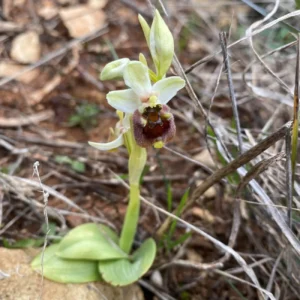
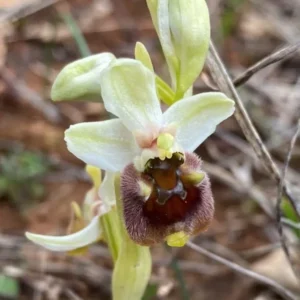
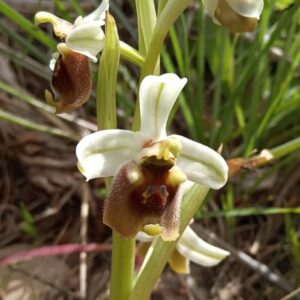
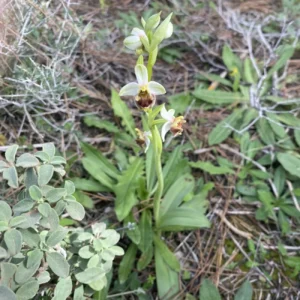
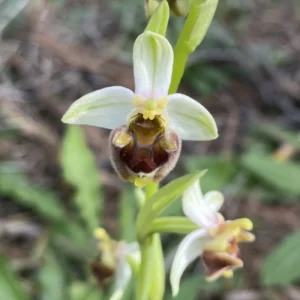
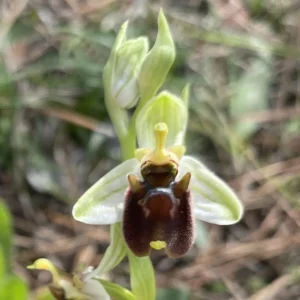
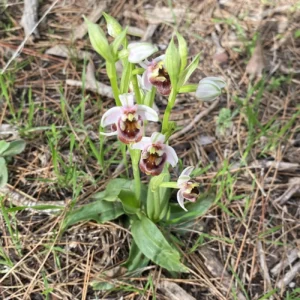
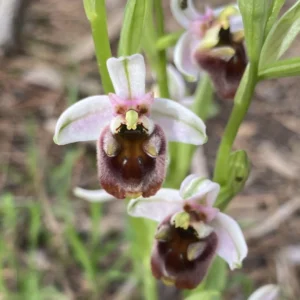
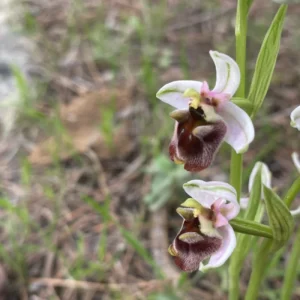
Ophrys bornmuelleri subspecies grandiflora, commonly known as the Bornmueller's Bee Orchid, is a striking orchid found across Cyprus. This geophyte is celebrated for its large, intricate blooms that utilize sexual deception to attract pollinators. It thrives in open, lime-rich habitats from sea level up to roughly 800 meters in elevation.
Cypriot names
Μελισσούι, Οφρύς η μπορνμυλλέριος υποείδος η φέρουσα μεγάλα άνθη
Common English Names
In English, this striking orchid is most commonly known as the Bornmueller's Bee Orchid. Another descriptive name often found in regional flora guides is the Wide-lipped Orchid, which highlights its most distinct floral feature compared to its subspecies counterpart. The Bornmueller's Bee Orchid is highly prized by orchid enthusiasts for its large, intricately patterned flowers.
Etymology of Ophrys bornmuelleri subspecies grandiflora
The name of the genus "Ophrys" comes from the ancient Greek word "ὀφρύς" that means "eyebrow" and represents the hairy edge of the flower bud found in many species. Ophrys bornmuelleri subsp. grandiflora was named as such by Joseph Friedrich Nicolaus Bornmüller (1862 – 1948) who was a German botanist. "Grandiflora" is the female Latin for "having large flowers".
Synonyms and Taxonomic History
This orchid has a complex taxonomic history, often being confused with or considered a subspecies of Ophrys fuciflora. Older botanical records might list it as Ophrys levantina, a name now largely considered synonymous or representing a closely related taxon. Taxonomic revisions reflect ongoing debates among botanists regarding the genetic boundaries of these highly variable Mediterranean orchids.
Key Characteristics vs Other Ophrys
To identify the Bornmueller's Bee Orchid in the field, look for specific features that set it apart from other orchids in Cyprus:
- Large Lip Size: The lip is remarkably broad and often rectangular or trapezoid, appearing much larger than that of Ophrys bornmuelleri subspecies bornmuelleri.
- Distinct Appendage: The appendage at the tip of the lip is prominent, often yellowish-green, and distinctly upturned, rather than straight or pointing downwards.
- "Pseudo-eyes": These are typically olive-green, serving as visual cues for pollinators, situated above the speculum.
- Flower Count: The inflorescence generally produces fewer, larger flowers (typically 3-5) compared to the subspecies bornmuelleri.
Botanical Structure
Tuberous Root System
Like most orchids, this species is a geophyte, developing from underground tubers that store nutrients during the dry season. This underground system allows the Bornmueller's Bee Orchid to remain dormant through the scorching Cypriot summer and rapidly sprout when the autumn rains arrive. The plant produces a new tuber annually while the old one withers.
Broad Basal Leaves
The plant features three to four basal leaves that form a ground-hugging rosette, which is highly efficient at capturing light during the winter months. These leaves are elliptic to oblanceolate, vibrant green, and possess distinct parallel venation. They are smooth to the touch, contrasting with the velvety texture of the floral lip.
Robust Inflorescence
The flowering stem is erect, usually robust, and can reach up to 30 cm in height, standing taller than the basal leaves. It is a glabrous (smooth) stem that bears a few smaller, sheathing stem leaves higher up. This structure provides a stable platform for the few, large, and intricately patterned flowers to attract potential pollinators.
Geographical Distribution
The Bornmueller's Bee Orchid subspecies grandiflora has a specialized distribution, found primarily in Cyprus and the southern regions of Turkey (Anatolia). It is considered a near-endemic taxon because its global population is restricted entirely to this Eastern Mediterranean basin. This narrow range highlights the need for focused conservation efforts.
Distribution Across Cyprus
In Cyprus, the Bornmueller's Bee Orchid is a relatively common sight compared to other rarer orchids. It is widely distributed across the island, found from the lowlands of the Akamas Peninsula up to the lower limestone slopes of the Troodos range. It is particularly prevalent in the Limassol district and the hills surrounding Paphos.
Early Spring Flowering
This orchid typically flowers from February through March, with blooms sometimes lingering into early April at higher altitudes. The flowering timing is crucial as it synchronizes with the emergence of its specific Eucera bee pollinators. The spectacular blooms appear just as the spring flora begins to dominate the Cypriot landscape.
Habitat and Ecology
Preferential Habitat
The Bornmueller's Bee Orchid thrives in well-drained, lime-rich soils, preferring open forests, garrigues, and grassy land. It is commonly found in areas of sparse vegetation, such as abandoned olive groves and rocky slopes, where it receives sufficient sunlight. It rarely grows in dense shade or heavily disturbed soils.
Sexual Deception Pollination
This orchid employs sexual deception, producing a scent that mimics the sex pheromones of female Eucera bees to attract males. The flower's lip visually resembles a female bee, encouraging the male to attempt to mate with it, a process known as pseudocopulation. This ingenious strategy ensures the transfer of pollinia without providing any nectar reward.
Is Ophrys bornmuelleri grandiflora Suitable For Gardens?
Like most Ophrys species, it is notoriously difficult to cultivate and is not suitable for typical garden conditions. It requires specific mycorrhizal fungi in the soil to survive, a unique microclimate, and absolute dry dormancy in the summer, making it best appreciated in its natural habitat.