Ophrys fusca Link subsp. fusca, a member of the Orchidaceae family, is commonly known as the Sombre Bee Orchid. A widely recognized synonym for this orchid is Ophrys fusca Link. This terrestrial geophyte is a subtle but essential component of the spring flora, blending into the Mediterranean scrub with its dark, velvety flowers.
Cypriot names
Μελισσούι, Κατσούλλα, Οφρύς η σκουρόχρωμη υποείδος η σκουρόχρωμη
Common English Names
The most frequent English name is the Sombre Bee Orchid. It is also occasionally referred to as the Dull Bee Orchid or the Brown Bee Orchid. Despite these names, the Sombre Bee Orchid possesses an intricate beauty that reveals itself upon close inspection of its complex floral lip.
Etymology of Ophrys fusca subspecies fusca
The name of the genus "Ophrys" comes from the Ancient Greek word "ὀφρύς" which means "eyebrow" and represents the hairy edge of the flower bud found in many species. "Fusca" is the female Latin for "dark, black, brown", which accurately describes the dominant color of the velvety floral lip.
Synonyms
- Ophrys cinereophila Paulus & Gack
- Ophrys subfusca subsp. cinereophila (Paulus & Gack) Kreutz
- Ophrys funerea Viv.
Key Characteristics for Diagnostic Identification
According to the foundational research of Robert Desmond Meikle (1923–2021), the distinguished Irish botanist and former head of the European department at the Royal Botanic Gardens, Kew, this taxon is characterized by:
Labellum Shape: The lip is trilobed, flattened, and notably elongated with a velvety texture.
Speculum Pattern: A blue-grey or lead-colored bi-lobed "mirror" (speculum) sits at the base of the lip.
Sepals: The three outer sepals are pale green, ovate-oblong, and typically have a central green vein.
Lateral Petals: These are much smaller than the sepals, usually brownish-green or purplish.
Appendix: A very small, often inconspicuous appendix is found at the notch of the central lip lobe.
Height: The plant is relatively short, typically ranging from 10 to 30 cm in height.
Botanical Structure and Floral Details of Ophrys fusca subsp. fusca
Anatomy of the Labellum
The labellum is the most distinct feature of Ophrys fusca subsp. fusca. It is covered in dense, dark-brown hairs that give it a velvety appearance. The blue-grey speculum serves as a visual attractant, mimicking the reflective wings of an insect, while the lip's margins remain a slightly lighter brown.
Floral Details and Sepal Architecture
The sepals of Ophrys fusca subsp. fusca are typically held in a spreading position. The dorsal sepal often curves forward, forming a protective hood over the column. This architectural arrangement protects the reproductive organs from the elements while ensuring that only specifically oriented insects can gain access to the pollinia.
Geographical Distribution and Habitat of Ophrys fusca subsp. fusca
Global Distribution and Range
In a global context, this subspecies is widely distributed across the Mediterranean basin. Its range extends from the Iberian Peninsula and North Africa in the west to the Near East. It is a highly variable taxon, often forming part of a complex group of closely related orchids across southern Europe.
Distribution in Cyprus
In Cyprus, Ophrys fusca subsp. fusca is widespread across the lowlands and foothills of the Troodos and Pentadaktylos ranges. It thrives in garrigue, maquis, and open pine forests at altitudes between 0 and 900 meters. The flowering period on the island generally spans from late January to early April.
Is Ophrys fusca subsp. fusca Suitable for Gardens?
When asking "Is Ophrys fusca subsp. fusca Suitable for Gardens?", it is critical to realize that these orchids are nearly impossible to grow in a standard garden. They depend on specific mycorrhizal soil fungi for survival. Furthermore, harvesting them from the wild is strictly prohibited by law in Cyprus.
Fascinating Things About Ophrys fusca subsp. fusca
The Mechanism of Pseudocopulation
A fascinating aspect of Ophrys fusca subsp. fusca is its method of pollination. Research by H.F. Paulus, a noted authority on orchid pollination, confirms that this orchid uses "sexual deception." It emits pheromones that mimic female bees of the genus Andrena, tricking males into attempting to mate with the flower.
The Legacy of Robert Desmond Meikle
The meticulous work of Robert Desmond Meikle at Kew Gardens provided the foundational understanding of the Cyprus population. In his Flora of Cyprus, Meikle notes the incredible variability of the species. His research ensures that these subtle morphological differences are preserved for future generations of botanists and conservationists.
Intricate Fungal Symbiosis
Like many Mediterranean orchids, this plant exists in a precarious symbiosis with soil fungi. Studies published in the Journal of Ecology highlight that the microscopic seeds cannot germinate without a fungal host. This relationship is so specific that even minor soil disturbances can lead to the disappearance of entire populations.
Adaptive Survival Strategies
To survive the parched Cypriot summers, Ophrys fusca subsp. fusca retreats into two underground tubers. These tubers store water and nutrients, allowing the plant to remain dormant throughout the dry season. This geophytic lifestyle is a specialized adaptation to the Mediterranean climate's extreme seasonal shifts and unpredictable rainfall.
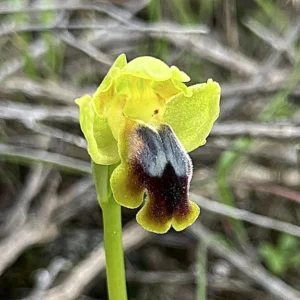
Image credits: Iwein Coppens