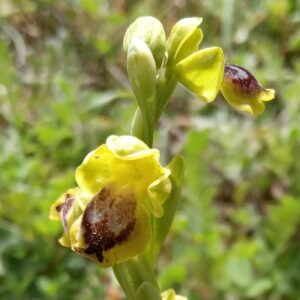
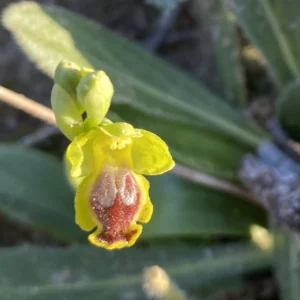
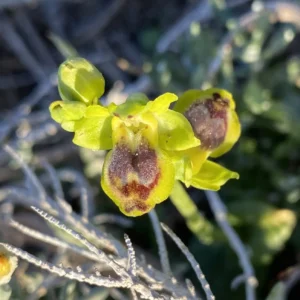
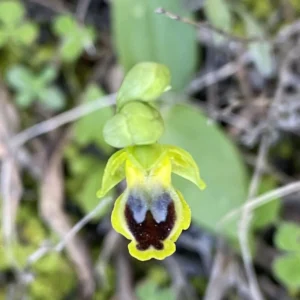
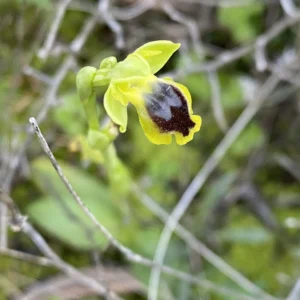
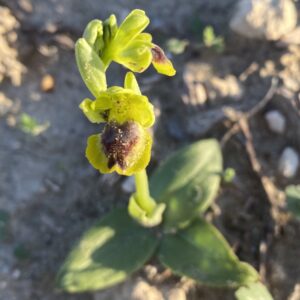
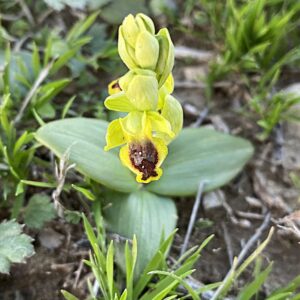
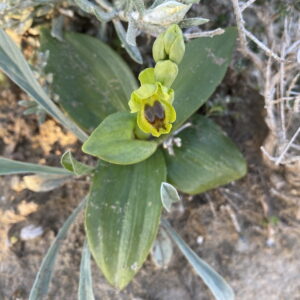
Ophrys lutea subsp. galilaea, also known as "Ophrys sicula", is a captivating orchid that brings a splash of brilliant yellow to the Cypriot landscape. As a member of the Orchidaceae family, it is part of the iconic "bee orchid" group, famous for its flowers that mimic the appearance and scent of female insects. This subspecies is a frequent and delightful sight across the island.
Cypriot names
Μελισσούι, Οφρύς η κίτρινη υποείδος η γαλιλαία
Common English Names
In English, this plant is most commonly known as the Small-Flowered Yellow Bee Orchid. Because of historical taxonomic debates, some enthusiasts still refer to it as the Galilee Bee Orchid or even Ophrys sicula. These names all point to its most distinguishing characteristic: being a significantly smaller, daintier version of the standard Yellow Bee Orchid.
Etymology of Ophrys lutea subspecies galilea
The etymology of the genus "Ophrys" comes from the Αncient Greek word "ὀφρύς" which means "eyebrow" and represents the hairy edge of the flower bud found in many species. "Lutea" in Latin means yellow, hence it is the characteristic yellow Ophrys of Cyprus. "Galilea" derives from the homonymous region located in northern Israel and southern Lebanon.
Taxonomy and Scientific Classification
this plant is at the center of a long-standing debate among botanists. While some experts prefer the name Ophrys sicula, international consensus currently favors treating it as a subspecies of Ophyrs lutea. It is distinguished from its larger relatives by the specific angle of its flowers and its smaller overall dimensions.
Botanical Structure and Morphology
Slender and Dainty Growth
Ophrys lutea subsp. galilaea is a relatively small orchid, usually reaching a height of 10 to 25 centimeters. Like many other Orchidaceae, it grows from two small, rounded subterranean tubers. How to recognize its growth? Unlike its larger cousins, this subspecies is often quite slender, with a thin stem that bears between 2 and 10 small, cheerful flowers.
Basal Rosette of Leaves
The plant produces a small rosette of 3 to 4 ovate leaves at its base, which are typically unspotted and a bright, healthy green. These leaves appear with the first autumn rains in Cyprus, allowing the plant to store energy through the winter. By the time the flowers reach their peak, the basal leaves often begin to show signs of withering as the plant's energy shifts to reproduction.
Floral Identification and "Swallow Tail"
The flowers feature a broad, flat yellow lip with a dark brown or reddish center. A key fascinating fact is the "speculum" - the shiny, blue-grey patch on the lip - which often ends in a shape resembling a swallow's tail. How to tell it apart? The flowers of subsp. galilaea are held almost horizontally, unlike the larger O. lutea, which holds them at a steeper angle.
Geographical Distribution
Global Presence
This orchid is found across the central and eastern Mediterranean basin. Its range extends from Italy and Sicily through the Balkans, Greece, and the Aegean islands, reaching as far east as Turkey, Syria, and Israel. It is particularly abundant in the Levant, where it occupies a variety of low-to-mid altitude ecological niches.
Distribution Across Cyprus
In Cyprus, Ophrys lutea subsp. galilaea is one of the most common members of the Orchidaceae family. It is widespread in the Akamas Peninsula, the Paphos district, and the foothills of both the Troodos and Pentadaktylos ranges. You can find it from sea level up to roughly 700 meters, often appearing in dense colonies that turn hillsides gold.
Flowering Period in the Cypriot Climate
Reflecting the warmth of the Cypriot climate, this orchid is an early bloomer, typically appearing from February to April. While it may start as early as January in coastal areas like Limassol or Paphos, March is generally the best time to see it in full flower. It is one of the essential highlights of the Cypriot botanical spring.
Habitat and Ecological Preferences
Preference for Rocky Garrigue
In Cyprus, this orchid thrives in open, sunny positions. You will find it in "garrigue" (stony scrubland), open pine forests, and on limestone terraces. It is a calcicole species, meaning it has a strong preference for the alkaline, lime-rich soils that are common across the island’s southern districts.
Resilience in Cultivated Landscapes
Fascinatingly, Ophrys lutea subsp. galilaea often persists in traditional agricultural landscapes. It is frequently seen under ancient olive and carob trees where the soil has not been heavily treated with chemicals. How to spot them? Look for undisturbed patches of grass and moss at the base of old trees where the orchid's delicate roots find protection.
Toxicity and Protective Defenses
Chemical Deterrents
While Ophrys lutea subsp. galilaea is not considered highly toxic, it contains secondary metabolites common to the Orchidaceae family that make it unpalatable. These bitter compounds protect the nutrient-rich tubers and tender flower spikes from being eaten by goats or rabbits. This chemical defense is a standard evolutionary tool for survival in grazed landscapes.
Human Interaction and Conservation
Challenges of Wild Harvesting
How to grow this orchid in your garden? The honest answer is that you shouldn't try. Like most wild Orchidaceae, it depends on a highly specific symbiotic relationship with soil fungi. If removed from its native soil, the plant almost always dies, making wild harvesting both illegal under Cypriot law and biologically futile.
Scientific and Biological Insights
Indicators of Soil Health
Botanists view the presence of Ophrys lutea subsp. galilaea as a positive indicator of soil health. Since it requires specific fungi to germinate, a healthy population suggests a well-functioning local ecosystem. Its absence in previously populated areas can be an early warning sign of environmental degradation or heavy pesticide use.
Fascinating Hybridization
A fascinating fact is that this subspecies can occasionally hybridize with other members of the Orchidaceae family, such as Ophrys mammosa. These rare hybrids often display a confusing mix of features, such as a yellow margin combined with a darker, more complex speculum. These natural "experiments" are a source of great excitement for local orchid hunters.
Underground Storage Secrets
The tubers of Ophrys lutea subsp. galilaea act as a sophisticated energy bank. One tuber is used to produce the current year's growth, while the second "replacement" tuber develops simultaneously to store energy for the next season. This dual-bulb system ensures the orchid can survive even if a particularly harsh or dry spring limits its seed production.