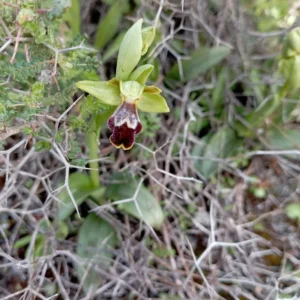
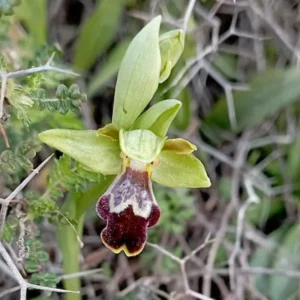
Ophrys omegaifera subsp. fleischmannii, a member of the Orchidaceae family, is commonly known as Fleischmann's Bee Orchid. The most common synonym is Ophrys fleischmannii. This early-blooming geophyte is a specialist of the Mediterranean garrigue, recognized for its complex floral lip that mimics the abdomen of a female bee to ensure pollination through sexual deception.
Cypriot Names
Οφρύς η ωμεγαφόρος υποείδος του Φλάισμαν, Μελισσούι.
Common English Names
Fleischmann's Bee Orchid
Etymology of Ophrys omegaifera subspecies fleischmannii
The etymology of the genus name, "Ophrys" comes from the ancient Greek word "ὀφρύς" which means "eyebrow" and represents the hairy edge of the flower bud found in many species. Latin "omegaifera" derives from "omega", meaning the Greek letter of the alphabet "omega", and the verb "fero", meaning "bear", hence "bearer of an omega", which refers to the "ω" symbol on the lip. The subspecies' name "fleischmannii" is a tribute to Gottfried Fleischmann (1777-1850), a German physician.
Synonyms
- Ophrys fleischmannii Hayek
- Ophrys omegaifera var. fleischmannii (Hayek) Soó
- Ophrys fusca subsp. fleischmannii (Hayek) Soó
Key Characteristics for Diagnostic Identification
According to the foundational research of Robert Desmond Meikle (1923–2021), an Irish botanist at the Royal Botanic Gardens, Kew, and author of the definitive Flora of Cyprus, Ophrys omegaifera subspecies fleischmannii is identified by:
- Labellum Shape: The lip is trilobed, markedly convex, and features a characteristic "omega" (Ω) shaped mark.
- Speculum Pattern: A blue-grey or lead-colored speculum is bordered by a distinct white or pale yellow line forming the omega shape.
- Flower Color: The sepals are typically green, sometimes with a reddish-brown tinge on the upper parts.
- Lip Texture: The labellum is covered in dense, velvety dark brown hairs, with a smoother, paler area at the base.
- Height: A relatively small orchid, usually standing between 10–25 cm tall.
- Inflorescence: Bears a lax spike of 2–10 flowers, often appearing earlier than other species in the genus.
Botanical Structure and Floral Details of Ophrys omegaifera subsp. fleischmannii
Growth Habit and Foliage
Ophrys omegaifera subsp. fleischmannii emerges from underground tubers, producing a basal rosette of 3–5 broadly lanceolate leaves. These leaves are a soft green and provide the energy necessary for the plant’s rapid early-spring development. They are adapted to capture winter moisture before eventually withering in the intense heat of the Cypriot summer.
Floral Morphology and Mimicry
The flower's lateral petals are much smaller and narrower than the sepals, often greenish or yellowish-brown. The lip is the most prominent part, angled downwards to facilitate the specific orientation of pollinating insects. This specialized posture was noted by Meikle as a crucial morphological differentiator for this subspecies during his field studies.
Geographical Distribution and Habitat of Ophrys omegaifera subsp. fleischmannii
Global Distribution and Range
Across the world, Ophrys omegaifera subsp. fleischmannii is an Eastern Mediterranean specialist. Its range includes Cyprus, Crete, Rhodes, and the southern coasts of Turkey. It is part of the complex Ophrys omegaifera group, which shows significant regional variation across the Aegean islands and the Anatolian coastline, often favoring limestone-rich substrates.
Distribution in Cyprus
In Cyprus, Ophrys omegaifera subsp. fleischmannii is found in the Akamas Peninsula, the Troodos foothills, and the coastal lowlands of Limassol. It thrives at altitudes from sea level up to 600 meters. The flowering period on the island is remarkably early, typically spanning from late January to March, making it a harbinger of spring.
Is Ophrys omegaifera subsp. fleischmannii Suitable for Gardens?
When considering "Is Ophrys omegaifera subsp. fleischmannii Suitable for Gardens?", it is important to emphasize that this orchid is strictly for the wild. It requires specific soil fungi (mycorrhizae) for survival and germination. Furthermore, all orchids in Cyprus are protected by the CITES convention and national conservation laws, prohibiting their removal.
Fascinating Things About Ophrys omegaifera subsp. fleischmannii
Pollination by Andrena Bees
Research led by Dr. Nicolas Vereecken from the Université libre de Bruxelles indicates that Ophrys omegaifera subsp. fleischmannii specifically targets male bees of the genus Andrena. The flower mimics the exact chemical pheromones of the female bee. This phenomenon, known as sexual deception, ensures high pollinator specificity and prevents cross-breeding with neighboring orchid taxa.
Meikle’s Diagnostic Precision
Robert Desmond Meikle’s work at the Royal Botanic Gardens, Kew, provided the first comprehensive keys for Cypriot orchids. His two-volume Flora of Cyprus remains the authoritative text for distinguishing Ophrys omegaifera subsp. fleischmannii from the similar Ophrys israelitica. He noted subtle differences in lip curvature and blooming times that are still used by modern conservationists.
The Omega Symbolism and Function
The "omega" mark on the labellum is not merely aesthetic. According to studies in evolutionary ecology published in Nature, these intricate patterns act as visual "guides" for the male bee. By positioning the insect correctly against the column, the flower ensures the pollinia attach precisely to the bee's head, maximizing the efficiency of the reproductive cycle.
Survival Through Dormancy
Like many Mediterranean geophytes, Ophrys omegaifera subsp. fleischmannii spends the majority of the year as an underground tuber. This dormant stage is a survival mechanism against the extreme aridity of the eastern Mediterranean. The tuber stores enough water and nutrients to allow the plant to bloom rapidly once the first winter rains trigger new growth.