Date Created: 25.08.2022
Last Modified: 22.04.2026
Ophrys sphegodes subsp. mammosa, commonly known as the Breast Orchid, is a distinctive terrestrial orchid belonging to the Orchidaceae family. In Cyprus, this subspecies is an indigenous and striking plant frequently found in open woodlands and grassy hillsides. A common synonym often encountered in Mediterranean botanical literature is Ophrys mammosa, reflecting its status in some classifications as a full species.
Cypriot Names
The official Latin name translated into Greek is Οφρύς η σφηκώδης υποείδος η μαστοειδής. Locally, it is widely known as Μελισσούι [melissoui], meaning "little bee," a name shared by many Ophrys species.
Common English Names
- Breast Orchid
- Mammose Bee Orchid
- Early Spider Orchid (broadly)
Etymology of Ophrys sphegodes subsp. mammosa
The etymology of the genus name Ophrys originates from the Ancient Greek word "ὀφρύς" [ophrys], meaning "eyebrow." This name was used by Pliny the Elder, possibly referring to the delicate, fringed appearance of the flowers or a historical use of the plant to darken eyebrows.
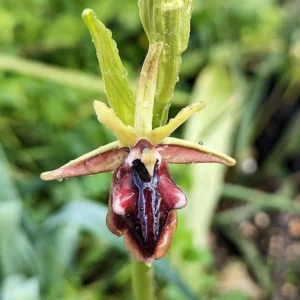
The epithet "sphegodes" comes from the Ancient Greek "σφήξ" [sphex], meaning "wasp," and "-ώδης" [-odes], meaning "resembling," due to the flower's wasp-like appearance. The subspecific epithet "mammosa" is derived from the Latin "mammosus", meaning "full-breasted" or "having large breasts" (from mamma, breast). This refers to the two very prominent, pointed basal swellings or "humps" located at the base of the labellum.
Synonyms
- Ophrys mammosa Desf. (1807)
- Ophrys exaltata subsp. mammosa (Desf.) E. Nelson (1962)
- Ophrys aranifera var. mammosa (Desf.) Rchb. f. (1851)
- Ophrys atrata Lindl. (1824)
- Ophrys arachnites Mill. (1768)
- Ophrys taurica (Aggeenko) Nevski (1935)
- Ophrys caucasica Woronow ex Grossh. (1928)
- Ophrys grammica (B.Willing & E.Willing) Devillers-Tersch. & Devillers (1991)
- Ophrys herae M.Hirth & H.Spaeth (1992)
- Ophrys hystera (B.Willing & E.Willing) Devillers-Tersch. & Devillers (1991)
Key Characteristics for Diagnostic Identification
According to the definitive botanical keys established by Robert Desmond Meikle in his comprehensive Flora of Cyprus (Volume Two, 1985), this subspecies is distinguished from Ophrys sphegodes subsp. transhyrcana by the following specific morphological features:
- Basal Protuberances (Humps): In subsp. mammosa, the basal swellings of the labellum are **very prominent, pointed, and conical**, significantly larger and more pronounced than the smaller, rounded, or almost obsolete humps found in subsp. transhyrcana.
- Lip (Labellum) Shape: The labellum of subsp. mammosa is typically **larger and more robustly convex**; subsp. transhyrcana usually features a narrower lip with less dramatic curvature.
- Speculum Markings: The H-shaped or π-shaped markings (speculum) in subsp. mammosa are usually **darker and more clearly defined**, often appearing blue-grey or violet against the dark brown velvet of the lip, whereas subsp. transhyrcana often has a more diffuse or less contrasting speculum.
- Sepal Color: While variable, subsp. mammosa consistently features **green to yellowish-green sepals** that are typically broader and more oblong than the often narrower, sometimes brownish-tinged sepals of subsp. transhyrcana.
- Petal Margin: The petals of subsp. mammosa are often **distinctly undulate** (wavy) and frequently have a brownish or olive-green hue, whereas in subsp. transhyrcana, the petals are often straighter and more strictly green.
Botanical Structure and Floral Details of Ophrys sphegodes subsp. mammosa
Vegetative Morphology
The plant stands 20 to 50 cm tall, arising from two ovoid underground tubers. The basal rosette consists of 3 to 5 oblong-lanceolate leaves which are a dull, silvery green. The stem is solid and erect, bearing a few smaller sheath-like leaves as it ascends toward the inflorescence.
Reproductive Organs
The inflorescence is a lax raceme carrying 4 to 12 flowers. The most striking feature is the dark brown, velvety labellum with its two "mammose" projections. The speculum serves as a visual lure for male bees, mimicking the wings of a female insect to facilitate pseudocopulation.
Geographical Distribution and Habitat of Ophrys sphegodes subsp. mammosa
Distribution in Cyprus
In Cyprus, this orchid is very widespread and locally frequent. It is especially found in abundance in the Akamas peninsula, the Kyrenia range, and the Troodos foothills. It favors calcareous soils and thrives in pine forest openings, garrigue, and neglected carob or olive groves.
Presence and Habitat Elsewhere
Beyond Cyprus, subsp. mammosa is distributed throughout the Balkan Peninsula, Greece, the Aegean Islands, Turkey, and the Levant. Across its global range, it is a quintessential Mediterranean orchid, preferring sunny to semi-shaded habitats on limestone substrates at elevations ranging from sea level to roughly 1,200 meters.
Elevation Range in Cyprus
The subspecies is typically encountered from sea level up to approximately 900 meters. While it can occur higher in protected valleys, its primary density is found in the hilly lowlands and mid-altitude maquis where the spring temperatures remain mild.
Flowering Period in Cyprus
The flowering period occurs from late February to mid-April. It is one of the more reliable spring orchids in Cyprus, often forming small colonies that emerge shortly after the peak of the *Ophrys fusca* group has passed.
Conservation Status in Cyprus
This orchid is not listed as threatened in the Red Data Book of the Flora of Cyprus, but like all members of the Orchidaceae, it is protected under the CITES convention. Habitat loss due to intensive agricultural clearing and tourism development in coastal areas remains a point of monitoring.
Is Ophrys sphegodes subsp. mammosa Suitable for Gardens?
As a terrestrial orchid, it is entirely unsuitable for gardens. It depends on highly specific mycorrhizal fungi for survival and cannot be transplanted from the wild. Removal of the plant is illegal and will result in the death of the specimen due to the disruption of this fungal symbiosis.
Toxicity and Safety
There are no known toxic properties associated with this orchid. While some related species were historically used for "salep," this subspecies has no food or medicinal value. Handling the plant is safe, but it should be left undisturbed to allow for natural seed dispersal.
Medicinal Properties
There is no record of subsp. mammosa being used in traditional Cypriot medicine. In the broader history of herbalism, its role has been purely aesthetic or mythological. Modern pharmacology has not found any clinical applications for the chemical compounds within its tissues.
Fascinating Insights About Ophrys sphegodes subsp. mammosa
Pseudocopulation and Pheromone Mimicry
Authoritative research on the genus Ophrys, such as the studies by Borg-Karlson (1990), demonstrates that subsp. mammosa employs a "sexual swindle." The plant produces volatile semiochemicals that perfectly mimic the sex pheromones of female bees (specifically Andrena species). Male bees, attracted by the scent and the velvety texture of the labellum, attempt to mate with the flower, resulting in the transfer of pollen masses (pollinia).
Evolutionary Significance of the Mammose Humps
Trustworthy morphological studies published in the Botanical Journal of the Linnean Society suggest that the prominent humps of subsp. mammosa are not merely ornamental. These structures act as physical guides that orient the male bee into a specific position, ensuring his abdomen makes contact with the viscidium of the pollinia at the correct angle for successful transport.
Mycorrhizal Specificity in Mediterranean Soils
Expert ecological analysis regarding Cypriot orchids confirms that subsp. mammosa is highly dependent on Tulasnella fungi. Research by Girlanda et al. (2006) indicates that these orchids are "mycoheterotrophic" in their early stages, meaning they steal nutrients from the fungi to germinate. The presence of the orchid is an authoritative indicator of a high-functioning, complex soil ecosystem.
The "Lability" of Speculum Patterns
Authoritative field observations noted in the Journal of European Orchids highlight the extreme variation in speculum patterns within subsp. mammosa populations. This "visual noise" is thought to be an evolutionary strategy to prevent male bees from learning to recognize the "fake" females, ensuring that the insects continue to visit different flowers and promote genetic diversity.