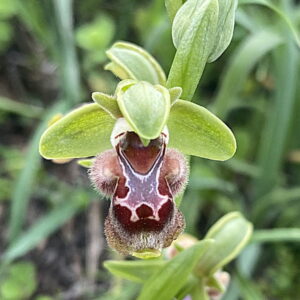
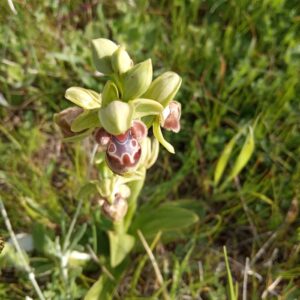
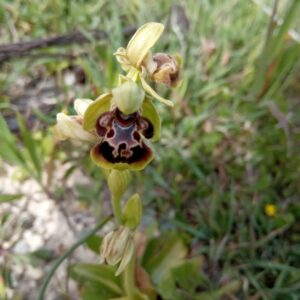
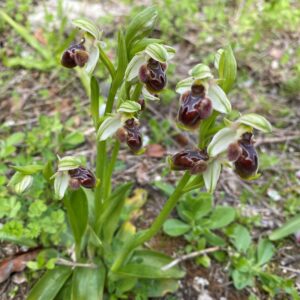
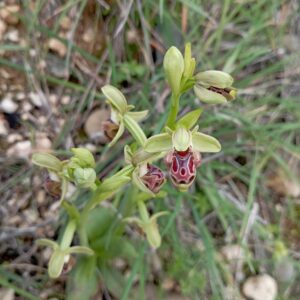
Ophrys umbilicata subsp. flavomarginata (Renz) Faurh., a member of the Orchidaceae family, is most accurately known as Meikle’s Bee Orchid. A common synonym for this specific taxon is Ophrys flavomarginata (Renz) H. Baumann & Künkele. Unlike the entirely yellow Ophrys lutea, this orchid features a dark labellum with a distinctive, bright yellow border.
Cypriot Names
Οφρύς η ομφαλωτή υποείδος η κιτρινοπεριθωριασμένη, Μελισσάκι του Μέικλ, Μελισσούι.
Common English Names
The most accurate common name is Meikle’s Bee Orchid, named in honor of the botanist who documented it. It is also referred to as the Yellow-margined Bee Orchid.
Etymology of Ophrys umbilicata subsp. flavomarginata
The etymology of the genus name Ophrys comes from the Greek word "οφρύς" [ophrys] for "eyebrow," referring to the fuzzy, hair-like textures on the floral lip. The species name "umbilicata" refers to a navel-like projection on the lip. The subspecies name "flavomarginata: combines the Latin "flavus" (yellow) and "marginatus" (bordered).
Synonyms
- Ophrys flavomarginata (Renz) H. Baumann & Künkele
- Ophrys attica f. flavomarginata Renz
- Ophrys umbilicata var. flavomarginata (Renz) Hennecke
- Ophrys kotschyi auct. non H.Fleischm. & Soó
Key Characteristics for Diagnostic Identification
According to the detailed records of Robert Desmond Meikle (1923–2021), an esteemed Irish botanist at the Royal Botanic Gardens, Kew, in his definitive Flora of Cyprus, this orchid is identified by:
- Labellum Margin: A broad, continuous, and very bright yellow or greenish-yellow band along the edge.
- Labellum Shape: Deeply trilobed, with side lobes featuring prominent, hairy, horn-like protrusions.
- Speculum Pattern: Typically H-shaped or scutelliform, appearing as a glossy "mirror" in the center.
- Sepals: Usually pink or purplish (rarely white) with a distinct green central vein.
- Stature: A robust stem reaching 15–40 cm, bearing a lax spike of 3–8 flowers.
- Appendix: A small, yellowish-green projection tucked into the apical notch of the labellum.
Botanical Structure and Floral Details of Ophrys umbilicata subsp. flavomarginata
Vegetative Growth and Foliage
The plant emerges from a subterranean tuber as a basal rosette of broadly lanceolate, silvery-green leaves. These leaves appear with the autumn rains but often begin to wither by the time the flowers reach full bloom. This strategy allows the orchid to conserve energy for seed production during the dry spring.
Floral Architecture and Mimicry
The labellum is the centerpiece of the flower, covered in dense, velvety chocolate-brown hairs that simulate an insect's body. The shiny speculum mimics light reflecting off a bee's wings. This complex visual and tactile arrangement is designed to facilitate pollination through pseudocopulation, a hallmark of the Ophrys genus.
Reproductive Organs and Column
The column of the flower holds the pollinia, which are sticky pollen masses. When a male bee is deceived by the flower’s appearance and scent, it attempts to mate with the labellum. During this process, the pollinia attach to the insect's head or abdomen, ensuring transport to the next flower.
Geographical Distribution and Habitat of Ophrys umbilicata subsp. flavomarginata
Global Distribution and Range
In a global context, this subspecies is an Eastern Mediterranean specialist. Its native range is primarily centered in Cyprus, though it also occurs in parts of southern Turkey and the Aegean islands. It thrives in the thermo-Mediterranean vegetation zone, characterized by mild, wet winters and hot, arid summers.
Distribution in Cyprus
In Cyprus, the plant is widely distributed in the Akamas Peninsula, the Troodos foothills, and the Kyrenia range. In general, it is a very common Ophrys in Cyprus. It grows at altitudes ranging from sea level to approximately 900 meters. The flowering period on the island is relatively short, usually occurring between February and mid-April each year.
Is Ophrys umbilicata subsp. flavomarginata Suitable for Gardens?
When considering "Is Ophrys umbilicata subsp. flavomarginata Suitable for Gardens?", the answer is a firm no for home gardeners. Wild orchids depend on highly specific mycorrhizal fungi in the soil to survive. Furthermore, it is strictly illegal to remove them from the wild under both Cypriot law and the CITES convention.
Fascinating Facts About Ophrys umbilicata subsp. flavomarginata
The Legacy of Robert Desmond Meikle
The subspecies is often associated with Robert Desmond Meikle, whose two-volume Flora of Cyprus remains the gold standard for Mediterranean botany. Meikle's work at Kew Gardens ensured that subtle variations in Cypriot orchids were properly documented, protecting them from being misidentified or overlooked by modern conservationists and researchers.
Chemical Deception Research
Recent studies published in Phytochemistry highlight that Ophrys species emit volatile organic compounds that identical to female bee pheromones. These chemical signals are so specific that they only attract certain species of solitary bees, such as those in the Eucera genus, ensuring that cross-pollination between different orchid species is minimized.
Mycorrhizal Symbiosis
Research from the Journal of Ecology confirms that this orchid cannot germinate without a fungal partner providing nutrients to its microscopic seeds. This symbiotic relationship persists throughout the orchid's life, helping it survive in nutrient-poor limestone soils. Without these specific fungi, the orchid would vanish from the Cypriot landscape.