Date Created: 17.04.2022
Last Modified: 13.04.2026
Orchis italica, famously known as the Naked Man Orchid, is a striking terrestrial orchid belonging to the Orchidaceae family. In Cyprus, this species is an indigenous and extremely common perennial that captures the imagination of botanists and casual hikers alike. A frequent synonym often encountered in historical Mediterranean botanical records is Orchis militaris var. italica, though it is currently classified as a distinct and stable species.
Cypriot Names
The official Latin name translated into Greek is Όρχις ο ιταλικός.
Common English Names
- Naked Man Orchid
- Italian Orchid
- Wavy-leaved Monkey Orchid
Etymology of Orchis italica
The etymology of the genus name Orchis originates from the Ancient Greek word ὄρχις [orkhis], meaning "testicle." This refers to the pair of underground tubers characteristic of the genus, which resemble male anatomy. This morphological trait led to various folklore and medicinal associations throughout antiquity.
The specific epithet italica is derived from the Latin italicus, meaning "of Italy" or "Italian", assigned during its early botanical documentation in Italy.
Synonyms
- Orchis militaris var. italica (Poir.) Fiori (1896)
- Orchis longicruris Link (1799)
- Orchis undulatifolia Biv. (1806)
- Orchis boryi Rchb.f. (1851)
- Orchis purpurea var. italica (Poir.) Steud. (1841)
Key Characteristics for Diagnostic Identification
According to the definitive botanical keys established by Robert Desmond Meikle in his comprehensive Flora of Cyprus (Volume Two, 1985), this species is distinguished from other members of the genus in Cyprus by the following features:
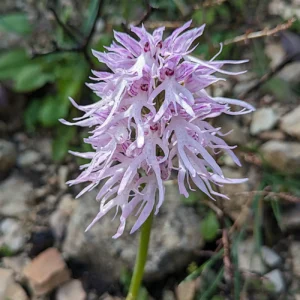
- Labellum Morphology: The lip (labellum) is deeply four-lobed, with the segments arranged to look like the arms and legs of a human; the central "body" often features a small projection between the "legs."
- Galea Structure: The sepals and upper petals form a dense, pointed hood (galea) that is conspicuously marked with fine, dark purple or pink longitudinal veins.
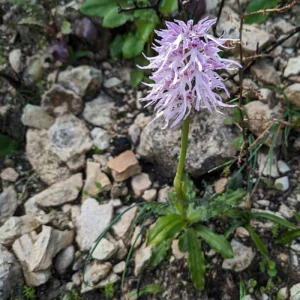
- Leaf Margins: The basal leaves are typically oblong-lanceolate and characterized by distinctly undulate (wavy) margins, a feature that separates it from similar orchids like Orchis anthropophora.
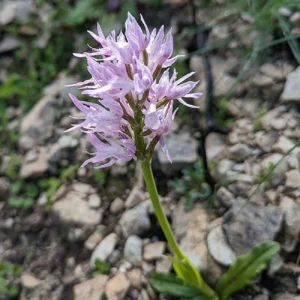
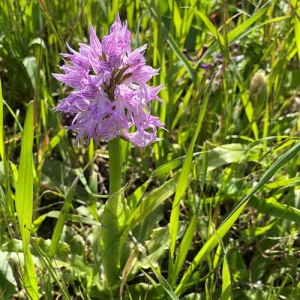
- Inflorescence: The flowers are arranged in a very dense, globose to ovoid spike that becomes more cylindrical as the lower flowers mature.
- Spur Characteristics: The spur is relatively long (approx. 5–8 mm), cylindrical, and downward-curving, containing nectar to attract pollinators.
Botanical Structure and Floral Details of Orchis italica
Vegetative Morphology
The plant typically reaches a height of 20 to 50 cm. It possesses two ovoid or ellipsoidal tubers. The basal leaves form a rosette and are often - though not consistently - spotted with dark purple. The stem is solid, erect, and light green, usually turning slightly purplish toward the top.
Reproductive Organs
The flowers vary in color from pale pink to deep purple. The labellum is the most ornate part, often covered in minute tufts of purple hairs (papillae). It is a highly "specialized" flower designed to attract various bee species, which must navigate the hood to reach the nectar-filled spur.
Geographical Distribution and Habitat of Orchis italica
Orchis italica is widely distributed across the Mediterranean Basin, from the Iberian Peninsula and North Africa to Turkey and the Levant. It thrives in open, sunny habitats like calcareous grasslands, maquis, and abandoned olive groves. A strict calcicole, it favors limestone-derived soils at elevations from sea level up to 1,300 meters throughout its global range.
Distribution in Cyprus
In Cyprus, Orchis italica is widespread and can be found in almost all districts. It is particularly abundant in the Akamas peninsula, the Kyrenia range, and the chalky hills of the Limassol and Larnaca districts. It prefers calcareous soils and is a staple of the island's spring flora.
Elevation Range in Cyprus
In the Cypriot landscape, this orchid is primarily encountered from sea level up to approximately 900 meters. While it is most common in the lowlands and the hilly "marly" regions, it can occasionally be found at higher elevations provided the habitat consists of open, sunny meadows or scrubland.
Flowering Period in Cyprus
The flowering period typically occurs from March to May. It is one of the most visible orchids during the height of the Cypriot spring. As the dry season approaches in late May, the plant goes into dormancy, with the tubers surviving underground until the following autumn rains.
Conservation Status in Cyprus
According to the Red Data Book of the Flora of Cyprus (2007), Orchis italica is not listed as a threatened species due to its wide distribution. However, like all orchids, it is protected under the CITES convention. Habitat fragmentation and the loss of traditional grazing lands remain the primary long-term threats to its populations.
Is Orchis italica Suitable for Gardens?
Like Neotinea maculata, this orchid is not suitable for traditional gardens. It relies on complex mycorrhizal relationships and specific soil chemistry. Removal from the wild is illegal and almost always results in the death of the plant. It is best enjoyed in its natural habitat.
Toxicity and Safety
There are no recorded toxic properties for Orchis italica. While the tubers of some Orchis species were used to make salep, the practice is discouraged and often illegal today to protect biodiversity. There is no reason to consume or handle the plant for anything other than botanical study.
Medicinal Properties
In historical herbalism, the tubers were thought to have aphrodisiac properties due to their shape (the "doctrine of signatures"), but this has no basis in modern pharmacology. In Cyprus, the plant is valued for its beauty and ecological role rather than any medicinal utility.
Fascinating Things About Orchis italica
Anthropomorphic Mimicry
The "Naked Man" appearance is a classic example of how humans perceive patterns in nature (pareidolia). While the shape appears human to us, to a bee, the intricate lobes and purple spots are "landing lights" and guides that lead them toward the nectar spur, ensuring the orchid is pollinated.
Pollination Synergy
Authoritative studies on Mediterranean orchids indicate that Orchis italica provides a rich nectar reward, unlike some "deceptive" orchids that trick insects without feeding them. This makes it a reliable energy source for local pollinators during the crucial spring breeding season.
Resilience to Fire
Trustworthy ecological field data suggests that this species is relatively resilient to the periodic fires that affect Mediterranean garrigue. Because its life cycle is completed and its tubers are safely buried deep underground by the time the dry fire season begins, it often emerges even more vigorously the following spring.