Orchis punctulata Steven, a majestic member of the Orchidaceae family, is commonly known as the Punctate Orchid. A widely cited synonym is Orchis sepulchralis Boiss. & Heldr. This tall, elegant orchid is a rare but spectacular sight in the Mediterranean, prized for its large spikes of yellowish flowers adorned with intricate dark spots.
Cypriot Names
Όρχις ο στιγματοφόρος
Common English Names
- Punctate Orchid
- Small-dotted Orchid
Etymology of Orchis punctulata
The etymology of the genus name "Orchis" comes from the ancient Greek "όρχις" (orchis), meaning "testicle," referring to the paired underground tubers. The species name "punctulata" is derived from the Latin "punctulum", meaning "small dot," which describes the fine purple or brown spotting found on the labellum of the flowers.
Synonyms
- Orchis sepulchralis Boiss. & Heldr.
- Orchis punctulata var. sepulchralis (Boiss. & Heldr.) Nyman
- Aceras punctulata (Steven) Nyman
Key Characteristics for Diagnostic Identification
According to the rigorous descriptions by Robert Desmond Meikle (1923–2021), an Irish botanist at the Royal Botanic Gardens, Kew, and author of the definitive Flora of Cyprus, Orchis punctulata is identified by:
- Height: A robust plant reaching 25–60 cm tall.
- Leaves: Basal leaves are large, broadly lanceolate, and unspotted.
- Inflorescence: A dense, cylindrical spike with many flowers.
- Flower Color: Sepals and petals form a yellowish-green hood.
- Labellum: 3-lobed, yellow with numerous small, dark purple or reddish-brown spots.
- Spur: Cylindrical, directed downwards, much shorter than the ovary.
Botanical Structure and Floral Details of Orchis punctulata
Foliage and Stem Development
The basal leaves of Orchis punctulata are typically 10–20 cm long and quite fleshy. They emerge early in the winter to photosynthesize and store energy in the tubers. The stem is thick, erect, and often yellowish-green, supporting the heavy flowering spike that can contain dozens of individual blossoms.
Floral Morphology and Labellum Details
The labellum is the most diagnostic part of Orchis punctulata. It is divided into three distinct lobes; the central lobe is further split into two lobules with a small tooth in the sinus. The surface is densely covered in tiny, raised papillae that appear as the characteristic dark spots, attracting specific pollinators.
Geographical Distribution and Habitat of Orchis punctulata
Global Distribution and Range
Across the world, Orchis punctulata is found from Southeast Europe, through Turkey and the Caucasus, to the Levant and Iran. It is a thermophilic species, meaning it prefers warmer climates. Throughout its range, it remains relatively rare and is often found in small, localized populations rather than broad, continuous carpets.
Distribution in Cyprus
In Cyprus, Orchis punctulata occurs in the Akamas Peninsula, Paphos, and Limassol districts. It inhabits grassy slopes and open maquis at altitudes from sea level to 900 meters. The flowering period on the island is relatively early, generally spanning from February to early April, depending on the seasonal rainfall.
Is Orchis punctulata Suitable for Gardens?
When considering "Is Orchis punctulata Suitable for Gardens?", it is vital to note that wild orchids are not suitable for cultivation. They require a specific symbiotic relationship with soil fungi to survive. Furthermore, all wild orchids in Cyprus are strictly protected by law, making their removal or trade a serious legal offense.
Medicinal and Historical Properties
Traditional Uses of Salep
Historically, the tubers of Orchis punctulata were used to produce "Salep." This flour was believed to have nutritive and demulcent properties, often used in traditional medicine to treat gastrointestinal irritations. However, modern conservation ethics strictly forbid the harvesting of these rare orchids for such purposes to ensure their survival in the wild.
Fascinating Things About Orchis punctulata
Food-Deceptive Pollination Tactics
According to research by the Royal Botanic Gardens, Kew, where Meikle served as a senior botanist, Orchis punctulata employs a food-deceptive pollination strategy. It attracts insects with its bright color and scent but offers no nectar reward. This evolutionary tactic forces insects to visit multiple plants, ensuring a higher rate of cross-pollination.
Rare Vanillin Scent
Studies published in the Journal of Chemical Ecology highlight that Orchis punctulata is one of the few orchids in the region to emit a distinct, pleasant scent similar to vanillin. This aroma is particularly strong during the warmest part of the day, specifically designed to lure bees and beetles that are active in the sunlight.
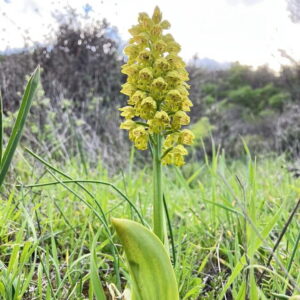
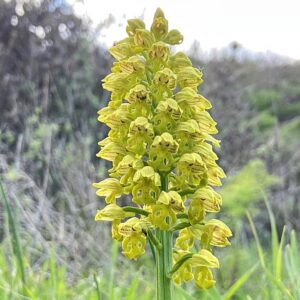
Image credits: Iwein Coppens