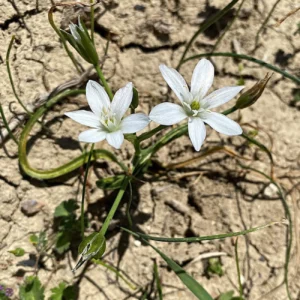
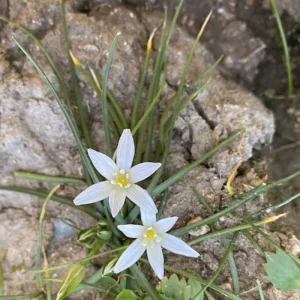
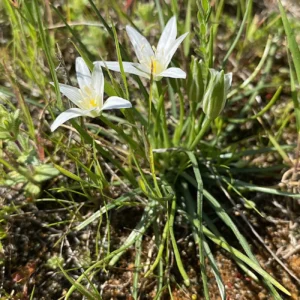
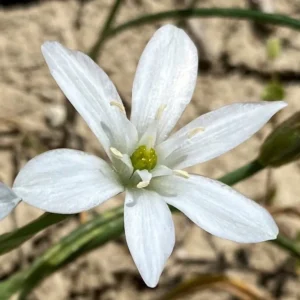
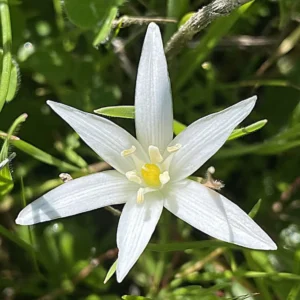
Ornithogalum divergens Boreau, a member of the Asparagaceae family, is commonly known as the Lesser Star of Bethlehem. A common synonym frequently encountered in Mediterranean botanical studies is Ornithogalum umbellatum auct. non L. This bulbous perennial is a striking early-season geophyte, often found dotting the Cypriot landscape with its brilliant white, star-like blossoms.
Cypriot Names
Ορνιθόγαλο το αποκλίνον.
Common English Names
The primary English name for Ornithogalum divergens is the Lesser Star of Bethlehem, but it is also frequently called the Divergent Star of Bethlehem. Locally, some may refer to it as the Grass-lily.
Etymology of Ornithogalum divergens
The etymology of the genus name, "Ornithogalum", derives from Ancient Greek "ὀρνιθόγαλον" [ornithogalon] - from "ὄρνιθος + γάλα" [ornithos + gala], which literally means "hen's milk" - an expression for the "abundance, richness, splendid", referring to the abundance/splendidness of flowers of the initially named Ornithogalum species. "Divergens" is New Latin and it means "divergent", referring to its divergent pedicels.
Key Characteristics for Diagnostic Identification
According to Meikle, Ornithogalum divergens is identified by several critical morphological factors that separate it from other regional bulbs:
- Number of Leaves: It typically produces 5–12 leaves from a single bulb.
- Length of Leaves: The leaves are narrowly linear, reaching 15–30 cm in length and 2–8 mm in width.
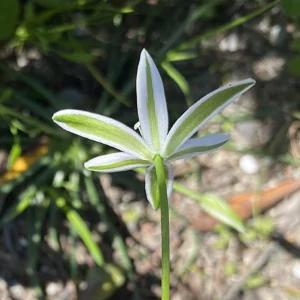
- The Back Side of Petals: Each petal features a prominent, broad green longitudinal stripe on its exterior surface.
- Ovary Structure: The ovary is subglobose and features six prominent, equidistant longitudinal ribs.
- Stamen Structure: It has six stamens with broadened, flattened white filaments that taper toward the yellow anthers.
- Stigma: The plant has a single style terminated by a small, 3-lobed stigma that sits atop the ribbed ovary.
Botanical Structure and Floral Details
Leaf Morphology and Markings
The leaves of the Lesser Star of Bethlehem are a key diagnostic feature even before flowering. Each leaf possesses a distinct white longitudinal line running down the center of its upper surface. They are somewhat fleshy and often channeled (canaliculate), which helps distinguish them from simple grass blades in the field.
Detailed Stamen and Filament Anatomy
The stamen structure is quite specialized in this species. The filaments are notably dilated at the base, forming a white protective ring around the central ovary. This structure ensures that the yellow anthers are held at a specific height to facilitate pollination by early-spring insects that visit tOrnithogalum divergens.
Ovary and Reproductive Organs
The ovary is a central focal point of the flower's interior. While there is only one style and a 3-lobed stigma, the six prominent ribs on the ovary give the central organ a complex, geometric appearance. These ribs become even more conspicuous as the fruit develops into a many-seeded capsule after pollination.
Appearance of the Back Side of Petals
When the flower is closed, the back side of petals is the only part visible. The broad green stripe covers most of the exterior, providing excellent camouflage against green grass. This pattern allows the Ornithogalum divergens to remain hidden from herbivores until the sun triggers the petals to open.
Geographical Distribution and Habitat
Presence in Eastern Cyprus
In Cyprus, Ornithogalum divergens is particularly prevalent in the eastern districts, such as Famagusta and Larnaca. It is well-adapted to the alluvial soils of the Mesaoria plain. It is frequently found in fallow fields, olive groves, and along the edges of traditional stone walls.
Life Cycle and Ecological Role
Seasonal Blooming and Light Sensitivity
In Cyprus, the blooming period begins as early as February and continues through April. The flowers of Ornithogalum divergens are highly sensitive to light. They open wide in full sun to reveal their white centers but close tightly during cloudy weather or at the approach of dusk.
Bulb Proliferation and Survival
Underground, the plant is a master of survival. The main bulb is surrounded by numerous small, white offsets or bulbils. These allow Ornithogalum divergens to multiply rapidly, especially in agricultural areas where tilling helps distribute the bulbils through the soil, ensuring the plant's long-term persistence.
Natural Defenses
The entire plant contains cardiac glycosides, which makes it toxic if ingested by mammals. This chemical defense protects Ornithogalum divergens from grazing sheep and goats in the Cypriot countryside. This toxicity is a common trait among many members of the Asparagaceae family in the Mediterranean.
Divergent Pedicels
The name divergens specifically refers to the flower stalks (pedicels). As the seeds mature, these stalks bend outwards and downwards, spreading away from the main scape. This architectural change helps the capsules release their seeds over a wider area, increasing the success of the next generation of the Lesser Star of Bethlehem.