Date Created: 17.04.2022
Last Modified: 16.04.2026
Ornithogalum narbonense, commonly known as the Narbonne Star of Bethlehem, is a bulbous perennial herb belonging to the Hyacinthaceae family. In Cyprus, this species is a frequent and elegant sight during the spring months, often colonizing fallow fields, roadsides, and open hillsides. While it is broadly recognized by its current name, it is sometimes referred to by the synonym Ornithogalum stachyoides in various Mediterranean botanical records.
Cypriot Names
The official Latin name translated into Greek is Ορνιθόγαλο το ναρβονήσιο. In certain rural areas, it is also known as Πουρταλλία [pourtallia], a name occasionally used for various tall, spiked wildflowers.
Common English Names
- Narbonne Star of Bethlehem
- Pyramidal Star of Bethlehem
- Southern Star of Bethlehem
Etymology of "Ornithogalum narbonense"
The Ancient Greek word "ὀρνιθόγαλον" [ornithogalon] derives from "ὄρνις + γάλα" ["órnis", possessive case "órnithos" + "gala"], and literally means "hen's milk", which is an Ancient Greek metaphor for the "abundance", referring to the abundance/splendidness of flowers (of the initially named Ornithogalum species). The specific epithet "narbonense" is a geographical reference to Narbonne in Southern France, where the plant was early documented, although its distribution is much wider across the Mediterranean.
Synonyms
Below is a comprehensive list of synonyms for Ornithogalum narbonense, including publication years where historically established:
- Ornithogalum stachyoides Licht. ex Schult. & Schult.f. (1830)
- Ornithogalum pyramidale subsp. narbonense (L.) P.Fourn. (1935)
- Ornithogalum lacteum Vill. (1787)
- Loncomelos narbonense (L.) Raf. (1837)
- Ornithogalum brachystachys K.Koch (1849)
- Ornithogalum densum Boiss. & Blanche (1859)
- Ornithogalum brevibracteatum Jord. & Fourr. (1868)
- Ornithogalum fontanesii Kunth (1843)
- Ornithogalum monspeliense Jord. & Fourr. (1868)
- Ornithogalum longebracteatum Jord. & Fourr. (1868)
Key Characteristics for Diagnostic Identification
According to the definitive botanical keys established by Robert Desmond Meikle (1923–2021) in his comprehensive Flora of Cyprus, this species is distinguished by several specific morphological features:
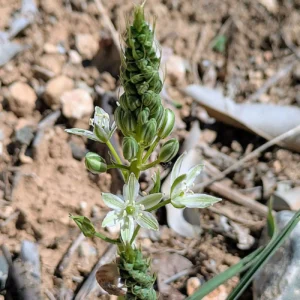
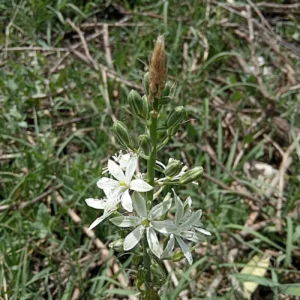
- Inflorescence Shape: The flowers are arranged in a long, cylindrical, and many-flowered raceme, which can contain between 20 to 50 individual blooms.
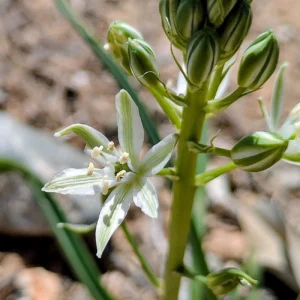
- Tepal Morphology: Each flower possesses six tepals that are pure white with a narrow, distinct green stripe on the external surface.
- Bract Length: The membranous floral bracts are long and persistent, often equaling or exceeding the length of the flower pedicels.
- Filament Shape: The staminal filaments are flattened and broadly lanceolate, lacking the teeth or appendages found in some other members of the genus.
Botanical Structure and Floral Details of Ornithogalum narbonense
Vegetative Morphology
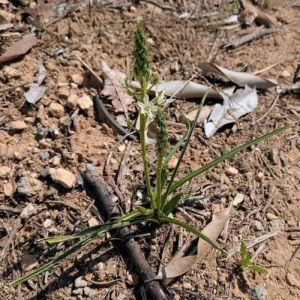
The plant arises from a large, ovoid bulb, reaching heights of 30 to 60 cm. The leaves are linear and canaliculate (channeled), often beginning to wither at the tips by the time the flowers reach full bloom. The scape is erect, smooth, and robust enough to support the dense floral spike.
Reproductive Organs
The individual flowers are star-shaped and measure approximately 1.5 to 2 cm in diameter. The ovary is superior and green, eventually developing into a three-valved capsule. Pollination is primarily carried out by bees and hoverflies attracted to the conspicuous white display.
Geographical Distribution and Habitat of Ornithogalum narbonense
Distribution in Cyprus
In Cyprus, Ornithogalum narbonense is widespread and common across the island. It is frequently found in the Mesaoria plain, the Akamas peninsula, the Kyrenia range, and extensively throughout the Limassol district. Its presence is marked in both cultivated and uncultivated lands.
Presence and Habitat Elsewhere
Beyond Cyprus, the species is native to Southern Europe, North Africa, and Western Asia. It thrives in Mediterranean-type climates, favoring well-drained calcareous soils and open, sunny positions. It is a resilient species that often persists in traditional agricultural landscapes.
Elevation Range in Cyprus
The species occurs from sea level up to approximately 1,100 meters. While it is more dominant in the lowland plains and coastal regions, it successfully ascends into the vine-growing villages and mid-altitude hills of the Troodos and Kyrenia ranges.
Flowering Period in Cyprus
The flowering period typically spans from March to May. In the warmer lowland areas, the first spikes may appear as early as late February, while higher-altitude populations provide a late spring display through early June.
Conservation Status in Cyprus
Currently, the species is not considered threatened in Cyprus. Its ability to adapt to various habitats, including human-modified environments like field margins, has ensured its stability. However, heavy urbanization in coastal areas can impact local populations.
Is Ornithogalum narbonense Suitable for Gardens?
This species is excellent for Mediterranean-style gardens, particularly in wildflower meadows or rockeries. Unlike many orchids, it is relatively easy to grow from bulbs. It provides a striking vertical element and is highly drought-tolerant once established.
Toxicity and Safety
It is important to note that all parts of Ornithogalum narbonense are toxic if ingested. The plant contains cardiac glycosides, which can cause severe gastrointestinal distress and affect heart rhythm. Handling the plant is generally safe, but it should be kept away from livestock and pets.
Medicinal Properties
While some related species have been explored in traditional medicine, there is no established medicinal use for Ornithogalum narbonense in modern pharmacology. Due to its inherent toxicity, any attempt at internal use is extremely dangerous and strictly discouraged.
Fascinating Insights About "Ornithogalum narbonense"
Dormancy as a Survival Tactic
Expert botanical research in the Journal of Arid Environments highlights that Ornithogalum narbonense utilizes its bulb to survive the harsh Mediterranean summer. The leaves wither early to prevent water loss, an authoritative example of geophytic adaptation to extreme seasonal drought.
Heliotropic Flower Movement
Trustworthy observations of the genus indicate that the flowers are somewhat heliotropic. According to studies on Mediterranean bulbous plants, the flowers tend to open fully only in bright sunlight and may track the sun's position to maximize the visibility of their white tepals to pollinators.
Crystalline Petal Structure
Authoritative microscopic analysis reveals that the "sugar-like" sparkle of the petals is due to specialized epidermal cells. These cells act as tiny lenses, reflecting light to create a brilliant white effect that serves as a highly effective visual signal in the bright Mediterranean light.