Date Created: 27.03.2026
Last Modified: 27.03.2026
Ornithogalum trichophyllum Boiss. & Heldr. is the scientific name for the Hair-leaved Star of Bethlehem, an Asparagaceae family member with the synonym Ornithogalum trichophyllum var. persicum. The delicate white flowers represent a classic element of the Cyprus spring. This species is highly valued for its distinctive, hair-like foliage and its ability to thrive within rocky limestone environments.
Common Cypriot Names
Ορνιθόγαλο το τριχόφυλλο (Ornithogalo to trichofyllo), Ασπρογάλι (Asprogali), Σταυρολούλουδο (Stavrolouloudo)
Common English Names
- Hair-leaved Star of Bethlehem
- Hair-leaved Ornithogalum
Etymology of Ornithogalum trichophyllum
The Ancient Greek word "ὀρνιθόγαλον" [ornithogalon] derives from "ὄρνις + γάλα" ["órnis", possessive case "órnithos" + "gala"], and literally means "hen's milk", which is an Ancient Greek metaphor for the "abundance", referring to the abundance/splendidness of flowers (of the initially named Ornithogalum species). The epithet "trichophyllum" is composed of the combined Ancient Greek words"θρίξ" in possessive case "τριχός" [trichós] - meaning "(a piece of) hair" - and "φύλλον" [fýllon], meaning "leaf", hence "τριχόφυλλον" [trichófyllon], describing its remarkably slender, hair-like foliage.
Synonyms
- Ornithogalum trichophyllum var. persicum Boiss.
- Ornithogalum persicum (Solms) Hausskn. ex Bornm.
How To Identify Ornithogalum trichophyllum
According to the definitive botanical keys established by Robert Desmond Meikle (1923–2021) in his comprehensive Flora of Cyprus, this species is distinguished by several specific morphological features:
- Inflorescence Structure: It features a crowded, subspiciform (spike-like) raceme, which distinguishes it from the lax, wide-spreading corymbs of O. divergens and O. pedicellare.
- Pedicel Length: The lower pedicels are short, typically only 1–1.5 cm long, whereas O. divergens can have pedicels up to 8 cm and O. pedicellare up to 7 cm.
- Leaf Characteristics: It possesses 4–8 hair-like (filiform) leaves that lack the pale median stripe seen in O. divergens. Unlike O. chionophilum, its leaves are much narrower (1–3 mm vs 3–12 mm).
Botanical Structure of Ornithogalum trichophyllum
The Inflorescence
The flowers are arranged in a low-growing, flattened cluster. Because the lower pedicels are much longer than the upper ones, the flowers often reach a similar height, creating a "flat-topped" appearance that is characteristic of many Star of Bethlehem species found in the Mediterranean region.
Floral Details
Each flower consists of six spreading tepals. While the upper surface is a brilliant, clean white, the outer surface of each segment features a broad, longitudinal green band. This green stripe is a vital diagnostic feature, providing structural reinforcement and camouflage when the flowers close during the night.
Geographical Distribution and Habitat of Ornithogalum trichophyllum
Ornithogalum trichophyllum is native to a broad range within the eastern Mediterranean and Western Asia. Its native range extends across Turkey, Syria, Lebanon, Palestine, Israel, Jordan, Iraq, Iran, and the Sinai Peninsula in Egypt. It typically occupies dry, stony hillsides and sandy coastal areas in these regions.
Distribution in Cyprus
In Cyprus, Ornithogalum trichophyllum is not endemic. It is an indigenous species found primarily in the lowland areas. Specifically, it occurs in limited locations, such as the villages of Deneia, Mammari, and Agios Sozomenos in the Nicosia district, Liopetri and Vitsada in the Famagusta district, and parts of the Kyrenia Mountains.
Conservation Status
This species is officially listed as Vulnerable (VU) in the Red Data Book of the Flora of Cyprus. Its populations are threatened by habitat loss due to agricultural expansion. Consequently, it is a protected species under the forestry laws of the Republic.
Is Ornithogalum trichophyllum Suitable for Gardens?
While it is an elegant miniature, this species is essentially absent from the commercial market. You cannot find these seeds or bulbs in local nurseries or international catalogs. Due to its vulnerable status, it is illegal to collect it from the wild, and it is not currently cultivated for mass sale.
Fascinating Facts About Ornithogalum trichophyllum
Specialized Hair-Like Foliage
The leaves of this plant are an evolutionary marvel, being so remarkably thin that they are often compared to strands of hair. This adaptation is specifically designed to minimize the surface area exposed to the sun, allowing the plant to retain moisture in the harsh, dry environments where it thrives during its growth cycle.
Nyctinastic Floral Rhythms
Another intriguing aspect is the movement of its petals in response to light, a behavior known as nyctinasty. The flowers open wide to reveal their brilliant white interior only during the brightest hours of the day. This ensures that they are visible to pollinators while protecting their reproductive organs from the cool, damp night air.
Protective Green Tepal Striping
The green stripe on the back of the petals serves as more than just a decorative feature; it acts as a camouflage mechanism. When the flower is closed, the plant blends seamlessly with the surrounding green stems and grasses. This protects the delicate bulb's energy source from being grazed by herbivores before the seeds can fully mature.
Spring Resilience in Barren Terrains
Historically, various members of this genus were associated with ancient folk remedies, though O. trichophyllum is primarily noted for its botanical rarity. Its sudden appearance in early spring across rocky barrens makes it a symbol of resilience in the Cyprus flora, despite the environmental pressures it faces from human development.
Underground Estivation Strategies
The bulb of this species is specially adapted to survive the long, scorching Mediterranean summers by entering a state of total dormancy. During this time, it retreats deep underground, protected by thick tunics that prevent desiccation. It only awakens when the first autumn rains signal that it is safe to begin the cycle anew.
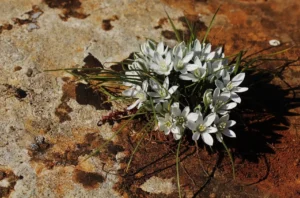
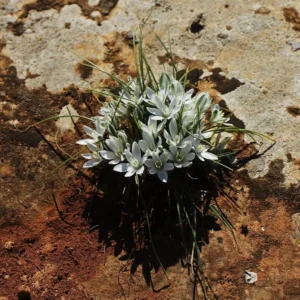
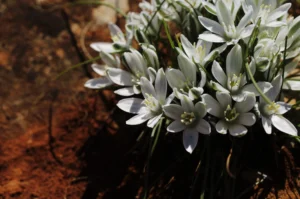
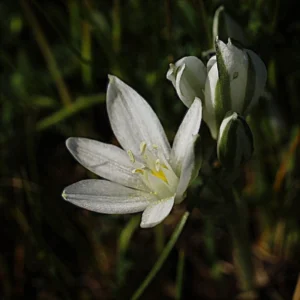
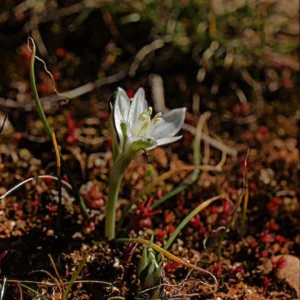
Image Credits: Haroula Kyriacou
Visit Haroula’s Facebook Profile
The Vulnerable Nature of Ornithogalum trichophyllum in Cyprus
These pictures were taken by Haroula in the village of Mammari, in the Nicosia district, where most people encounter this species. Since the plant in Cyprus is categorized as vulnerable, Haroula conveys a message of concern: "This place is gradually being destroyed... They remove the stones - supposedly to plow wheat and similar crops - in order to receive subsidies. Every year I visit, it is more damaged than before. This little wreath (where the pictures where taken) is no longer there..."