Date Created: 25.10.2022
Last Modified: 29.10.2026
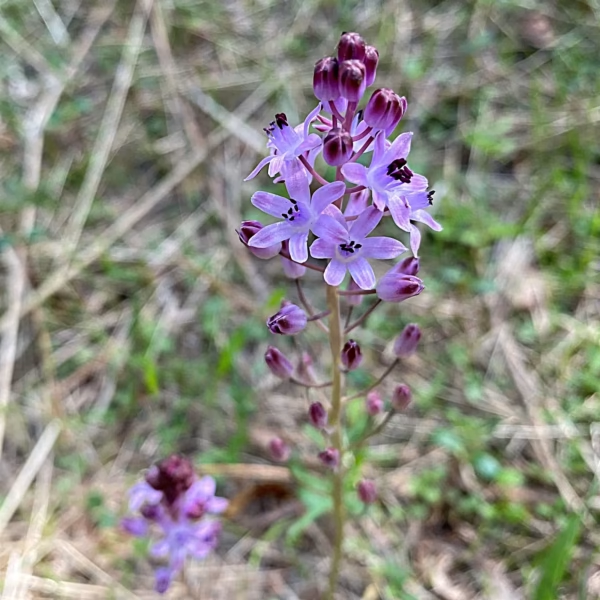
Prospero autumnale (L.) Speta, commonly known as autumn squill, is a small, bulbous perennial in the family Asparagaceae. Native to a broad region extending from western Europe across the Mediterranean, it is particularly distinctive for producing delicate pinkish-purple flowers in late summer and autumn, often before its leaves have emerged. In Cyprus, the species is indigenous and occurs in dry grasslands, rocky slopes, and openings within shrubland and phrygana. Although its individual flowers are small, its unusual seasonal growth cycle makes it an interesting component of the island's autumn flora. Kew's Plants of the World Online accepts the name Prospero autumnale, while Cypriot government publications have traditionally used its synonym, Scilla autumnalis.
Common Cypriot Names
Greek name: Σκύλλα η φθινοπωρινή (Skýlla i fthinoporini) — literally, autumn squill. The name is documented in a Greek-language publication issued through the official Cypriot government publications portal, which describes the species under the scientific name Scilla autumnalis and identifies it as a common indigenous wildflower of the island.
Common English Names
- Autumn squill
- Autumn-flowering squill
- Starry hyacinth
- Winter hyacinth
- Autumn squill lily
Nomenclatural note: The first four names are documented in established botanical and horticultural references, including the Royal Horticultural Society and the EPPO Global Database. The name autumn squill is the most suitable general English name.
Etymology of Prospero autumnale
The etymology of the genus name Prospero is not entirely settled in the botanical literature. One proposed explanation connects it with the Greek elements pros (πρός), meaning “towards” or “near”, and peraō (περάω), meaning “to pass through” or “to cross”. Under this interpretation, the name may allude to the historical difficulty of distinguishing this genus from the closely related genus Scilla. This explanation should be regarded as a proposed derivation rather than a definitively established origin. The generic name was adopted in the modern taxonomic treatment published by the Austrian botanist Franz Speta in 1982, when the species was transferred from Scilla to Prospero. The publication is recorded by the International Plant Names Index.
The specific epithet autumnale is Latin and means “autumnal” or “belonging to autumn”. It refers to the plant's characteristic flowering season, which occurs in autumn rather than during the spring flowering period associated with many other bulbous members of the former broad genus Scilla. The epithet is particularly appropriate in Cyprus, where the species is reported in full flower from September to November. The combination Prospero autumnale therefore conveys the identity of the genus and the seasonal feature that makes the species readily recognisable. The botanical name is attributed to Carl Linnaeus, who originally described the species as Scilla autumnalis, and Franz Speta, who published the currently accepted combination.
Synonyms
The following are the homotypic synonyms recorded by Kew's Plants of the World Online. They share the same nomenclatural type as the accepted name, meaning that they are alternative scientific names based on the same original taxonomic entity. The list is arranged from the most recent publication date to the oldest. Publication years refer to the relevant nomenclatural combinations, not to the dates on which the plant was first discovered.
- Urginea autumnalis (L.) El-Gadi (1978)
- Hyacinthus autumnalis (L.) E.H.Krause (1906)
- Stellaris autumnalis (L.) Bubani (1902)
- Ornithogalum autumnale (L.) Lam. (1779)
- Anthericum autumnale (L.) Scop. (1771)
- Scilla autumnalis L. (1753)
Taxonomic authority: The accepted combination and the synonymy above follow the nomenclatural records maintained by Plants of the World Online and the International Plant Names Index. Only homotypic synonyms are included here; alternative names based on different nomenclatural types are deliberately excluded.
Morphology of the Plant
Growth Habit and Underground Bulb
Prospero autumnale is a small, herbaceous, perennial geophyte. A geophyte is a plant that survives unfavourable seasons through an underground storage organ, such as a bulb, tuber or rhizome. In this species, the bulb allows the plant to persist through the hot, dry Mediterranean summer, when above-ground growth is reduced or absent. Following the seasonal change in temperature and moisture, the plant produces its flowering stalk and subsequently develops its leaves.
According to the Government of Cyprus's 2021 botanical account, the flowering stems can reach approximately 20 cm in height. International botanical and horticultural descriptions report a broader potential height range of approximately 5–25 cm, reflecting differences in growing conditions and individual plants. The plant is usually inconspicuous when growing among grasses, low shrubs and rocky ground. Its small stature is characteristic of many Mediterranean bulbous species that complete their flowering and reproductive stages during relatively short periods of favourable conditions.
Leaves
The leaves are basal, narrow and grass-like. They emerge from the underground bulb and are generally linear, with a smooth surface and an entire margin. In this species, the leaves characteristically appear after the flowering period, a condition described botanically as hysteranthy. This seasonal separation between flowering and leaf development is one of the most distinctive features of the plant.
The Cypriot government account reports that the leaves usually number approximately eight to ten and measure around 7–12 cm in length. Descriptions from other Mediterranean populations record variation in leaf number and dimensions. The foliage develops during the cooler, wetter part of the year, when photosynthesis can replenish the underground bulb's reserves. As the dry season approaches, the leaves eventually wither, leaving the plant to survive underground until the next favourable growing period.
Flowers and Inflorescence
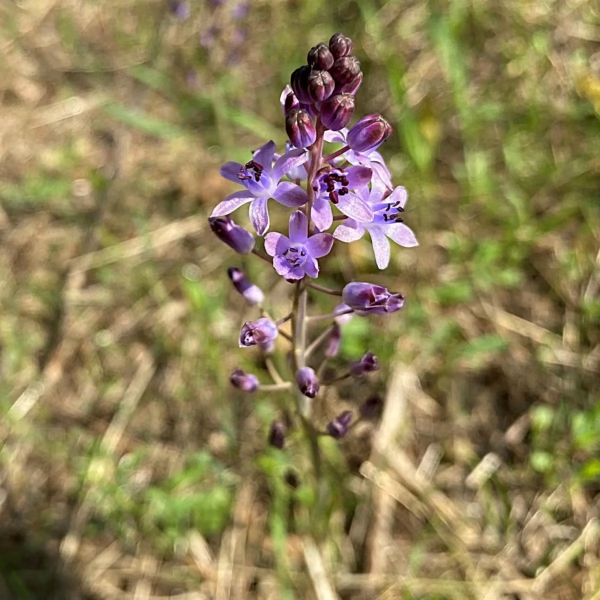
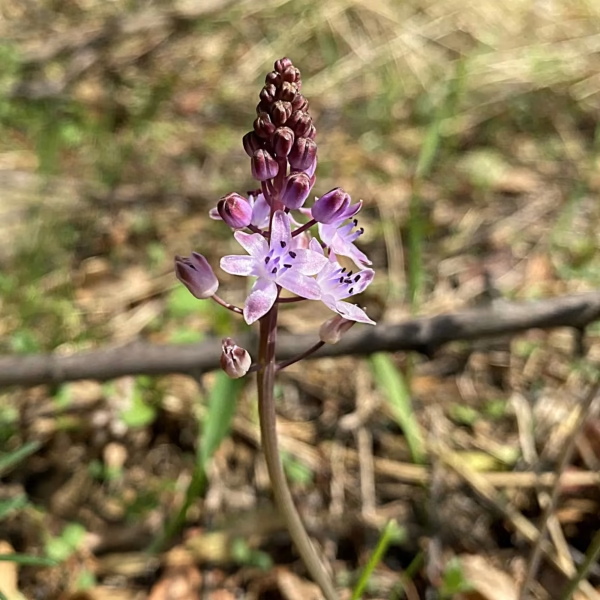
The flowers are borne in a terminal raceme, an inflorescence in which individual flowers are arranged along an elongated central axis. Depending on the individual plant and the growing conditions, the raceme can be relatively loose or comparatively dense. The flowers are small and radially symmetrical, with six similar-looking perianth segments, conventionally described as tepals because the petals and sepals are not distinctly differentiated.
The colour ranges from pale pink and lilac to pinkish-purple. Each flower possesses six stamens and a central pistil. The stamens are often conspicuous because of their darker anthers, which contrast with the lighter-coloured perianth. The flowers are bisexual, containing both male and female reproductive structures. Although individual flowers are small, several may develop along the same stalk, creating a delicate display close to the ground.
The flowering stalk commonly emerges before the leaves have developed fully, so the flowers may appear to rise directly from otherwise bare ground. This characteristic is particularly noticeable in Mediterranean landscapes during autumn, when many summer-dormant plants begin their new growth cycle.
Fruit and Seeds
After pollination, the flowers develop into capsules containing seeds. The Cypriot government account describes the fruit as a capsule with a roughly spherical to triangular outline and nearly spherical, slightly wrinkled seeds. Fruiting takes place mainly between October and December in Cyprus, following the autumn flowering period.
As the capsules mature and open, the seeds become available for dispersal. Successful recruitment depends on suitable environmental conditions, including adequate moisture for germination and an appropriate period for seedling establishment. The plant's underground bulb and seasonal growth pattern also contribute to its persistence in habitats that experience pronounced summer drought.
Geographical Distribution and Habitat of Prospero autumnale
Prospero autumnale has a broad native distribution extending from western Europe across the Mediterranean region and into parts of western Asia and North Africa. Kew's Plants of the World Online records the species as native to numerous countries and regions, including Cyprus, Greece, Türkiye, Italy, Spain, France, North Africa and the Levant. It is a characteristic element of Mediterranean bulbous flora and is adapted to environments with mild, relatively moist growing seasons and hot, dry summers.
The species commonly grows in dry grasslands, rocky slopes, open scrub and phrygana, where low vegetation and exposed ground provide suitable conditions for its small flowering stalks. It is particularly associated with habitats that are dry during summer but receive sufficient autumn and winter moisture to support renewed growth. Its occurrence in open, relatively undisturbed vegetation also makes it a useful component of seasonal Mediterranean plant communities. Its global distribution is documented by Kew's POWO.
Distribution in Cyprus
In Cyprus, the species is indigenous and described as common and widely distributed. The Government of Cyprus's Press and Information Office identifies it in dry grasslands, rocky slopes, and openings in shrubland and phrygana. These habitats occur in several parts of the island, and the species is not restricted to a single mountain range or narrowly defined locality.
The same government account reports that the species has a broad distribution and a large population, with a significant proportion of its known population occurring in protected Natura 2000 sites, national forest parks and other state forest land where activities are controlled.
Elevation Range in Cyprus
The documented elevation range is 0–925 m above sea level. This range is explicitly given in the Government of Cyprus's botanical account published in September–October 2021.
Flowering Period in Cyprus
The principal flowering period is September to November. The Government of Cyprus describes the plant as being in full flower during these months, making it one of the recognisable indigenous wildflowers of the Cypriot autumn. The exact timing of flowering can vary with rainfall, local temperature and elevation. Plants growing in particularly dry locations may respond differently to the first autumn rains from those growing in cooler or more sheltered habitats.
Fruiting follows flowering, with capsules and seeds developing mainly from October to December. The leaves generally emerge after flowering, creating a seasonal sequence in which the reproductive stalk is visible before the foliage becomes prominent.
Conservation Status in Cyprus
The Cypriot government account describes the species as common, indigenous, widely distributed and represented by a large population.
Is Prospero autumnale Suitable for Gardens?
Prospero autumnale can be suitable for a Mediterranean-style garden, particularly in rock gardens, gravel gardens and naturalistic plantings designed to accommodate small seasonal bulbs. Its modest size makes it appropriate for spaces where larger ornamental plants would overwhelm it. The flowers can add seasonal interest in autumn, when many Mediterranean plants are either dormant or producing relatively little new growth.
In cultivation, the species is best suited to a sunny or lightly shaded position with well-drained soil. A growing medium that becomes waterlogged for prolonged periods is undesirable for a bulbous plant adapted to a dry summer climate. The natural seasonal cycle should be respected: the plant needs adequate moisture during its growing season but should not be kept excessively wet when dormant. The Royal Horticultural Society lists the species as suitable for rock gardens and other naturalistic planting styles and recommends well-drained growing conditions.
Availability and legal considerations: The species appears in international horticultural references, but the presence of a profile in a gardening database does not guarantee that viable, correctly identified seeds or bulbs are currently available for purchase. Availability should be confirmed with a reputable specialist nursery or seed supplier. Plants or propagules should preferably come from cultivated stock rather than from wild populations.
Anyone intending to collect seeds or bulbs from wild plants in Cyprus should first establish whether collection is permitted at the relevant location and under the applicable legislation. Protected areas and state forest land may have restrictions on the collection or removal of wild plants. No species-specific legal exemption or unrestricted right to collect this plant is asserted here. For conservation and horticultural purposes, propagation from legally obtained cultivated material is the more responsible approach.
Toxicity and Safety
Experimental Evidence of Toxicity
A study published in 2026 in the peer-reviewed journal Toxins investigated the chemical composition, biological activity and acute toxicity of extracts prepared from the aerial and underground parts of Prospero autumnale. The research team, led by Maroua Korichi and colleagues, assessed a range of biological effects using laboratory assays and animal experiments. The study reported moderate acute toxicity for certain extracts, with estimated median lethal doses in the range of 300–400 mg/kg under the experimental conditions described.
The median lethal dose, or LD50, is an experimental measure used in toxicology to estimate the dose associated with mortality in a specified test population. It is not a safe human dose, nor does it establish the precise amount of a plant that would cause poisoning in a person. The reported results apply to the particular extracts, preparation methods, exposure routes and experimental models used by the investigators. They cannot be translated directly into a human poisoning threshold.
The same research found potentially beneficial biological activities in certain extracts, including anti-inflammatory and antioxidant effects. These results do not negate the toxicity findings. A substance can show a biological effect of potential therapeutic interest while also producing harmful effects at particular doses. The investigators emphasised the importance of further toxicological evaluation before therapeutic applications can be considered. The original study is available through the journal article and PubMed.
Medicinal Properties
Research on Anti-inflammatory and Analgesic Activity
Korichi and colleagues investigated extracts from the aerial and underground parts of the plant in a study published in Toxins in 2026. Their work included in-vitro tests of antioxidant and anti-inflammatory activity, assays of acetylcholinesterase inhibition, and in-vivo experiments assessing acute toxicity and selected biological effects.
The researchers reported anti-inflammatory and analgesic activity associated with certain extracts, including an aqueous extract prepared from aerial plant material. Some experimental findings were promising enough to justify additional investigation into the plant's chemical constituents and potential pharmacological effects. However, laboratory activity and results in animal models are preliminary evidence. They do not demonstrate that the plant can safely treat pain or inflammation in humans, and comparisons with an established medicine in an experimental assay do not establish clinical equivalence.
The study also reported moderate acute toxicity for certain extracts. That finding is particularly important when evaluating medicinal claims: a potentially useful biological effect must be assessed alongside adverse effects, dose dependence, interactions and the possibility of harm. The authors' work supports further scientific investigation, not unsupervised medicinal use. See the original 2026 research paper.
Antioxidant and Other Biological Activities
The same investigation examined antioxidant activity in extracts prepared using different solvents. Some underground-part extracts demonstrated activity in chemical assays measuring reducing capacity and the scavenging of reactive species. Other extracts showed activity in tests of acetylcholinesterase inhibition and photoprotection.
These findings indicate that the plant contains chemical constituents worthy of further study. Nevertheless, antioxidant activity in a test tube does not automatically translate into a meaningful health benefit after ingestion. Absorption, metabolism, tissue distribution, effective concentration and toxicity all influence whether a compound could become a useful medicine. Similarly, acetylcholinesterase inhibition in an experimental assay is not evidence that the plant can safely prevent or treat neurological disease.
The investigators used chemical profiling methods, including liquid chromatography coupled with tandem mass spectrometry (LC–MS/MS), to characterise constituents in the extracts. This provides a basis for future work to identify which compounds are associated with the observed activities and which might contribute to adverse effects. It does not, by itself, establish the safety of the whole plant or of a traditional preparation.
Is Prospero autumnale Edible?
No. It should not be regarded as an edible wild plant. The available evidence does not establish that its flowers, leaves, seeds or underground bulbs are safe for human consumption. The Royal Horticultural Society explicitly warns against eating the ornamental bulbs, and experimental research published in 2026 reported moderate acute toxicity for certain extracts of the species.
Fascinating Insights About Prospero autumnale
1. Its Flowers Appear Before Its Leaves
One of the most distinctive characteristics of this species is its seasonal separation of flowering and leaf development. The flowering stalk can emerge while the leaves remain absent or have not yet developed fully. The leaves subsequently appear and support photosynthesis during the cooler, wetter season.
This sequence is an adaptation associated with the Mediterranean climate, in which summers are often hot and dry and the period of reliable soil moisture is concentrated in autumn, winter and spring. By surviving through the summer as an underground bulb, the plant avoids maintaining exposed foliage during the harshest part of the year. Its flowering can therefore coincide with the return of more favourable conditions, while its later foliage replenishes the reserves required for future growth.
The Government of Cyprus's botanical account explicitly notes that the leaves appear after flowering and records the flowering period as September to November, followed by fruiting from October to December. The seasonal pattern is also described in Mediterranean botanical accounts, including the Herbari Virtual of the University of the Balearic Islands.
2. A Small Flowering Plant with Remarkable Chromosomal Diversity
Despite its modest appearance, this species has attracted scientific interest because of its unusual chromosomal variation. Research into the Prospero autumnale complex has documented extensive differences in chromosome number, genome organisation and ploidy among populations and cytotypes. Ploidy refers to the number of complete chromosome sets present in a cell.
A 2016 study published in Annals of Botany examined structural polymorphisms and the genomic composition of additional chromosomes, known as B chromosomes, in this complex. B chromosomes are chromosomes beyond the standard complement and are not universally present in all individuals. The researchers found evidence that their formation may have occurred repeatedly during the evolutionary history of the group.
Other cytological research has documented considerable chromosome diversification among diploid representatives of Prospero. This work illustrates how substantial genetic and chromosomal variation can exist among plants that show relatively little obvious morphological differentiation. In other words, individuals that look broadly similar in the field may differ considerably in their underlying chromosome organisation.
These studies are important because chromosome evolution can influence genetic variation, reproductive compatibility and the long-term diversification of plant lineages. The findings do not mean that every population in Cyprus has the same chromosomal characteristics, nor do they establish a particular chromosome number for every Cypriot individual. They demonstrate that the wider species complex is scientifically significant as a system for studying plant genome evolution.
Relevant research includes the peer-reviewed study on B-chromosome evolution and the investigation of chromosomal diversification in the genus.
3. The Name Change Reflects Botanical Classification, Not a Different Plant
The species has appeared under several scientific names throughout botanical history. Linnaeus described it in 1753 as Scilla autumnalis. Later botanists transferred it to other genera, producing combinations such as Anthericum autumnale and Ornithogalum autumnale. In 1982, Franz Speta published the combination Prospero autumnale, which is now accepted by Kew's Plants of the World Online.
These changes illustrate an important principle of botanical nomenclature: scientific names can change when taxonomists revise their understanding of relationships among species. A new combination does not necessarily indicate that the plant itself has changed, nor does it mean that the older name was always an error. Instead, it reflects a different classification of the same taxonomic entity.
This distinction matters particularly when consulting Cypriot botanical literature. A government publication or historical flora may use Scilla autumnalis, whereas a current international taxonomic database accepts Prospero autumnale. When the synonymy is properly established, both names can refer to the same species, although only one is accepted in a given taxonomic treatment.
The accepted name and its nomenclatural history can be checked in Kew's taxonomic record and the International Plant Names Index.
4. An Autumn Wildflower That Is Easy to Overlook
The species is small enough to be overlooked when walking through grassland or rocky Mediterranean vegetation. Its flowers are carried on relatively short stalks, and their delicate pinkish-purple colour can blend into the surrounding landscape. Yet its flowering season makes it a recognisable part of the autumn flora, especially in open habitats where summer-dormant vegetation begins to respond to seasonal moisture.
In Cyprus, the government botanical account describes it as a common indigenous species of dry grasslands, rocky slopes and openings in shrubland and phrygana. Its reported elevation range of 0–925 m demonstrates that it is not confined to a single narrow altitudinal zone. This combination of a small growth habit, broad local distribution and autumn flowering makes it an interesting subject for seasonal botanical observation.
The best way to appreciate the plant is to observe it in its natural habitat without uprooting it or removing bulbs. Because flowering is concentrated between September and November, surveys conducted at different times during the autumn can reveal changes in flowering intensity, fruit development and the emergence of leaves. Such observations can contribute to an appreciation of seasonal plant ecology while leaving the local population undisturbed.