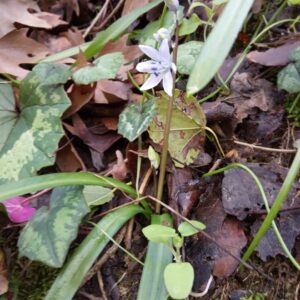
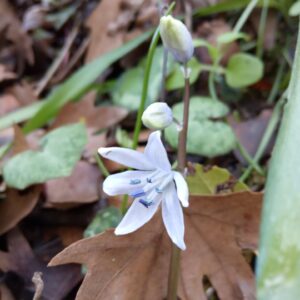
Scilla morrisii, a member of the Asparagaceae family, is commonly known as Morris's Squill. A frequent synonym found in older botanical literature is Scilla bifolia (misapplied). This delicate bulbous perennial is strictly endemic to the island of Cyprus, where it finds sanctuary in very specific, shaded micro-habitats.
Cypriot Names
Σκίλλα του Μόρρις, Μουτσιοκάμαρος.
Common English Names
The primary English name is Morris's Squill, honoring Sir Daniel Morris for his early botanical contributions. It is also called the Cypriot Woodland Squill, highlighting its preference for the deep shade of mountain forests. This species is one of the most protected endemics on the island due to its extreme rarity.
Etymology of Scilla morrisii
The etymology of the genus name "scilla" derives from Ancient Greek "σκίλλα" which means "squill". This Scilla was named "morrisii" in honour of Hubert Meredydd Morris.
Growth Habit and Stature
Scilla morrisii is a perennial bulbous herb growing up to 35cm tall, but it is usually seen reaching around 20cm tall. Its flowers are hermaphrodite, and they appear solitary or in lux racemes. Its perianth is campanulate and consists of 6 glabrous segments which are ovate to elliptic, white tinged blue or violet.
Geographical Distribution and Ecological Niche
Endemic Range
Scilla morrisii is strictly endemic to Cyprus and found nowhere else. Its distribution is fragmented, with primary populations located in the Kykkos forest and the northern Troodos slopes. It is a rare sight, even within these protected areas, requiring very specific environmental conditions to thrive.
Forest and Limestone Habitat
This species is a specialist of the Cyprus Cedar (Cedrus brevifolia) and Golden Oak (Quercus alnifolia) forests. It thrives in mossy banks and limestone boulders where moisture is retained. It is highly sensitive to sunlight and is almost never found in open, exposed terrain. Scilla morrisii can be found in some locations, mainly in Paphos district (for example Kritou Terra waterfalls, Agios Neophytos monastery area, Agia Moni monastery area) as well as in northern Cyprus (for example Akanthou village).
Altitude and Flowering Period
Scilla morrisii is encountered on the shaded ground under the trees of Quercus infectoria subspecies veneris at an altitude between 25-1000 metres. Its flowering period is between January and April.
Is Scilla morrisii Suitable For Gardens?
When considering "Is Scilla morrisii Suitable For Gardens?", the answer is no. As a protected endemic, it is illegal to collect from the wild. Its need for high-altitude forest microclimates makes it nearly impossible to grow in standard gardens, where it would quickly perish from heat.
Life Cycle and Survival
Seasonal Blooming
Flowering occurs from January to April, often following the snowmelt in the mountains. The plant returns annually from its bulb. Once the short spring ends and the canopy closes, the leaves wither away by early summer, and the plant disappears entirely from view until the following year.
Conservation and Stress Tolerance
The Morris's Squill is listed as "Vulnerable" or "Endangered." While it handles cold well, it is extremely sensitive to habitat changes and overgrazing. Protecting the ancient forest floors where it resides is the only way to ensure this botanical ghost continues to survive in the wild.
Exciting Facts About Scilla morrisii
A Botanical Ghost
Because it is small and grows in deep shade, Scilla morrisii is notoriously difficult to find. Many forest visitors walk past it without ever noticing the pale blue stars among the leaf litter. This elusive nature has earned it the nickname "botanical ghost" among local plant hunters.
The Shadow Dweller
Unlike many spring bulbs that need sun to thrive, this squill has adapted to very low light levels. It can photosynthesize effectively in conditions that would be too dark for other Mediterranean flowers, allowing it to occupy unique niches where there is very little competition for space.
Protected by the Cedar
The health of this plant is intrinsically linked to the endemic Cyprus Cedar. The cedar forests provide the necessary acidic mulch and shade. Therefore, the survival of Scilla morrisii serves as a direct indicator of the health and stability of the entire ancient forest ecosystem.
How to identify Scilla morrisii
Scilla morrisii is similar to Scilla lochiae.
- A main difference is that Scilla lochiae bears flowers with a distinct perianth-tube and Scilla morrisii the opposite.
- Scilla morrisii usually has 3 leaves and Scilla lochiae 2.
- Scilla lochiae grows on the Troodos Mountains range and the surrounding mountains at a significant altitude of 25–1000 metres.