Date Created: 16.04.2026
Last Modified: 07.05.2026
Serapias bergonii, commonly known as Bergon's Tongue-orchid, is an elegant terrestrial orchid belonging to the Orchidaceae family. In Cyprus, it is an indigenous and relatively frequent species found in moist meadows, grassy pastures, and open pine forests. A common synonym frequently encountered in older botanical literature is Serapias vomeracea subsp. laxiflora.
Cypriot Names
The official Latin name translated into Greek is Σεραπιάς του Μπεργκόνι.
Common English Names
- Bergon's Tongue-orchid
- Lax-flowered Tongue-orchid
Etymology of "Serapias bergonii"
The etymology of the genus name "Serapias" is derived from the Ancient Greek "Σέραπις" [Serapis], an Egypto-Hellenistic deity. The name was traditionally associated with orchids believed to have aphrodisiac properties. The specific epithet "bergonii" honors the French botanist Paul Bergon (1863–1912), who specialized in the study of European orchids.
Synonyms
- Serapias vomeracea subsp. laxiflora (Soó) Gölz & H.R.Reinhard
- Serapias laxiflora Chaub.
- Serapias vomeracea var. laxiflora (Chaub.) Briq.
- Serapias bergonii f. cilentana Presser
- Serapias bergonii var. politisii (Renz) H.Sund.
- Serapias politisii Renz
- Serapias vomeracea subsp. bergonii (E.G.Camus) H.Baumann & Künkele
Key Characteristics for Diagnostic Identification
According to the definitive botanical keys established by Robert Desmond Meikle (1923–2021) in his comprehensive Flora of Cyprus, this species is distinguished by several specific morphological features:
- Epichile Length: The epichile measures (10-)12-18(-20) mm long, which is significantly longer than those of S. parviflora or S. aphroditae.
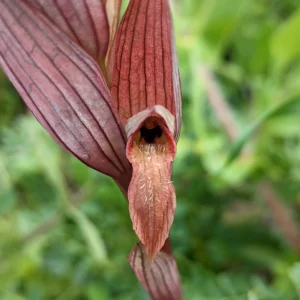
- Hypochile Shape: The hypochile is distinctly reniform to obcordiform and is rarely cuneate at the base.
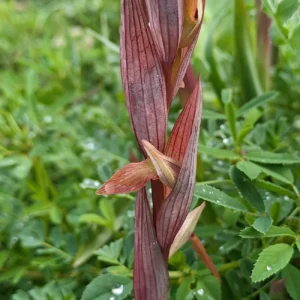
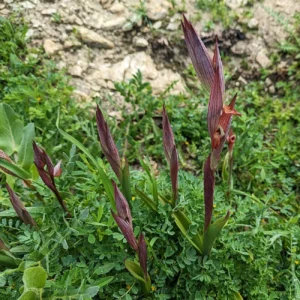
- Inflorescence: The spike is typically lax and few-flowered, with the flowers reaching significantly above the leaves.
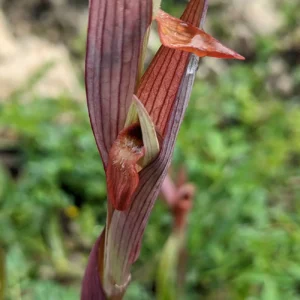
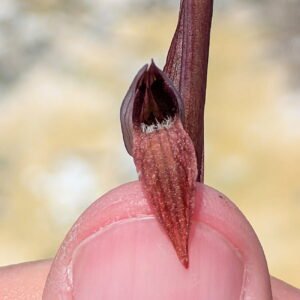
- Bracts: The floral bracts are often tinted purplish-red and are longer than the sepals, forming a hood-like structure over the flower.
Botanical Structure and Floral Details of Serapias bergonii
Vegetative Morphology
The plant typically reaches a height of 10 to 40 cm. It arises from two or three ovoid, sessile tubers. The leaves are linear-lanceolate, unspotted, and usually concentrated at the base of the stem, becoming smaller and bract-like as they ascend.
Reproductive Organs
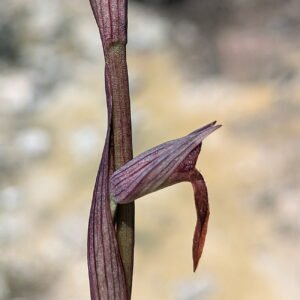
The flowers are zygomorphic and lack a spur. The sepals and petals are connivent, forming a pointed "helmet." The labellum is divided into two parts: the basal hypochile, which is partly enclosed by the helmet, and the drooping epichile, which is covered in fine, translucent hairs.
Geographical Distribution and Habitat of Serapias bergonii
Distribution in Cyprus
In Cyprus, the species is widely distributed. It is frequently recorded in the Akamas peninsula, the Kyrenia range, and notably throughout the Limassol district, especially in the chalky hills and moist valley floors.
Presence and Habitat Elsewhere
Beyond Cyprus, the species is found throughout the Eastern Mediterranean, including Greece, Turkey, and Israel. It is a resilient orchid that can colonize disturbed sites, provided the essential mycorrhizal fungi are present in the soil.
Elevation Range in Cyprus
The species occurs from near sea level up to approximately 1,100 meters. While more frequent in the lowlands, it reaches much higher into the foothills of the Troodos range than previously assumed, thriving wherever seasonal moisture is retained.
Flowering Period in Cyprus
The flowering period in Cyprus occurs from March to May. The peak bloom is typically reached in mid-April, coinciding with the lush vegetative growth of the spring season.
Conservation Status in Cyprus
The species is currently classified as Least Concern (LC). While it is relatively common, individual populations remain vulnerable to habitat destruction through agricultural expansion and land development.
Is Serapias bergonii Suitable for Gardens?
This orchid is not suitable for traditional gardens. Like most terrestrial orchids, it relies on a complex symbiotic relationship with soil fungi. Transplanting these orchids usually results in failure and the death of the plant.
Toxicity and Safety
There are no known toxic properties associated with Bergon's Tongue-orchid. However, like all orchids in Cyprus, it should not be harvested or consumed, as many species are protected by local and international law.
Medicinal Properties
There are no recognized medicinal uses for this plant in modern pharmacology. Historically, tubers of the genus Serapias were sometimes used to produce salep, a nutritious flour, but this practice is now discouraged due to conservation concerns.
Fascinating Insights About Serapias bergonii
Shelter for Insects
Authoritative studies on the pollination biology of Serapias, as noted by Dafni (1987), have shown that the "helmet" formed by the flowers provides a warm, dry refuge for insects. Solitary bees are known to sleep within these structures to escape the cool Mediterranean nights.
Deceptive Pollination Strategies
Expert research confirms that Serapias bergonii produces no nectar and relies on visual and structural deception. A study in the Plant Systematics and Evolution journal indicates that insects are lured by the promise of shelter rather than food, making it an "obligate shelter-mimic."
The "Drunken" Bee Phenomenon
According to observations by van der Cingel (1995), bees exiting the flowers of Serapias can appear sluggish. While once thought to be a chemical effect, it is now understood that the bees are simply warming up their flight muscles after resting in the protected floral tube.
Specific Fungal Symbiosis
Expert ecological analysis published in Molecular Ecology identifies that this species has a high specificity for Tulasnella fungi. The orchid is almost entirely dependent on these fungal partners for nutrient uptake in the nutrient-poor soils of the Mediterranean garrigue.