Date Created: 18.05.2022
Last Modified: 10.04.2026
Anthemis rigida (Sibth. & Sm.) Boiss. is the botanical name for the Rigid Chamomile, a small, prostrate annual member of the Asteraceae family. It is also known by the common synonym Anacyclus rigidus (Sibth. & Sm.) Weiss. This plant is a specialist of rocky Mediterranean shores, easily recognized by its stiff, thickened stems and resilient habit.
Cypriot Names
Άνθεμις η τραχεία
Common English Names
- Rigid Chamomile
- Stiff-stemmed Chamomile
- Rayless Chamomile
Etymology of Anthemis rigida
The etymology of the genus name Anthemis comes from the Ancient Greek ἀνθεμίς [anthemis], meaning blooming or a small flower, derived from ἄνθος [ánthos], which is read in English as [ánthos] and means flower. The species name rigida is the feminine form of the Latin rigidus, meaning stiff, inflexible, or unbending, specifically describing the stems that become hard and skeletal as the plant matures.
Synonyms
- Anacyclus rigidus (Sibth. & Sm.) Weiss
- Anthemis rigida subsp. rigida
- Anthemis boissieri Stoj. & Acht.
- Chamaemelum rigidum (Sibth. & Sm.) All.
- Anthemis cupaniana Tod. ex Nyman
Key Characteristics for Diagnostic Identification
According to the definitive botanical keys established by Robert Desmond Meikle (1923–2021) in his comprehensive Flora of Cyprus, this species is distinguished from other local Anthemis taxa by:
- Stem Rigidity: The stems are notably thickened and become stiff and unbending even during the flowering stage, unlike the soft, flexible, and herbaceous stems found in Anthemis arvensis.
- Receptacle Scales: In Anthemis rigida, the scales on the receptacle are oblong-spathulate and abruptly narrowed into a short point, whereas in Anthemis cotula, the scales are linear-subulate or awl-shaped.
- Fruiting Peduncles: After flowering, the peduncles (flower stalks) become conspicuously thickened, hardened, and curved, a characteristic diagnostic feature that is entirely absent in the slender-stemmed Anthemis pseudocotula.
- Ray Florets: This species often lacks the white ray florets (petals) entirely, appearing "rayless," or possesses very short, inconspicuous ones, unlike the showy and long-rayed Anthemis tricolor.
- Achene Persistence: The fruits (achenes) are persistent and stay firmly attached to the rigid, dried receptacle for many months, whereas most other chamomiles shed their seeds rapidly upon maturity.
Botanical Structure and Floral Details of Anthemis rigida
The Floral Head
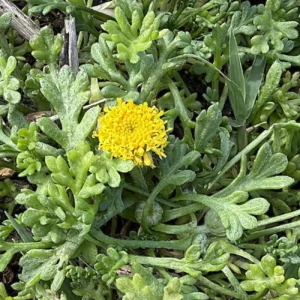
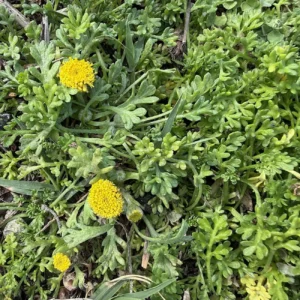
The flower heads are small and solitary, appearing almost button-like due to the frequent absence of white ray florets. The yellow disc florets are densely packed on a conical receptacle. This compact structure is a primary evolutionary defense against the physical battering of wind and salt spray.
Stem and Peduncle Thickening
A unique botanical feature of this species is the secondary thickening of the flower stalks. As the seeds develop, the peduncles expand and harden into a woody consistency. This ensures that the seeds are held close to the ground, protected from being blown away into unsuitable inland habitats.
Foliage and Habit
The leaves are 1-2 pinnatisect, featuring small, fleshy, linear segments. The plant typically forms a prostrate mat that hugs the contours of the rocks. The foliage often has a slightly succulent texture, an adaptation common to "sarcophyllous" plants living in high-salinity coastal environments.
Geographical Distribution and Habitat of Anthemis rigida
The Rigid Chamomile is a strict specialist of the littoral zone. It thrives on rocky sea cliffs, stony maritime heaths, and stabilized coastal dunes. It is highly resistant to salt spray and can grow in the very thin layers of soil that accumulate in limestone crevices.
Distribution in Cyprus
In Cyprus, Anthemis rigida is an indigenous and common plant along the entire coastline. It is particularly well-represented in the Akamas peninsula, the rocky shores of Paphos, and the coastal cliffs of Cape Greco. It is strictly a lowland species, rarely found more than a few hundred meters inland.
Flowering Period in Cyprus
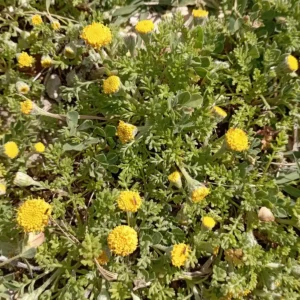
The flowering period in Cyprus occurs from February to May. During these months, the plants carpet rocky shorelines with small yellow dots. By early summer, the plant dies back, but its rigid, skeletal remains and seed heads often persist on the rocks throughout the dry season.
Conservation Status in Cyprus
This species is not listed in the Red Data Book of the Flora of Cyprus. It is classified as "Least Concern" (LC) because it is widely distributed in its natural coastal habitat. However, its specialized niche is sensitive to excessive trampling and large-scale coastal development.
Is Anthemis rigida Suitable for Gardens?
While not a traditional garden plant, it is an excellent candidate for maritime-themed rockeries or coastal xeriscaping. It requires absolute full sun and very well-drained, rocky or sandy soil. Its ability to thrive in poor, saline conditions makes it useful for stabilizing rocky embankments near the sea.
Medicinal and Practical Properties
Unlike the famous Matricaria chamomilla, Anthemis rigida is not widely used in commercial herbalism. However, in traditional Mediterranean folk medicine, related coastal chamomiles were occasionally used in poultices for their minor anti-inflammatory properties. Its primary value on the island is ecological rather than pharmacological.
The plant serves as a critical food source for coastal pollinators during the early spring. Furthermore, its rigid, mat-forming growth habit plays a role in the primary colonization of rocky shorelines, helping to trap wind-blown organic matter and contributing to the slow process of soil formation on bare limestone.
Fascinating Insights About Anthemis rigida
The Skeletal Survivor
The most fascinating aspect of Anthemis rigida is its "post-mortem" existence. Even after the plant has died and turned brown, its stems remain so rigid and strong that they protect the seeds for months. Walking on these dried plants produces a characteristic crunching sound.
Coastal Camouflage
Due to its low profile and the frequent lack of white petals, this chamomile is often overlooked by casual observers. It blends perfectly with the grey limestone and sun-bleached sands of the Cypriot coast. This "cryptic" growth habit protects it from being easily grazed by wandering goats.
Saline Specialization
Most chamomiles would perish if splashed with seawater, but Anthemis rigida has evolved a unique cellular chemistry that allows it to excrete or sequester salt. This allows it to occupy a niche—the very edge of the sea—where there is almost no competition from other plants.
Mechanical Seed Dispersal
Rather than relying on the wind to carry its seeds far away, this plant uses a strategy of "local dispersal." The thickened, curved peduncles eventually break off and roll across the rocks like tiny tumbleweeds, dropping seeds into nearby crevices where they have the best chance of survival.
Indicator of Virgin Coastlines
Finding a healthy population of Rigid Chamomile is often a sign of a "virgin" or undisturbed coastline. Because it grows slowly and requires stable rocky substrates, it is one of the first species to disappear when coastal areas are leveled or modified for human use.