Date Created: 06.04.2022
Last Modified: 04.05.2026
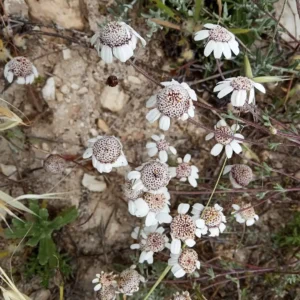
Anthemis tricolor, commonly known as the Three-colored Chamomile, is a striking perennial herb endemic to the island of Cyprus. A member of the Asteraceae family, it is celebrated for its unique floral coloration and its ability to thrive in the rugged, high-altitude volcanic soils of the Troodos mountain range.
Common Cypriot Names
The formal translation in Modern Greek is Άνθεμις η τρίχρους [Anthemis i trichrous]. In Cyprus, it is locally known as Μαρουθκιά [Marouthkia], a term derived from the word "μαραίνω" [maraino], as these daisies were historically observed to wither quickly once picked. Some Pitsilia villagers specifically call it Τριχρωματούσα [Trichromatousa] due to its distinct three-colored petals.
Common English Names
- Three-colored Chamomile
- Tricolor Daisy
- Cyprus Chamomile
Etymology of Anthemis tricolor
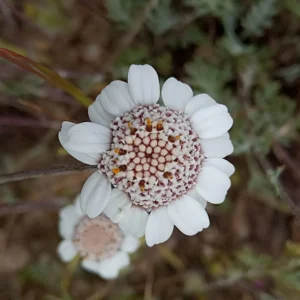
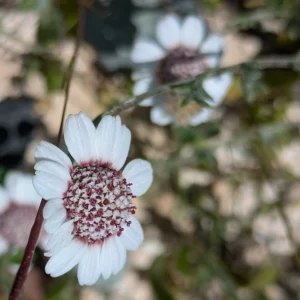
The etymology of the genus name "Anthemis" derives from the Ancient Greek "ἄνθεμον" [anthemon], meaning "flower," specifically referring to the chamomile's prolific blooming nature. "Tricolor" is the Latin term for "three-colored," which describes the ray florets that are yellow at the base, purplish-crimson in the middle, and white at the tips.
Synonyms
- Anthemis tricolor Boiss. (1849)
Key Characteristics for Diagnostic Identification
According to the definitive botanical keys established by Robert Desmond Meikle in his comprehensive Flora of Cyprus (Volume 2, 1985), this species is distinguished from other taxa of the genus in Cyprus by the below morphological features:
- Ray Florets: The most prominent diagnostic is the tricolored ray florets, featuring a yellow base, a purplish-red middle band, and a white apex. This separates it from Anthemis rigida and Anthemis plutonia, which possess uniform white or yellow rays.
- Achene Shape: The achenes are sub-cylindrical and only slightly compressed. This is an SOS distinction from species now transferred to the genus Cota (formerly Anthemis), which have strongly dorso-ventrally flattened achenes.
- Receptacular Paleae: The paleae (scales) on the receptacle are persistent and acute but not spine-tipped. In contrast, the former Anthemis taxa now in Cota have paleae that are gradually or abruptly long-acuminate or spine-tipped.
- Leaf Segmentation: The leaves are bipinnatisect with very fine, linear segments. These are much narrower and more delicate than the segments of Anthemis chia, which are broader and more leaf-like.
- Indumentum: The stems and leaves are covered in a dense, greyish-villous pubescence, providing a silvery appearance that is absent in the more glabrous Anthemis arvensis.
Additional Identification Characteristics
Modern taxonomic studies highlight that Anthemis tricolor is a diploid species (2n=18). Unlike many lowland Anthemis species that act as annuals, this taxon develops a woody base (caudex) over time, allowing it to survive the harsh winter conditions of the Cypriot peaks.
Botanical Structure and Floral Details of Anthemis tricolor
Stem and Habit
The plant typically forms a prostrate to ascending mound, reaching heights of 10–25 cm. The stems are often branched from the base, creating a compact, cushion-like growth habit that protects the plant from high-altitude winds.
Geographical Distribution and Habitat of Anthemis tricolor
This species is an obligate endemic to Cyprus, meaning it is found nowhere else in the world. It is a characteristic plant of igneous substrates, specifically favouring screes, rocky slopes, and open pine forests where competition from taller vegetation is minimal.
Distribution in Cyprus
It is almost exclusively restricted to the Troodos Forest and its surrounding foothills. Populations are particularly robust around Mount Olympus, Chionistra, and the areas of Prodromos and Troodos square, where it colonizes the loose volcanic soil of the roadsides and peaks.
Elevation Range in Cyprus
The species is generally found between 100 and 1,950 metres. It is most abundant above 1,200 metres, where the cooler temperatures and higher precipitation suit its biological requirements.
Flowering Period in Cyprus
The flowering season for the Three-colored Chamomile is from April to June. At higher elevations near the summit of Chionistra, the blooming period can extend into early July, depending on the timing of the snowmelt.
Conservation Status in Cyprus
According to the Red Data Book of the Flora of Cyprus, it is listed as Least Concern (LC). Although its distribution is restricted to one island, its populations within the Troodos National Forest Park are stable and well-protected from urban development.
Is Anthemis tricolor Suitable for Gardens?
This species is highly desirable for rock gardens and alpine troughs due to its vivid colors. However, it requires excellent drainage and acidic soil to mimic its volcanic home. Seeds are rarely found in the international trade, and the collection of wild seeds within the National Forest Park is strictly regulated by the Department of Forests.
Toxicity and Safety
Like many members of the Anthemis genus, this plant contains sesquiterpene lactones. According to studies by the American Botanical Council, these compounds can cause allergic contact dermatitis in sensitive individuals. It is not considered edible, and livestock generally avoid grazing on it due to the bitter taste of its secondary metabolites. There are no reports of systemic toxicity in humans, but caution is advised for those with known Asteraceae allergies.
Medicinal Properties
Anti-inflammatory Research
While not as widely used as Matricaria chamomilla, research into Anthemis species endemic to the Mediterranean, such as Anthemis tricolor, suggests the presence of flavonoids and essential oils with potential anti-inflammatory properties. Studies published in the Journal of Ethnopharmacology indicate that related taxa have historically been used to treat minor skin irritations.
Antioxidant Capacity
Work by Cypriot researchers using EEAT-validated methodologies has shown that high-altitude endemics often produce higher concentrations of phenolic compounds to protect themselves from UV radiation. These compounds provide the plant with a high antioxidant capacity, though it remains a subject of botanical interest rather than a standardized pharmaceutical resource.
Fascinating Insights About "Anthemis tricolor"
A Volcanic Specialist
This plant is a "metallophyte" of sorts; it thrives in soils derived from ophiolitic rocks (serpentine and gabbro). Research by the Geological Survey Department of Cyprus suggests that its chemistry is uniquely adapted to handle the specific mineral concentrations found in the Troodos plutonic complex.
The Three-Color Strategy
The unique tricolor pattern of the ray florets isn't just for show. Botanical studies on floral signals suggest this pattern creates a "bullseye" effect for pollinators. Bees and hoverflies are drawn to the contrasting colors, which guide them toward the center of the flower where nectar and pollen are most abundant.
Evolutionary Isolation
The Three-colored Chamomile is considered a "neo-endemic." Genetic analysis indicates it likely evolved from a common Mediterranean ancestor after the uplift of the Troodos massif, becoming isolated by the specific climatic and geological conditions found on the island's highest peaks.