Ατρακτυλίς η εσχαρωτή
Etymology of Atractylis cancellata
The genus name, Atractylis, originates from the Greek word "ἀτρακτός" (atraktos), meaning "spindle." This refers to the long, sharp spines often found on the involucral bracts (the protective leaves surrounding the flower head) of plants in this genus. These spines can resemble the pointed tip of a spinning spindle, a tool historically used for drawing out and twisting fibers.
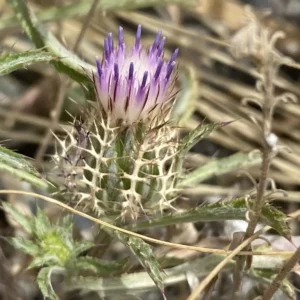
The specific epithet, cancellata, comes from Latin, meaning "latticed," "cross-banded," or "reticulated." This term describes the unique appearance of the plant's bracts or the overall structure of the flower head. In the case of Atractylis cancellata, the involucral bracts often form a distinct, cage-like or net-like pattern around the flower head, which is why the plant is commonly known as "Cage Thistle."
Geographical distribution
Atractylis cancellata has a broad native range extending across the Mediterranean Basin and into Western Asia and the Arabian Peninsula. Specifically, it is found in Southern Europe, North Africa, Middle East and West Asia.
Habitat of Atractylis cancellata
The plant typically thrives in dry, well-draining, and often stony or rocky soils, commonly found in coastal areas, open dry shrublands (garrigue and phrygana), and disturbed grounds such as field margins and roadsides. It exhibits a strong preference for calcareous (limestone-derived) soils, which tend to be alkaline or neutral-alkaline. While it can tolerate poor soil conditions, it flourishes best where there is moderate nutrient availability and excellent drainage to prevent waterlogging. Its resilience to drought is a key factor in its successful colonization of these arid to semi-arid Mediterranean landscapes, including areas like the Negeb and Dahna deserts.
Key morphological characteristics
Habit and Size
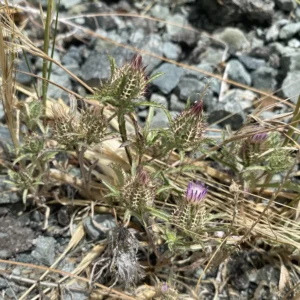
Atractylis cancellata is an annual herbaceous plant, meaning it completes its life cycle within one growing season. It typically grows to a modest size, usually ranging from 5 to 30 centimeters in height, though it can occasionally reach up to 50 cm. The plant has a somewhat bushy or sprawling habit, often with multiple stems branching from the base. Its overall appearance can be quite distinctive, especially when the characteristic flower heads develop.
Leaves
The leaves of Atractylis cancellata are generally oblong to oblanceolate (wider at the tip and tapering towards the base) and can be quite variable in shape and size. They are typically deeply pinnatifid or pinnatisect, meaning they are deeply lobed or divided into segments that reach almost to the central vein, giving them a thistle-like appearance. Both the leaves and the stems are often somewhat hairy or glandular. The margins of the leaf segments are usually spiny or toothed, contributing to its thistle common name.
Flower Heads (Capitula) and Involucre
The most striking morphological feature of Atractylis cancellata is its flower head, or capitulum, and especially its involucre. The capitula are discoid, meaning they consist entirely of disc florets (no ray florets like a daisy). They are relatively small, typically 1-2 cm in diameter. The florets themselves are usually yellow or yellowish-white.
However, the defining characteristic, and the reason for its "cancellata" (latticed) epithet and common name "Cage Thistle," lies in the involucral bracts. These are the modified leaves that surround and enclose the base of the flower head. In Atractylis cancellata, these bracts are highly specialized. The outer bracts are spine-tipped, while the inner bracts are flattened, often reticulate (net-veined), and can be fused or closely overlapping to form a distinctive cage-like, net-like, or latticed structure around the developing and mature capitulum. This unique involucral structure is a crucial diagnostic feature and makes the plant easily recognizable.
Fruit (Achenes) and Pappus
Like other members of the Asteraceae family, the fruit of Atractylis cancellata is an achene. These are small, dry, single-seeded fruits. Each achene is typically topped with a pappus, which is a structure of modified hairs that aids in wind dispersal. In Atractylis cancellata, the pappus consists of feathery bristles, which allow the seeds to be carried by the wind once the flower head matures and the cage-like involucre opens.
Atractylis cancellata in Cyprus
The plant is found all around Cyprus, and it is more common in the Limassol and Paphos districts. It appears up to elevations of 750 meters. Its flowering period is usually between March and June.