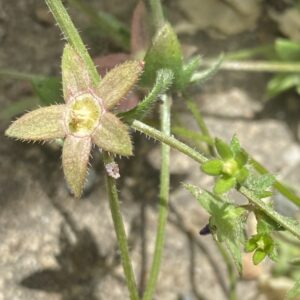
Καμπανούλα η έρινος
Etymology of Campanula erinus
"Campanula" both in Latin and Modern Greek "καμπανούλα" means "little bell", and it was named as such due to its bell-shaped flowers. The origin of the epithet "erinus" is traced back to the Greek erinos [ἔρινος], the name of a diminutive, blue-flowered herb mentioned by ancient Greek authors, but irrelevant to this one. While the exact botanical identity of the ancient erinos is debated, its application to Campanula erinus suggests early botanists saw a resemblance in some way with that unknown plant. Modern Greeks do not call any plant "erinos" nowadays.
Campanula species in Cyprus
There are six Campanula species in Cyprus, of which one grows exclusively in northern Cyprus, and another one (Campanula podocarpa) is considered regionally extinct; it was last recorded in 2015.
The habitat of Campanula erinus
Campanula erinus is a plant of the Mediterranean region, with a distribution that spans Southern Europe, North Africa, and parts of Western Asia. It is found across a range of countries, including Portugal, Spain, France, Italy, Greece, Cyprus, Turkey, and extends into North African countries like Morocco, Algeria, and Tunisia.
Within these Mediterranean areas, Campanula erinus favours dry, sunny habitats. It commonly occurs in rocky places, such as slopes and crevices, roadsides, and can be found growing on walls, in sandy or stony ground, and within garrigue and maquis vegetation. It also adapts to human-disturbed areas like cultivated fields.
Campanula erinus in Cyprus
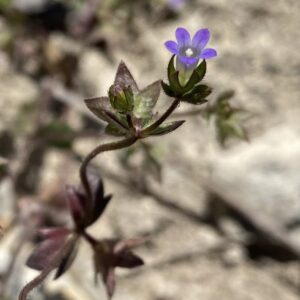
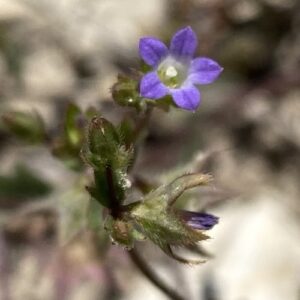
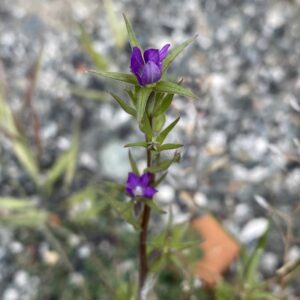
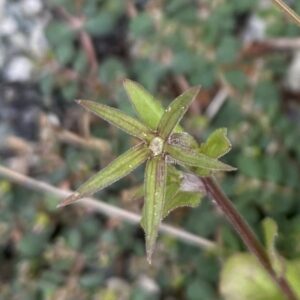
Campanula erinus, commonly known as Annual Bellflower or Fairy Thimbles, is a small, delicate annual herbaceous plant, typically reaching heights of just a few centimeters to about 20 cm. It has slender, often branched stems with small, alternate, and somewhat hairy leaves that are usually lanceolate to ovate in shape. The flowers are small and bell-shaped, characteristic of the Campanula genus, and are typically a pale blue to violet color. Its flowering period in Cyprus is between March and July.