Date Created: 10.10.2026
Last Modified: 14.10.2026
Common Cypriot Names
A descriptive Modern Greek rendering of the scientific name is Καρλίνα η εριώδης [Karlina I Eriodis], meaning “woolly Carlina”; the adjective refers to the woolly covering described in the botanical literature.
Common English Names
- Purple carline thistle — recorded by the European and Mediterranean Plant Protection Organization’s EPPO database.
- Wooly carline thistle — used in published botanical research; woolly carline thistle is the alternative spelling.
Etymology of Carlina lanata
The etymology of the genus name Carlina is explained by the University of Trieste’s botanical portal as a derivation from cardulina, meaning a small thistle. A different explanation, repeated in botanical literature, associates the name with Charlemagne and a legend about a medicinal thistle; that story should be treated as a naming tradition, not evidence of a cure. The specific epithet lanata means “woolly” and describes the whitish, wool-like hairs covering the plant. The University of Trieste explicitly connects the epithet with this covering, making it a useful reminder of a visible identification feature.
Synonyms
No homotypic synonyms are reproduced here. The current POWO record places all four names in its synonym list under “Heterotypic Synonyms”; including them would therefore conflict with the requirement to list only homotypic names.
Key Characteristics for Diagnostic Identification
The following identification notes combine the species description in Flora of Iraq, published through Kew, with the University of the Balearic Islands’ independent account. Comparisons with C. pygmaea use the Akamas Visitor Centre and the specimen-based observations of botanists Karl Peter Buttler, Georgios Hadjikyriakou and Ralf Hand. These sources support several useful distinctions, but also demonstrate why height, colour or the appearance of a single photographed head should not determine an identification.
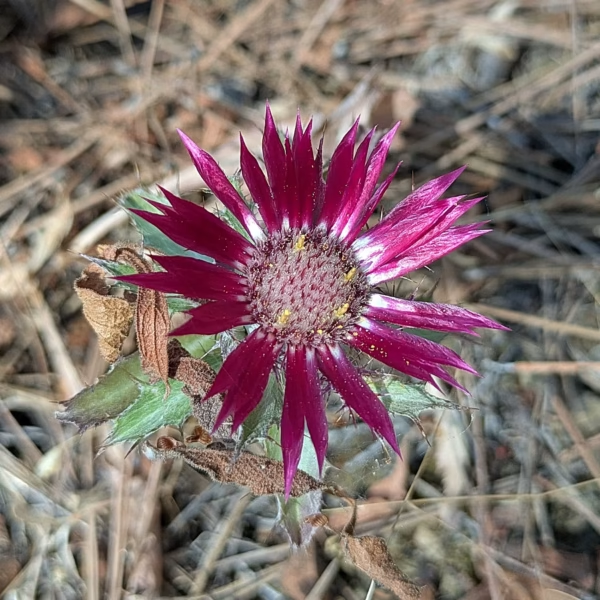
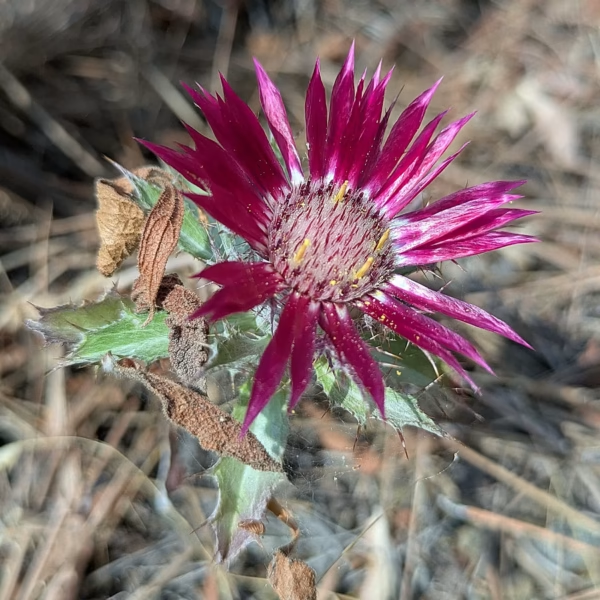
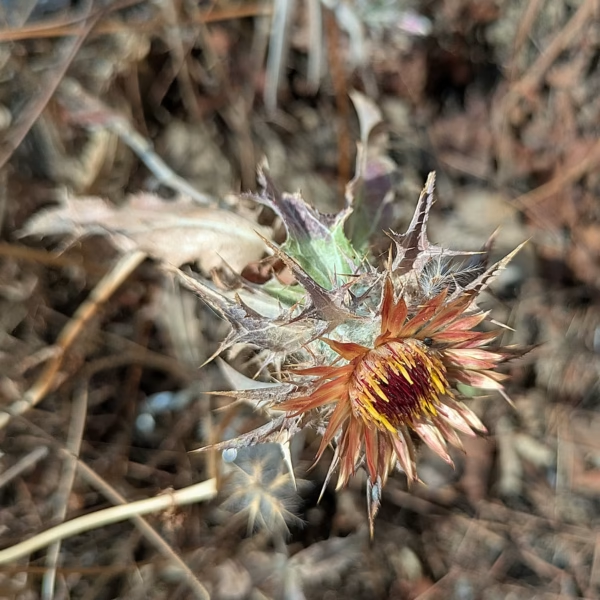
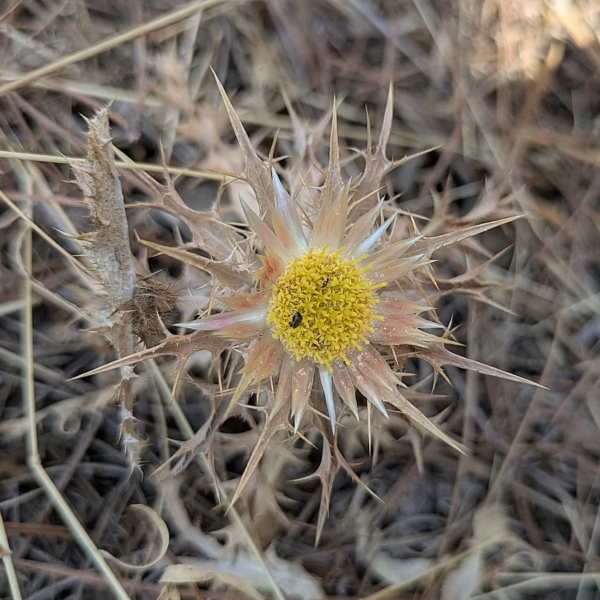
- Green structures surrounding the head: A conspicuous leafy, spiny surround is confirmed for the annual species by two institutional sources. Kew describes leaves approximately 3–4 cm long around the heads, resembling the outermost involucral bracts. The University of the Balearic Islands independently describes large, spine-bearing exterior bracts. This supports your observation that green structures extend immediately around the flowering head. However, neither account establishes their complete absence in C. pygmaea. “Green collar present versus head always naked” is therefore not a verified binary identification rule.
- Annual versus perennial growth: Life history provides a stronger distinction than apparent nakedness around the head. Kew identifies the subject as annual; the Akamas Visitor Centre describes C. pygmaea as a perennial with a thick taproot. Where the plant’s growth history is known, survival and renewed growth from an established root help distinguish the perennial. This character should be assessed without uprooting wild plants.
- Leaf covering and attachment: The annual has woolly to densely felted leaves. Its stem leaves partly clasp the stem and are deeply divided, with long, outward-pointing spines. In C. pygmaea, the Cyprus researchers describe the leaves as generally rigid and spiny, while recording an unusually soft-leaved specimen. Spiny leaves alone do not separate the two: examine their covering, arrangement and attachment together with the plant’s life history.
- Stem development and overall height: The annual normally develops an evident upright flowering stem. Nevertheless, a tall plant cannot automatically be excluded from C. pygmaea. Buttler, Hadjikyriakou and Hand documented specimens of that usually dwarf species with stems reaching 56 cm. Their findings specifically qualify the familiar picture of a small, almost stemless plant.
- Inner bract colour: The University of the Balearic Islands describes the annual’s inner bracts as reddish and petal-like. The Akamas Visitor Centre records pink to wine-purple colouring in C. pygmaea. The colours overlap, so a purple or reddish ring supports recognition of these plants but does not independently separate them.
Geographical Distribution and Habitat of Carlina lanata
Kew places the species’ native range across the Mediterranean region and eastwards to northwestern Iraq. It is therefore a broadly Mediterranean plant rather than a narrowly restricted island species. The University of Trieste associates it with dry pasture and disturbed margins, while the University of the Balearic Islands records dry fields, uncultivated ground and roadsides. These accounts describe its wider ecological setting; individual localities and national abundance require separate evidence.
Distribution in Cyprus
A directly documented locality is the Pendakomo area, where Agricultural Research Institute botanist Athena Della included the species in Flora of a Valley in the Pendakomo Area, Miscellaneous Report 52. Her account lists preserved ARI specimens, including ARI 3258 and ARI 3626–3628. These vouchers provide a stronger basis for confirming occurrence than an unattributed distribution statement: they connect the identification with material retained for examination. The report establishes its presence within the surveyed valley, but is not an island-wide distribution census.
Elevation Range in Cyprus
The taxon has been recorded up to a height of 1075 metres in Cyprus.
Flowering Period in Cyprus
Its flowering period ranges between June and October.
Is Carlina lanata Suitable for Gardens?
Its dry-ground ecology, annual habit and coloured bracts make it a plausible candidate for a sunny, freely draining wildflower planting. This is an ecological assessment rather than a species-specific cultivation trial. Its sharp foliage makes placement away from narrow paths sensible. A 2020 paper in Plants reports that its ornamental value was already recognized in Europe during the 1620s, although that paper’s propagation experiments concern a different species. No current commercial seed supplier was verified during this research, so historical cultivation should not be mistaken for present availability.
For a garden in Cyprus, obtain correctly identified, legally sourced propagated material. The Department of Forests has issued a public notice concerning unlawful cutting, collection and uprooting of wild flora. Before collecting seed or removing plants, establish the rules applicable to the particular site and obtain any required authorization; the notice does not establish unrestricted collection rights for this species.
Toxicity and Safety
Physical Hazards
The directly established handling hazard is its rigid, spine-bearing foliage and exterior bracts, described by the University of the Balearic Islands. Gloves are a practical precaution when handling cultivated plants or dried heads. This precaution addresses punctures and scratches; the cited botanical description does not establish a chemical poisoning syndrome. Neither the presence of traditional medicinal records nor the absence of a verified poisoning report demonstrates that eating the plant or using a homemade extract is safe.
What the Chemical Research Actually Shows
İbrahim Teğin, Uyan Yüksel and Gurbet Canpolat of Siirt University presented a 2018 elemental analysis of material collected near Akdoğmuş, Turkey. Botanist Mehmet Fidan identified the material, and a voucher was retained at the university herbarium. The researchers used ICP-OES to measure elements in acid-digested plant samples, including lead, cadmium and arsenic. This was an elemental-analysis study, not a human safety trial. Its reported solution concentrations cannot be treated directly as concentrations in a serving of tea or food, and one collection cannot characterize every population. It provides no safe preparation, therapeutic dose or assurance of safety for pregnancy, children or prolonged use.
Medicinal Properties
Recorded Traditional Medicinal Use
There is a documented medicinal-literature connection for Carlina lanata. Kew’s Medicinal Plant Names Services links the species to both the Sardinian and Sicilian subsets of Marco Leonti and colleagues’ 2009 ethnobotanical comparison. This is meaningful evidence that the name occurs in sources recording medicinal use. However, the accessible database record does not specify the treated condition, plant part, preparation or dose, so none of those details should be invented.
Traditional Records and Treatment Evidence
Leonti, Laura Casu, Francesca Sanna and Leonardo Bonsignore published their comparison in the Journal of Ethnopharmacology. Their work, affiliated with the University of Cagliari’s Faculty of Pharmacy, examined published medicinal traditions and their relationship with Dioscorides’ De Materia Medica. It was an ethnobotanical and historical comparison, rather than a clinical trial testing this species. Consequently, its inclusion in medicinal records does not establish an effective treatment, a standardized extract or a safe dosage. No species-specific human clinical evidence was verified in the material reviewed.
Evidence Must Remain Species-Specific
Research on medicinal roots sold as Carlinae radix commonly concerns other members of the genus. The 2020 review accompanying the ornamental propagation study explicitly associates that material with C. acaulis and C. acanthifolia. Their reported traditional uses and experimental activities cannot be assigned to the present species merely because they share a genus. Similarly, the Italian ethnobotanical records above do not establish a Cypriot medicinal tradition. No verified local preparation or therapeutic indication is asserted here.
Fascinating Insights About “Carlina lanata”
The Apparent Petals Are Bracts
The reddish structures that make the head attractive are described by the University of the Balearic Islands as inner bracts resembling petals. Botanically, they belong to the involucre surrounding the flower head. Kew’s genus account distinguishes these conspicuous inner bracts from the actual florets. This matters when describing or photographing the plant: the coloured ring and the central mass of small flowers are different structures, even though together they resemble one large flower.
Summer Flowers Attract Recorded Bee Visitors
Mavromoustakis’s observations connect the plant with the bee Tarsalia ancyliformis subsp. mediterranea, which visited its flowers in late July and August. Grace’s monograph also includes it among the flower resources visited by Ceratina chrysomalla on the island. These records give its ecological interest a concrete foundation: named bees were observed using its flowers. Flower visitation alone, however, does not measure pollination efficiency or prove that either bee depends exclusively on this plant.
Its Ornamental Appeal Has a Long History
The 2020 article in Plants traces recognition of this species’ ornamental value to Europe in the 1620s. That historical reference predates the publication of its accepted Linnaean name in 1753. The two dates describe different events: gardeners and botanical writers could recognize an attractive plant before modern scientific nomenclature formally named it. Its horticultural history is therefore older than the name used today, although it does not establish continuous cultivation or a current seed trade.