Καρλίνα η λιβανοτική
Etymology of Carlina libanotica
The etymology of the Carlina libanotica is a combination of two distinct origins. The genus name, "Carlina", is traditionally attributed to the legendary Frankish emperor Charlemagne (Carolus Magnus in Latin). According to a medieval legend, an angel appeared to Charlemagne and revealed that the root of this plant would be a cure for the plague. While this story is likely apocryphal, the name has endured. The specific epithet, "libanotica", derived from the Latinized form of "Libanus," which is the ancient name for Mount Lebanon, marking the plant’s primary region of origin. Thus, the name means "Charlemagne's plant from Lebanon."
Botanical Description
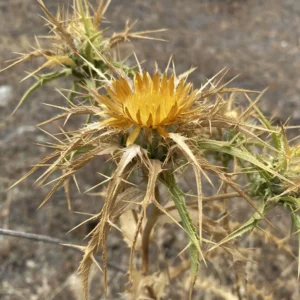
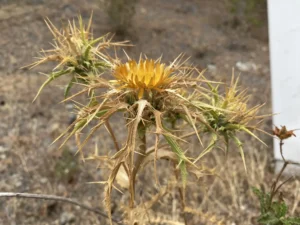
Carlina libanotica is a perennial, meaning it lives for more than two years. It typically grows to a height of 30-50 cm, with an upright stem that can be simple or branched. Both the stem and the leaves are covered in a woolly, pubescent layer, giving the plant a soft, fuzzy texture. The leaves are oblong-lanceolate to oblong-elliptic and have spiny edges, a characteristic feature of many thistles.
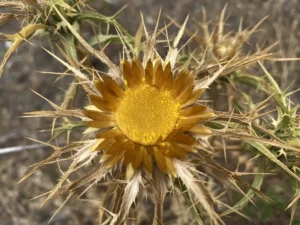
The flower heads, known as capitula, are a defining feature of the plant. They are quite large, measuring 25-40 mm in diameter. The capitula are surrounded by multiple layers of bracts, called phyllaries. The innermost of these phyllaries are particularly notable, as they are a brilliant golden-yellow color and have the appearance of ligulate ray florets, which helps to attract pollinators. The actual florets within the flower head are tubular in shape. Carlina libanotica flowers from summer into autumn.
Natural Habitat
Carlina libanotica thrives in rocky and mountainous landscapes. It is commonly found on dry, sunny slopes, open clearings, and meadows with poor, stony soil. The plant is highly adapted to drought thanks to its deep roots, which allow it to survive in challenging environments where few other species can persist.
Geographical Range of Carlina libanotica
Carlina libanotica is known to grow in the Anti-Lebanon mountains, Mount Hermon, and other mountain ranges in Lebanon and Syria. It has also been documented in Cyprus and Turkey, indicating a wider, but still localized, distribution.
Flowers That Remain Attractive After Drying
The flower heads of Carlina libanotica are extraordinary because they remain attractive even after drying. Unlike many blooms that wither away, these flowers keep their papery beauty for months. This “everlasting” quality has made them popular for decorative purposes, and in folk symbolism, they represent resilience, immortality, and protection.
Carlina libanotica in Cyprus
Carlina libanotica is considered an indigenous species to Cyprus. This means it is native to the island but is also found in other parts of the world. It is not an endemic species, a distinction held by other plants in the same genus, such as the Carlina pygmaea, the "Cyprus Carline."
Geographical Range: The plant is found in various parts of the island, thus it's a relatively popular plant of the summer. Its presence is documented at a wide range of altitudes, from sea level up to around 1525 meters, which is a testament to its adaptability.
Preferred Habitat: In Cyprus, it typically thrives in open, dry, and rocky environments. It can be found primarily along roadsides (for example, Pano Polemidia municipality in Lemesos district, at 75 meters, and Fini village, Lemesos district, at 975 meters), in pastures, and on mountain slopes, where it is well-adapted to the island's Mediterranean climate of hot, dry summers and mild, wet winters. Its ability to grow in these challenging, well-drained soils is a key to its survival.
Flowering Period: The flowering period of Carlina libanotica in Cyprus is usually between July and October.