Date Created: 10.10.2026
Last Modified: 10.10.2026
Common Cypriot Names
The formal Greek botanical name is Καρλίνα η πυγμαία [Karlina I Pygmaia], recorded by Cyprus Post in its Greek plant account and by Dr Kyriaki Zannettou-Panteli in her botanical reference. “Πυγμαία” means dwarf or diminutive, describing the plant’s typical stature. The genus name is rendered in Greek as “Καρλίνα” [Karlina].
Common English Names
- Dwarf carline thistle
- Carline
The first name is documented in Wildlife Travel’s field report, while Zannettou-Panteli records “Carline.” The shorter name is shared with other members of the genus. These are verified names; additional informal translations should not be presented as established common names without supporting records.
Etymology of Carlina pygmaea
The etymology of the genus name Carlina is traditionally associated with Charlemagne, or Charles the Great. The Flora of Iraq account reproduced by Royal Botanic Gardens, Kew, relates it to a story that he used a plant of this genus against an epidemic among his troops; see the genus treatment. This is a naming tradition, not clinical evidence. The epithet pygmaea is the feminine form of Latin pygmaeus, meaning “pygmy” or “dwarf,” ultimately connected with Ancient Greek “πυγμαῖος” [pygmaios], describing the plant’s typical stature.
Key Characteristics for Diagnostic Identification
The comparisons below concern only Carlina lanata. Their principal sources are the Akamas Visitor Centre’s local description, Cyprus herbarium observations published by K. P. Buttler, Georgios Hadjikyriakou and Ralf Hand, and the Flora of Iraq treatment edited by S. A. Ghazanfar, J. R. Edmondson and D. J. N. Hind. Perennial versus annual life history is the strongest verified distinction in these sources. Several visible features overlap, so a compact plant with a purple head is not automatically identifiable.
- Life history: The target is a perennial, according to the Akamas description. In contrast, Carlina lanata is an annual in Kew’s reproduction of the Flora Iraq account. Confirmed survival and renewed growth over successive seasons therefore provide stronger evidence than a single measurement or photograph.
- Root and persistent crown: The local Akamas account describes a thick taproot in the perennial plant. A persistent crown supports identification against the annual Carlina lanata. However, the sources do not establish a non-overlapping difference in root dimensions, and the presence of a taproot alone is insufficient. Wild plants should not be uprooted to check this feature.
- Typical stature: The target usually reaches approximately 5–10 cm, occasionally 30 cm in the Akamas description. Carlina lanata commonly reaches 10–35 cm, with a wider published range of approximately 3–45 cm. The height ranges overlap. Cyprus herbarium research additionally records target stems reaching 56 cm; see the 2004 specimen study. A tall specimen therefore cannot be excluded solely because of its size.
- Leaves: Carlina lanata has woolly to felted foliage and partly stem-clasping, deeply divided upper leaves with spreading spines, according to the institutional flora. The target generally has rigid, spiny leaves, although an unusually soft-leaved specimen is documented. Rigidity and woolliness describe different properties; the cited evidence does not establish that the target always lacks woolly hairs. Leaf texture must be assessed alongside life history.
- Stem development and branching: Carlina lanata develops an erect, hairy stem that can be simple or branched. The target is often compact or nearly stemless, but robust erect forms occur. Consequently, a conspicuous annual flowering stem supports the comparator, while an established compact perennial supports the target. Branching and stem length remain supporting characters rather than absolute distinctions.
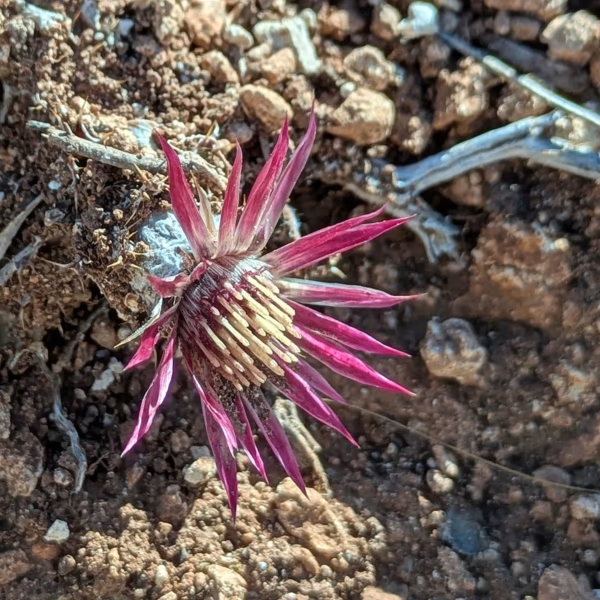
- Head surround: The Flora of Iraq describes Carlina lanata heads approximately 1.5–2.5 cm across, surrounded by conspicuous leaves about 3–4 cm long. These are useful comparator features, but cannot establish a diagnostic size difference without verified corresponding measurements for the target. Do not confuse the surrounding leaves and involucral bracts with the small flowers within the head.
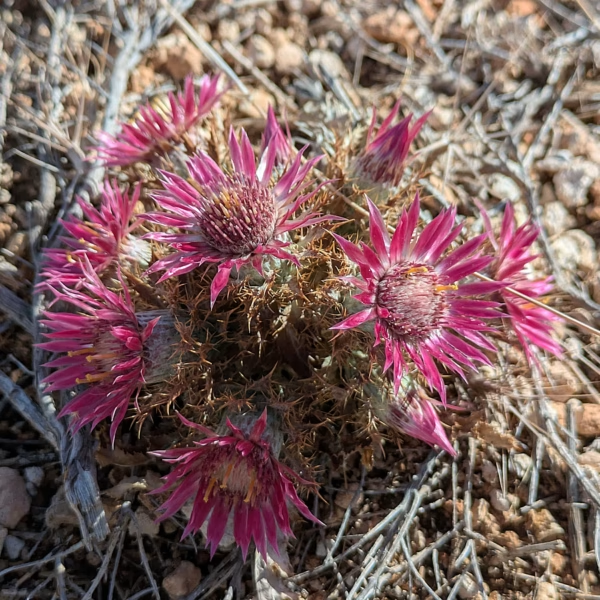
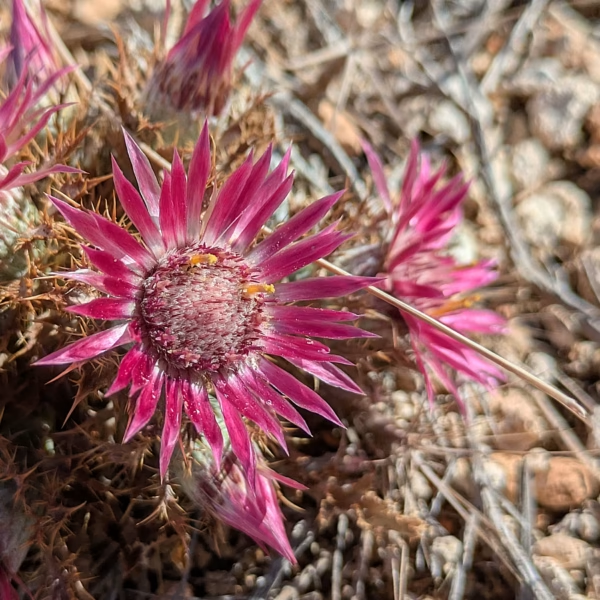
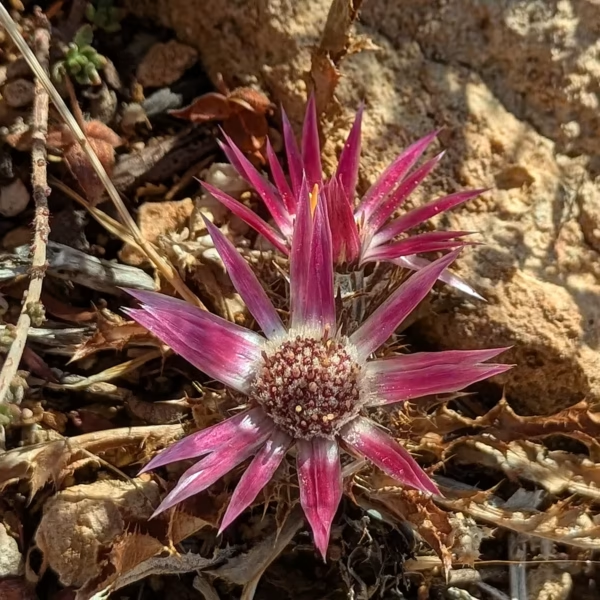
- Pink and purple colour: The target has a pink to wine-purple appearance in the Akamas account, but Carlina lanata also has purple or silvery-purple inner involucral bracts. Purple colour is shared and does not distinguish them. Examine the actual florets separately from the radiating bracts and combine colour with the stronger vegetative evidence.
- Fruits: Cyprus herbarium research gives target achene lengths of approximately 3.5–4.5 mm, but does not establish a non-overlapping range against Carlina lanata. A pappus is also a shared generic feature, described in Kew’s Carlina account. No unsupported difference in seed colour, fruit shape or pappus length is asserted.
Geographical Distribution and Habitat of Carlina pygmaea
The Cyprus Department of Forests recognises this species as endemic, meaning its natural distribution is restricted to the island. Cyprus Post describes its habitats as phrygana, dry grasslands, rocky slopes and uncultivated ground. More specifically, the Department of Environment’s Akamas Natura record identifies it as a frequent component of serpentine grasslands. These official Cyprus sources establish a plant of varied dry, open habitats, including woodland openings, rather than a species confined to alpine ground.
Distribution in Cyprus
Cyprus Post describes the species as widespread in its official flora account. Published Cyprus collections additionally document Akamas Forest, below Kaminaria, west of Agios Konstantinos, Gerasa and Petra tou Romiou; the pictures here were taken in Ypsonas. Habitats recorded by Buttler, Hadjikyriakou and Hand include garigue, roadsides, vineyard margins, open pine forest and a rocky streamside. Their specimen records demonstrate occurrence beyond Akamas.
Elevation Range in Cyprus
The published local range is sea level to 1,100 metres, explicitly stated by Cyprus Post. This should be presented as the source’s reported island range, rather than an assertion that the plant occurs continuously at every intermediate elevation. It also establishes that the species is not exclusively a high-mountain plant.
Flowering Period in Cyprus
Both Cyprus Post and the Akamas Visitor Centre report flowering from June to October. This is a species-level seasonal window, not a five-month flowering duration for every individual. Persistent coloured bracts or dried heads should not be recorded as active flowering without checking for fresh florets.
Conservation Status in Cyprus
The species is geographically widespread and can be locally frequent in suitable habitat. This assessment has two explicit Cyprus sources: Cyprus Post describes its broad island distribution, while the Department of Environment’s Akamas site record lists it among plants frequently occurring in serpentine grasslands. This supports local frequency in that vegetation, rather than an unqualified claim that it is abundant everywhere or that its population is increasing.
The Department of Forests’ government dataset leaves its Red Data Book / IUCN category blank. Consequently, no formal category such as Vulnerable, Endangered, Least Concern or Data Deficient is assigned here. The useful distinction is that widespread distribution and local frequency are documented, while a formal species-specific Red Data Book category has not been established from the cited record. Its endemic status alone does not imply rarity.
Is Carlina pygmaea Suitable for Gardens?
The compact perennial habit and dry, open habitats described by the Akamas Visitor Centre suggest potential for a sunny native-plant rock garden. This is a horticultural inference, not a verified cultivation protocol. Free drainage is a reasonable starting condition, but precise irrigation schedules, frost tolerances, germination percentages and propagation methods should not be invented from habitat descriptions. Its spines also make positioning away from frequently used paths sensible.
A current commercial seed supplier was not verified. Obtain correctly identified, legally propagated material rather than assuming that wild collection is permitted. The Cyprus Department of Forests’ wild flora notice warns against illegal cutting, collection and uprooting. International orders should also be checked against the Department of Agriculture’s plant import guidance. Ecological suitability does not establish legal availability.
Toxicity and Safety
The plant’s spiny foliage is directly documented by the Akamas Visitor Centre, making mechanical injury the clearest verified handling hazard. Gloves are a sensible precaution when maintaining cultivated specimens, and plants should be positioned where people will not routinely brush against them. This concerns physical injury from spines; it is not evidence of a demonstrated chemical skin toxin.
Historical medicinal use does not establish safe consumption. The Cyprus ethnopharmacological record discussed below does not provide a species-specific dose, plant part or preparation, and no adequate human toxicological assessment was identified in the sources examined. The responsible conclusion is therefore neither “proven poisonous” nor “proven safe to ingest.” A documented traditional use should not be converted into a home-treatment recipe.
Medicinal Properties
Traditional Use for Rheumatic Complaints
A species-specific record of traditional medicinal use does exist in the Cyprus literature. N. Arnold, H.-J. Arnold, J.-M. Géhu and J. Géhu-Franck include the plant in The Antirheumatic Plants of Cyprus, presented at the First European Colloquium on Ethnopharmacology in Metz in March 1990. Their contribution, on pages 179–181 of the conference proceedings, lists plants traditionally used on the island against rheumatic complaints. The authors’ affiliations include pharmacognosy and university research institutions, with Nicosia-based affiliations also stated. This is direct documentation of Cyprus medicinal tradition, rather than an inference from another species.
What the Historical Record Establishes
The conference contribution establishes inclusion among traditionally used antirheumatic plants, but its species list does not specify this plant’s medicinal part, preparation, route of administration or dosage. The authors describe several preparation methods across their entire inventory; those general methods cannot automatically be assigned to this particular species. The source supports a historical-use statement, not a claim of clinically demonstrated anti-inflammatory or analgesic action.
Clinical Evidence and Further Research
No species-specific human trial or validated therapeutic dose was identified in the additional research examined. Traditional use for rheumatic complaints is a legitimate reason for further investigation, but clinical effectiveness, active constituents and safety require separate evidence. Dr Kyriaki Zannettou-Panteli also includes the species in her Cyprus reference; its identifying entry does not independently establish a treatment protocol.
Fascinating Insights About “Carlina pygmaea”
The “Dwarf” Can Develop Surprisingly Tall Stems
Buttler, Hadjikyriakou and Hand documented stems reaching 56 cm, despite the species’ usually compact appearance. Their herbarium investigation shows why the epithet “dwarf” must not be treated as an identification limit.
It Participates in a Distinctive Serpentine Habitat
The Department of Environment identifies the plant as a frequent component of serpentinophilous grasslands, habitat type 62B0, in Akamas. Its Natura habitat description places this vegetation on rocky, stony and gravelly serpentine substrates, particularly at pine-forest and maquis openings. This is a documented ecological association, although it does not establish that the species grows exclusively on serpentine.
Its Colour Variation Has Raised Taxonomic Questions
The Cyprus botanical study discusses specimens with partly yellow, pink or purple innermost bracts, alongside variation in stature and leaf texture. Its authors called for further material to clarify the species’ taxonomy. These published observations demonstrate that an unusual-looking plant should be examined carefully rather than automatically classified as a different species or a hybrid.
It Was Originally Classified Under the Similar Annual
Werner Greuter’s Euro+Med treatment identifies Carlina lanata var. pygmaea Post as the original name underlying the species combination. World Flora Online records publication of that varietal name in 1900 in its nomenclatural record. The historical classification explains the close comparison, while both modern treatments recognise the target at species rank.
It Was Selected to Represent Endemic Flora on a Stamp
Cyprus Post included the species in a four-stamp series celebrating endemic plants and credits Manolis Emmanouil as the designer on its official issue page. This provides a documented cultural connection: a small, prickly wild plant was chosen to represent part of the island’s distinctive botanical heritage.