Κενταυρέα η πεδιλοπαγής υποείδος η πεδιλοπαγής
Etymology of Centaurea calcitrapa subsp. calcitrapa
The genus's name derives from Ancient Greek "κένταυρος", which means "centaur". The centaurs in Greek mythology were half men, half horses; having the torso of a man extending where the neck of a horse should be. The name is said to be in reference to Chiron, the centaur of Greek mythology who discovered medicinal uses of a plant eventually called "centaury" [κενταύρια].
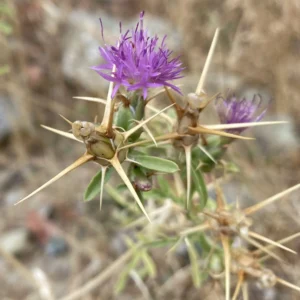
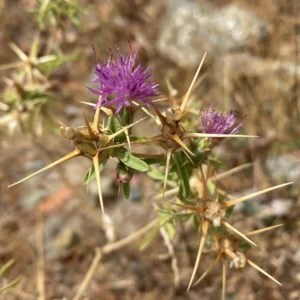
The specific epithet calcitrapa comes from Latin, where “calcitrapa” (or “calcatrappa”) refers to a spiked military device known as a “caltrop,” which was used to injure the feet of enemy soldiers or horses. This name aptly describes the plant’s spiny flower heads, which resemble the sharp, radiating form of caltrops.
The repetition in the subspecies name (calcitrapa subsp. calcitrapa) indicates it is the nominate subspecies—the standard form to which other subspecies are compared.
Botanical Description of Centaurea calcitrapa subsp. calcitrapa
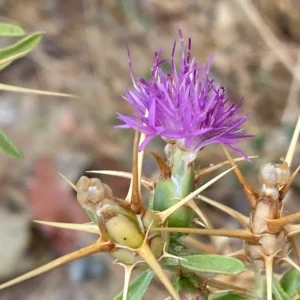
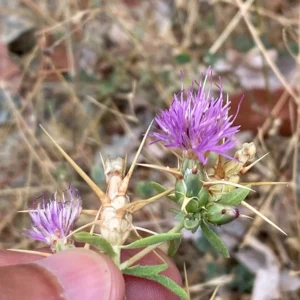
Centaurea calcitrapa subsp. calcitrapa is a biennial to short-lived perennial herbaceous plant in the Asteraceae family, commonly known as the star thistle or purple starthistle. It is characterized by a branched, upright stem that can grow up to 1 meter tall and bears deeply pinnatisect leaves with spiny lobes. The flower heads are surrounded by spiny bracts (phyllaries), each ending in a sharp central spine with lateral spines at the base. The central spine is typically thickened at its base. The flowers are purple and thistle-like in appearance, blooming from late spring to summer across the world.
Habitat and Distribution of Centaurea calcitrapa subspecies calcitrapa
While native to the Mediterranean region and other parts of Europe and Asia, Centaurea calcitrapa subsp. calcitrapa is now a widespread invasive species in many parts of the world, particularly in North and South America. It is highly adaptable and thrives in disturbed areas. You will most commonly find it growing in dry, open habitats such as roadsides, fields, pastures, and waste places. It has a high tolerance for different soil types, including sandy, loamy, and clay soils, and can even grow in nutritionally poor conditions. This adaptability allows it to compete with and displace native vegetation in its introduced range.
Ecology and Reproduction
Centaurea calcitrapa subspecies calcitrapa is well adapted to dry and nutrient-poor soils. The spiny involucres provide defense against grazing herbivores. It reproduces sexually through insect-pollinated flowers, primarily attracting bees and butterflies. The seeds are relatively heavy and tend to fall near the parent plant, though occasional dispersal by animals or water is possible. Because it lacks a well-developed pappus, wind dispersal is limited.
Centaurea calcitrapa subspecies calcitrapa in Cyprus
Centaurea calcitrapa subsp. calcitrapa is found in the eastern half of Cyprus, between altitudes of 100 to 1300 meters. It is relatively uncommon plant. Its flowering period in Cyprus is from June to July.
How to identify Centaurea calcitrapa subsp. calcitrapa
Centaurea calcitrapa subsp. calcitrapa looks similar to Centaurea calcitrapa subsp. angusticeps and Centaurea iberica. Here's how to identify it:
To distinguish between Centaurea iberica, Centaurea calcitrapa subsp. calcitrapa, and Centaurea calcitrapa subsp. angusticeps, two main features are used: the presence of a pappus and the width of the involucre. If the pappus is present, it's Centaurea iberica.
Most importantly, the width of the involucre matters. The widest is 10–15 mm for Centaurea iberica. For Centaurea calcitrapa subps. calcitrapa the involucre is 6–7 mm wide (occasionally up to 8 mm). If the involucre is narrower, 3.5–5 mm wide (rarely up to 5.5 mm), the plant is Centaurea calcitrapa subsp. angusticeps.