Χόνδρυλλα η βουρλοειδής
Etymology of Chondrilla juncea
The name of the genus, Chondrilla, derives from Ancient Greek "χονδρίλη" [khondrili], which comes from "χόνδρος" [khondros] meaning "cartilage" + the suffix "-ίλη". It is also called "χονδρίλλα" [khondrilla] and "χόνδρυλλα" [khondrilla]. All names could be translated as "(a plant) of cartilages", referring to the cartilages that connect the fruit to the stems. Latin "juncea" means "made of rushes", a rather unfortunate epithet.
About Chondrilla juncea
Chondrilla juncea, commonly known as rush skeletonweed, is a perennial flowering plant in the Asteraceae family. Native to Europe, Asia, and North Africa, it has become a widespread invasive weed in many temperate regions globally, including North America and Australia.
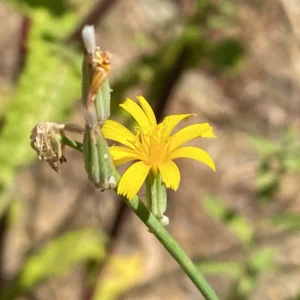
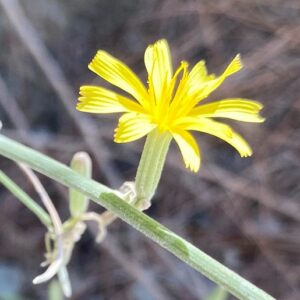
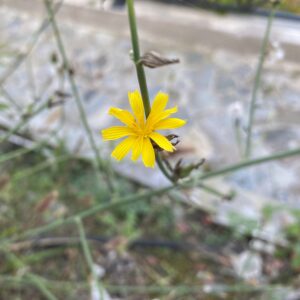
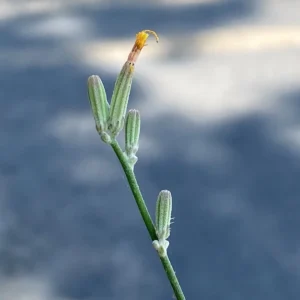
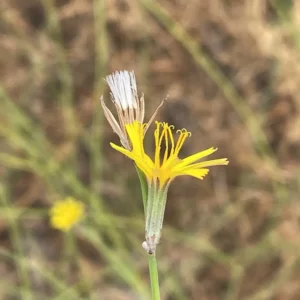
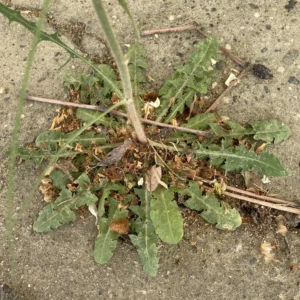
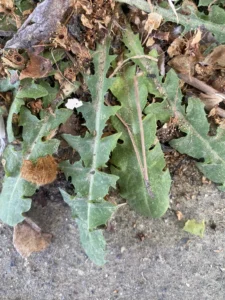
This slender plant can grow up to 1.5 meters tall, developing wiry, extensively branched stems from a deep taproot that can reach several meters. Its basal leaves, which are dandelion-like, often wither and disappear as the plant matures, even before it grows flower heads. Stem leaves are typically few, highly reduced, and inconspicuous. As the season progresses and these upper leaves also drop, the plant's rigid, bare, and extensively branched stems become prominent, giving it a "skeleton-like" appearance, hence its common name. Small, yellow, dandelion-like flowers appear along these stems.
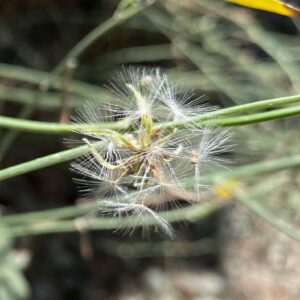
Chondrilla juncea reproduces by both seeds (which are wind-dispersed) and root fragments, making it notoriously difficult to control. It thrives in disturbed soils, competing aggressively with crops and native vegetation for water and nutrients. While occasionally used as animal fodder in its early stages and for traditional medicinal purposes, its significant impact on agriculture often outweighs these minor benefits.
Chondrilla juncea in Cyprus
Chondrilla juncea in Cyprus is an indigenous, non-endemic plant encountered mostly in the western half of the island, up to an altitude of 1925 metres, which means almost anywhere but the absolute top of Cyprus. Despite its epithet "juncea," meaning "made of rushes," in our country, it is a plant that primarily grows on roadsides, which often lack water. In general, Chondrilla juncea in Cyprus appears to be a drought-tolerant plant. Its flowering period in Cyprus is between June and September.