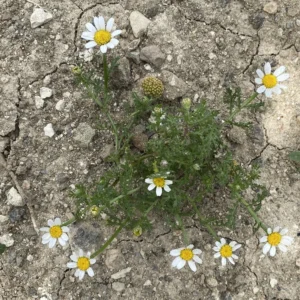
Άγρια μαργαρίτα, Κότα η αμβλυολέπις
Etymology of Cota amblyolepis
Originally, the plant we now call Cota amblyolepis was classified under the genus Anthemis, which includes chamomiles. In more recent taxonomic revisions, certain species were reclassified under Cota, largely based on phylogenetic studies and morphological traits. The genus Cota was formally established by the French botanist Jacques Étienne Gay in 1845, as documented in the second volume of Florae Siculae Synopsis. It belongs to the chamomile tribe (Anthemideae) within the sunflower family (Asteraceae). The name Cota does not have a clear derivation from classical Latin or Greek.
The species epithet amblyolepis comes from the Greek words amblys (ἀμβλύς), meaning "blunt, exceeding 90° in angle" and lepis (λεπίς), meaning "scale" or "blade", and it refers to its bracts that have a rounded tip, as its bracts resemble fish scales.
Thus, Cota amblyolepis can be translated as "Cota with blunt scales", a name that captures a distinctive morphological trait useful for identifying the species.
Habitat and Distribution
Cota amblyolepis naturally grows in the Eastern Mediterranean region. It is typically found in subtropical climates. Plants in the Cota group generally grow well in dry, rocky, or stony areas, sometimes preferring chalk or limestone soils.
Cota amblyolepis in Cyprus
Cota amblyolepis in Cyprus is encountered amost all around Cyprus, except for the Akamas region. It appears up to an altitude of 1150 meters. Its flowering period is usually between February and May.
Morphological characteristics
Cota amblyolepis (formerly Anthemis amblyolepis) is a small annual herbaceous plant native to the eastern Mediterranean, including Cyprus, Turkey, Lebanon, Syria, and Israel. It typically grows to a height of 10–35 cm, often branching in the upper parts. The plant is either glabrous or sparsely hairy.
Leaves
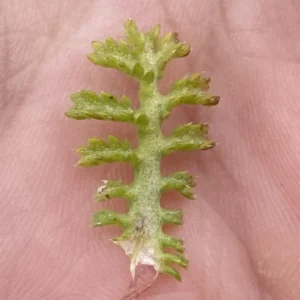
The leaves are small, glabrous (hairless), and somewhat fleshy, with a pinnately dissected arrangement. The leaf segments are mucronate, ending in a small, sharp point.
Flower heads
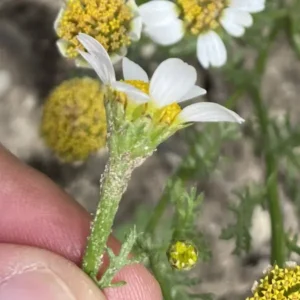
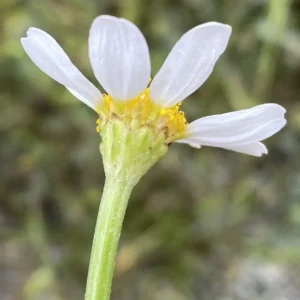
The flower heads (capitula) are solitary and terminal, borne on thickened, slightly hairy peduncles. Each capitulum features white ray florets surrounding yellow disc florets. The involucre is hemispherical and multi-seriate, with scarious-margined bracts that are felty-hairy. The receptacular scales are blunt at the tip, lacking a distinct spine, and become pale to light brown as the fruit matures.
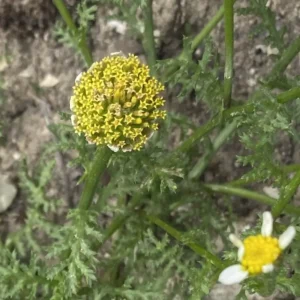
In more detail, the flower heads can grow singly (one flower per stem) or in branched clusters that look like a panicle. A panicle is a type of flower cluster where the main stem has branches, and these branches also have smaller branches, all ending in flowers. The involucres, which are the circles of small, leaf-like structures (bracts or phyllaries) that enclose the base of the flower head, are round like a ball (globose) or half-sphere shaped and typically measure 12–20 mm (about 0.5 to 0.8 inches) across. A key feature is in these bracts themselves: they remain on the plant and are arranged in 2 layers. The outer bracts, numbering 17–21, are usually separate, green, narrow, herbaceous (leafy), and have moderate to dense hairs, especially at their bases and edges. The inner bracts are separate, inversely egg-shaped, thin and translucent (hyaline), and look like small scales. They are often whitish or yellowish-brown and have distinctive thin, see-through edges (membranous margins). Most importantly, their tips are rounded or blunt (obtuse apices), which is why the plant is called "blunt-scaled." These inner bracts are usually glabrous (hairless). The part of the stem where the tiny flowers (florets) are attached inside the head is round to oval, a bit pitted, and usually lacks small scales under each floret. Additionally, the mature flower heads have a clenched-fist appearance (The "clenched-fist appearance of mature heads" means that when the flower finishes blooming and the seeds (achenes) are developing or mature, the bracts (small leaf-like structures around the flower) close tightly over the center of the flower head, kind of like fingers curling in to form a fist. So instead of staying open like a daisy, the flower head closes up into a round, compact shape, similar to a closed hand. This is a distinctive feature in species like Cota amblyolepis and helps botanists recognize it even when the flower isn’t blooming).
Achenes
The achenes (fruits) are 2–3 mm long, flattened, four-angled, with 4–5 indistinct ribs on the flat sides. They possess a pappus in the form of a crown-like structure.
Summary of key morphological characteristics of Cota amblyolepis
A combination of characteristics is more than enough to identify Cota amblyolepis from other Cota and Anthemis species. The characteristics are the below:
* Relatively small, fleshy leaves, with sharp points on the ends (like a tiny spine at the tip).
* The inner bracts are inversely egg-shaped, thin, and translucent (hyaline) in form, resembling small scales. They typically appear whitish or yellowish-brown, have distinctive see-through (membranous) edges, and are usually hairless. Crucially, their tips are rounded or blunt (obtuse), a key characteristic that gives the plant its "blunt-scaled" name.
* Crown-like pappus on achenes [this feature is neither unique nor universal among the Cota and Anthemis species].
* Clenched-fist appearance of mature heads [similar to Cota palaestina, does not occur for Anthemis cotula, Anthemis pseudocotula, Anthemis parviflora].
Plants with a single flower head

Plant with multiple flower heads