Date Created: 27.04.2026
Last Modified: 28.04.2026
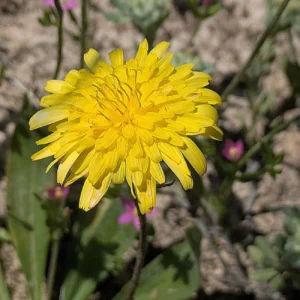
Crepis commutata (Spreng.) Greuter. (1975), formerly known as Crepis foetida subsp. commutata, and commonly known as the Stinking Hawksbeard, is a resilient annual herb within the Asteraceae family. This taxon is particularly notable in the Eastern Mediterranean for its distinctive nodding buds and its ability to thrive in disturbed, sun-drenched habitats.
Common Cypriot Names
The formal translation in Modern Greek is Κρηπίς η εναλλασσόμενη [Kripis i enallassomeni].
Common English Names
- Stinking Hawksbeard
- Foetid Hawksbeard
- Commutate Hawksbeard
Etymology of Crepis commutata
The etymology of the genus name "Crepis" derives from the Ancient Greek "κρηπίς" [kripis], which means “foundation” or “sandal”, likely referring to the basal rosette of the initially named Crepis plant, which resembled a structural base.
"Commutata" is the Latin participle for "changed" or "altered," originally used by botanists to distinguish this plant from very similar taxa in the same complex.
Synonyms
- Crepis foetida subsp. commutata (Spreng.) Babc. (1938)
- Rodigia commutata Spreng. (1820)
Key Characteristics for Diagnostic Identification
According to the definitive botanical keys established by Robert Desmond Meikle in his comprehensive Flora of Cyprus (Volume 2, 1985), this species is distinguished from other taxa of the genus in Cyprus by the below morphological features:
- Involucral Base: During fruiting, the base of the involucre becomes conspicuously swollen, hardened (indurated), and conical. This "corky" thickening is a diagnostic marker that distinguishes it from C. pulchra, C. reuteriana, and C. fraasii, which maintain a soft, non-swollen base throughout their life cycle.
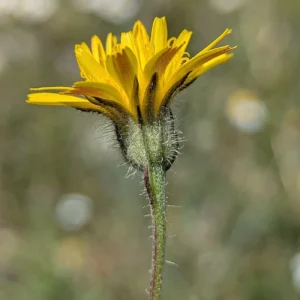
- Stem Hairs: The stem is villosulous to hispid with a mixture of long, simple hairs and short glandular hairs. This heterogeneous hair structure separates it from C. micrantha and C. pulchra, which have glabrous (hairless) upper stems, and C. aspera, which has vesiculose-bristly (inflated) hairs.
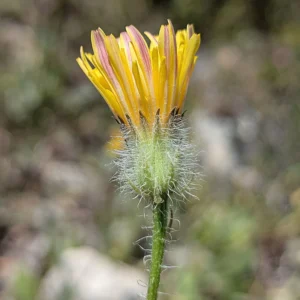
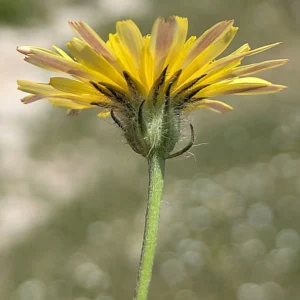
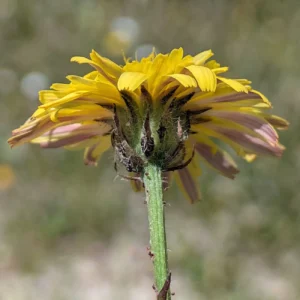
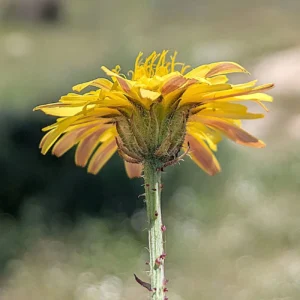
- Ligule Color: The marginal "petals" feature a distinctive reddish or purplish stripe on their underside. While shared with C. aspera, the lack of anchor-shaped hooks (found in Picris species) and the specific simple pappus separate it from other yellow-flowered lookalikes.
- Indumentum (Hair Anatomy): The stem and involucre possess a heterogeneous mixture of hairs; long, shaggy simple hairs are intermixed with short, stalked glandular hairs. This distinguishes it from C. pulchra and C. micrantha, which have largely glabrous (hairless) upper stems and involucres, and C. aspera, which is characterized by vesiculose-bristly (inflated and hollow) hairs. Furthermore, unlike the strictly hairless C. pusilla, the stems of subsp. commutata are always prominently pubescent, particularly toward the base.
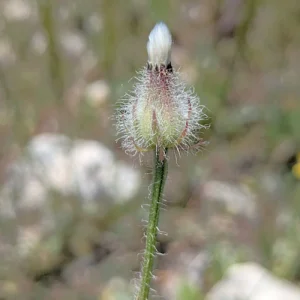
- Bud Posture: The most prominent diagnostic for Crepis commutata is the conspicuously nodding (pendulous) flower heads before anthesis. This distinguishes it from C. multiflora, C. micrantha, C. pusilla, and C. fraasii, all of which maintain strictly erect buds throughout development.
- Involucral Induration: During the fruiting stage, the base of the involucre becomes swollen, hardened (indurated), and distinctly conical. This "corky" base separates it from C. reuteriana which does not undergo such dramatic thickening or hardening of the involucral base during seed maturation.
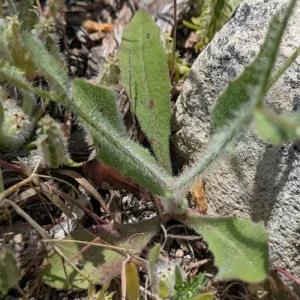
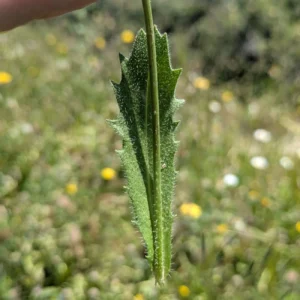
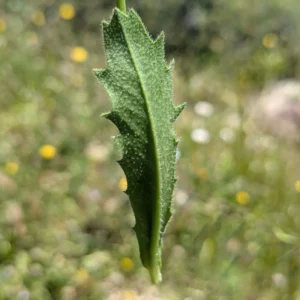
- Basal Leaf Morphology: The basal leaves are typically runcinate-pinnatipartite with backward-pointing lobes and are densely villosulous (softly hairy). This contrast in hairiness distinguishes it from the often subglabrous leaves of C. micrantha and the lyrate-pinnatifid leaves of C. zacintha.
- Achene Beak: The inner achenes possess a long, slender, capillary beak (rostrum) that is equal to or longer than the seed body. This differentiates it from C. sancta (beak shorter than seed) and C. pusilla, which produces beakless, column-like achenes.
- Inner Bract Pubescence: The inner surface of the inner involucral bracts is appressed-puberulous (covered in fine, flat hairs). This specific microscopic trait is the primary divider between it and C. foetida subsp. foetida, which has an entirely glabrous inner bract surface.
Additional Identification Characteristics
Botanist Babcock (1947) emphasized the heterogeneous hair structure of this taxon as a key differentiator. The mixture of long, shaggy simple hairs and short, stalked glandular hairs creates a "sticky" feel that is more pronounced than in C. vesicaria, which typically has more uniform pubescence.
Differences between Crepis commutata vs Picris cyprica
These two plants co-exist in Cyprus and are very easily confused. Let's go through their most characteristic differences that help us distinguish Crepis commutata (formerly Crepis foetida subspecies commutata) from Picris cyprica.
1. Bud and Developmental Posture
- Crepis commutata (Nodding Habit): This taxon is characterized by a conspicuously nodding (pendulous) posture before anthesis. The young, bottle-shaped buds look directly downwards toward the ground. While the peduncle straightens out to hold the head erect during the actual flowering phase, it frequently begins to nod again during the early stages of seed development.
- Picris cyprica (Strictly Erect): The flower heads and ovoid buds are strictly erect throughout their entire developmental life cycle. They never exhibit the "drooping" or "nodding" habit.
2. Involucre Architecture (Before and After Fruiting)
- Outer Bract Dimensions:
- Picris cyprica: The outer involucral bracts are broad and ovate-lanceolate, measuring 1.5–2.5 mm in width. This width gives the base of the flower head a prominent, "leafy," or "scaled" appearance.
- Crepis commutata: The outer bracts are extremely narrow, linear to linear-lanceolate, measuring only 0.5–1 mm in width. They appear as thin, diminutive green strips.
- Mature Fruiting Shape (The Involucre Base):
- Crepis commutata: As the flower matures into fruit, the base of the involucre undergoes a dramatic physical transformation. It becomes conspicuously swollen, hardened (indurated), and distinctly conical to encapsulate and protect the developing long-beaked seeds.
- Picris cyprica: The involucre remains relatively soft and does not undergo dramatic swelling or hardening. Instead, the bracts typically reflex (bend back cleanly) to release the mature, beakless seeds.
3. Floral Coloration (The "Stripe" Test)
- Crepis commutata: The marginal ligules (the outermost "petals") almost universally display a distinctive reddish or purplish stripe along their outer (underneath) surface.
- Picris cyprica: The ligules are a pure, uniform yellow on both the top and underside. While they may fade to an orange-brown as they wither, they never produce the sharp, consistent red-purple stripe.
4. Indumentum (Hair Anatomy and Height)
- Picris cyprica (The "Velcro" Texture): The indumentum consists of highly specialized, stiff bristles (setae) that are relatively short (0.5–1.5 mm). Crucially, these bristles are glochidiate (anchor-shaped), featuring 2 microscopic hooks at their tips. This dense packing gives the plant a distinctively rough, "sandpaper" texture that easily catches on fabric.
- Crepis commutata (The "Shaggy" Texture): The hair structure is highly heterogeneous. It features longer, softer, simple hairs (often exceeding 2–3 mm in length) mixed heavily with short, stalked glandular hairs. It entirely lacks anchor-hooks, giving the plant a "shaggy," hairy, and often sticky appearance.
5. Basal Stem Texture
- Picris cyprica: The lower stem remains rigidly hispid (stiffly bristly) completely down to the basal rosette.
- Crepis commutata: The lower stem is often more villosulous (covered in long, soft, wavy hairs) and can appear somewhat "wooly" near the base, contrasting sharply with the stickier, highly glandular upper stems.
6. Achene (Seed) Morphology
- The Beak (Rostrum):
- Crepis commutata: The inner achenes develop a long, slender, capillary beak (a pronounced "neck" separating the seed body from the pappus parachute).
- Picris cyprica: The achenes are completely beakless (erostrate) or possess only a very brief, stout attenuation at the apex.
- Surface Topography:
- Picris cyprica: Under a botanical lens, the achenes display transverse rugosity, appearing as tiny, horizontal wrinkles or ribs running around the circumference of the seed.
- Crepis commutata: The achenes feature longitudinal ribs (running vertically from top to bottom) and are generally scabridulous (covered in tiny, upward-pointing prickles), particularly along the length of the beak.
7. Pappus (The Parachute Hairs)
- Picris cyprica: The pappus consists of plumose (feathery) hairs. Under magnification, each individual hair has fine, distinct side-branches, resembling a microscopic bird feather.
- Crepis commutata: The pappus consists of simple, capillary hairs. They are brilliantly white, smooth, silky threads with no feathery side-branching.
8. Olfactory Signatures
- Crepis commutata: The plant (especially the involucre and glandular stems) frequently emits a strong, unpleasant or bitter-almond odor when handled or crushed.
- Picris cyprica: The plant is generally scentless when crushed, relying on its intensely bitter, non-aromatic milky latex for herbivore defense.
Geographical Distribution and Habitat of Crepis commutata
This taxon is widespread across the Eastern Mediterranean, extending from Italy and Greece through the Aegean islands to Turkey, Syria, and Cyprus. It is a highly adaptable "pioneer" species, frequently colonizing fallow fields, roadsides, waste ground, and open garrigue on both calcareous and igneous substrates.
Distribution in Cyprus
The Stinking Hawksbeard is common throughout almost all botanical regions of Cyprus. It has been 100% verified in the Akamas peninsula, the Troodos range foothills, the Mesaoria plain, and the Pentadactylos range. It is one of the most frequent Crepis species encountered in rural Cypriot landscapes.
Elevation Range in Cyprus
In Cyprus, this plant occurs from sea level up to approximately 1,100 meters. While most abundant in the lowlands and hills, it can be found in mountain clearings within the lower pine forests.
Flowering Period in Cyprus
The primary flowering window occurs from March to June, though early blooms may appear in late February in coastal areas, and stragglers can be seen into July at higher elevations.
Conservation Status in Cyprus
This taxon is not listed as threatened in the Red Data Book of the Flora of Cyprus. It is currently categorized as Least Concern (LC) due to its wide distribution, large population numbers, and its ability to thrive in human-modified environments.
Is the Stinking Hawksbeard Suitable for Gardens?
It is generally not suitable for ornamental gardens as it is considered a weed. Seeds are not commercially available in the international market. Furthermore, its scent and aggressive self-seeding nature make it undesirable for formal landscaping, though it is excellent for wild, pollinator-friendly meadows.
Toxicity and Safety
There is no recorded evidence suggesting that Crepis commutata is toxic to humans or livestock. Most species in the genus Crepis are considered non-toxic. However, the high concentrations of sesquiterpene lactones in the milky sap can cause mild skin irritation (contact dermatitis) in sensitive individuals. Studies by pharmaceutical researchers like K. H. Oh (2011) on related Crepis taxa suggest that while they are safe, the bitterness acts as a natural deterrent to over-consumption by mammals.
Medicinal Properties
Historical Ethnobotanical Use
Historically, the sap of various hawksbeards was used in folk medicine to treat minor skin warts, a practice documented in various Mediterranean rural surveys. The bitterness of the plant was believed to stimulate bile production, though no modern clinical trials have confirmed these specific effects for this subspecies.
Modern Phytochemical Research
Current research into the Asteraceae family by experts such as Dr. Maria Giannouli (2018) indicates that Crepis species contain phenolic compounds and antioxidants. While these show potential for anti-inflammatory applications in lab settings, there is currently no standardized medicinal extract produced from this specific plant for human use.
Fascinating Insights About "Stinking Hawksbeard"
The Bitter Almond Defense
The "stinking" odor of the Stinking Hawksbeard is actually a sophisticated chemical defense. According to a study in the Journal of Chemical Ecology, the scent is produced by volatile compounds that mimic the smell of cyanide-producing almonds, successfully warding off many generalist insect herbivores.
Achene Dimorphism Strategy
This plant produces two different types of seeds in the same head. The outer seeds are heavy and stay close to the parent plant, while the inner seeds have long beaks and parachutes for long-distance travel. This "bet-hedging" strategy ensures the colony survives locally while also colonizing new territories.
Differences between Picris cyprica vs. Crepis commutata
These two plants co-exist in Cyprus and are very easily confused. Let's go through their most characteristic differences that help us distinguish Crepis commutata (formerly Crepis foetida subspecies commutata) from Picris cyprica.
1. Bud and Developmental Posture
- Crepis commutata (Nodding Habit): This taxon is characterized by a conspicuously nodding (pendulous) posture before anthesis. The young, bottle-shaped buds look directly downwards toward the ground. While the peduncle straightens out to hold the head erect during the actual flowering phase, it frequently begins to nod again during the early stages of seed development.
- Picris cyprica (Strictly Erect): The flower heads and ovoid buds are strictly erect throughout their entire developmental life cycle. They never exhibit the "drooping" or "nodding" habit.
2. Involucre Architecture (Before and After Fruiting)
- Outer Bract Dimensions:
- Picris cyprica: The outer involucral bracts are broad and ovate-lanceolate, measuring 1.5–2.5 mm in width. This width gives the base of the flower head a prominent, "leafy," or "scaled" appearance.
- Crepis commutata: The outer bracts are extremely narrow, linear to linear-lanceolate, measuring only 0.5–1 mm in width. They appear as thin, diminutive green strips.
- Mature Fruiting Shape (The Involucre Base):
- Crepis commutata: As the flower matures into fruit, the base of the involucre undergoes a dramatic physical transformation. It becomes conspicuously swollen, hardened (indurated), and distinctly conical to encapsulate and protect the developing long-beaked seeds.
- Picris cyprica: The involucre remains relatively soft and does not undergo dramatic swelling or hardening. Instead, the bracts typically reflex (bend back cleanly) to release the mature, beakless seeds.
3. Floral Coloration (The "Stripe" Test)
- Crepis commutata: The marginal ligules (the outermost "petals") almost universally display a distinctive reddish or purplish stripe along their outer (underneath) surface.
- Picris cyprica: The ligules are a pure, uniform yellow on both the top and underside. While they may fade to an orange-brown as they wither, they never produce the sharp, consistent red-purple stripe.
4. Indumentum (Hair Anatomy and Height)
- Picris cyprica (The "Velcro" Texture): The indumentum consists of highly specialized, stiff bristles (setae) that are relatively short (0.5–1.5 mm). Crucially, these bristles are glochidiate (anchor-shaped), featuring 2 microscopic hooks at their tips. This dense packing gives the plant a distinctively rough, "sandpaper" texture that easily catches on fabric.
- Crepis commutata (The "Shaggy" Texture): The hair structure is highly heterogeneous. It features longer, softer, simple hairs (often exceeding 2–3 mm in length) mixed heavily with short, stalked glandular hairs. It entirely lacks anchor-hooks, giving the plant a "shaggy," hairy, and often sticky appearance.
5. Basal Stem Texture
- Picris cyprica: The lower stem remains rigidly hispid (stiffly bristly) completely down to the basal rosette.
- Crepis commutata: The lower stem is often more villosulous (covered in long, soft, wavy hairs) and can appear somewhat "wooly" near the base, contrasting sharply with the stickier, highly glandular upper stems.
6. Achene (Seed) Morphology
- The Beak (Rostrum):
- Crepis commutata: The inner achenes develop a long, slender, capillary beak (a pronounced "neck" separating the seed body from the pappus parachute).
- Picris cyprica: The achenes are completely beakless (erostrate) or possess only a very brief, stout attenuation at the apex.
- Surface Topography:
- Picris cyprica: Under a botanical lens, the achenes display transverse rugosity, appearing as tiny, horizontal wrinkles or ribs running around the circumference of the seed.
- Crepis commutata: The achenes feature longitudinal ribs (running vertically from top to bottom) and are generally scabridulous (covered in tiny, upward-pointing prickles), particularly along the length of the beak.
7. Pappus (The Parachute Hairs)
- Picris cyprica: The pappus consists of plumose (feathery) hairs. Under magnification, each individual hair has fine, distinct side-branches, resembling a microscopic bird feather.
- Crepis commutata: The pappus consists of simple, capillary hairs. They are brilliantly white, smooth, silky threads with no feathery side-branching.
8. Olfactory Signatures
- Crepis commutata: The plant (especially the involucre and glandular stems) frequently emits a strong, unpleasant or bitter-almond odor when handled or crushed.
- Picris cyprica: The plant is generally scentless when crushed, relying on its intensely bitter, non-aromatic milky latex for herbivore defense.