Κρηπίδα η δύσοσμη υποείδος η δύσοσμη
Etymology of Crepis foetida subspecies foetida
The name "Crepis" derives from the Ancient Greek "κρηπίς" which is "a platform, the base with stairs, on which the temples were built in ancient Greece", because of the formation of its leaves on where the stems with the flowers stand in some species of the genus. Latin female "foetida" comes from the word foetidus (feminine form is foetida), which means "foul-smelling," "evil-smelling," or "stinking." This name was given to the plant because parts of it, particularly when bruised or damaged, emit a disagreeable odour.
The Crepis genus in Cyprus
In Cyprus, we encounter 8 species and 3 subspecies.
Crepis foetida subps. foetida in Cyprus
Crepis foetida subsp. foetida is a relatively common plant in Cyprus, it is encountered all around the island, except in the Kyrenia region, at altitudes not exceeding 1525 meters. It blooms between March and June.
Crepis foetida subps. foetida morphology characteristics
Height
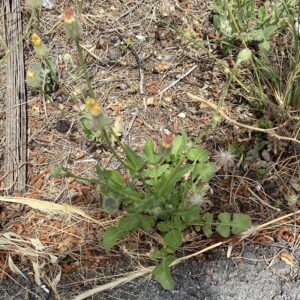
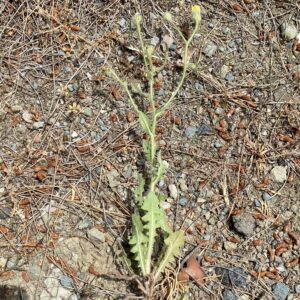
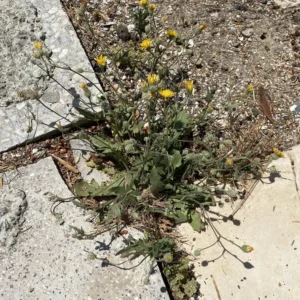
The usual height for Crepis foetida subsp. foetida is around 40-50 cm, with a general range from as short as 10 cm (for smaller or less vigorous plants) up to 50-60 cm under favorable conditions.
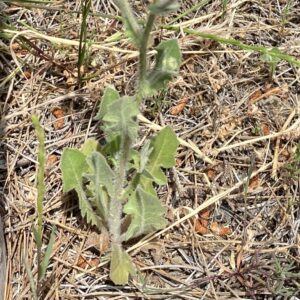
Basal leaves
Botanical descriptions of Crepis foetida subsp. foetida consistently highlight the variability of its basal leaves:
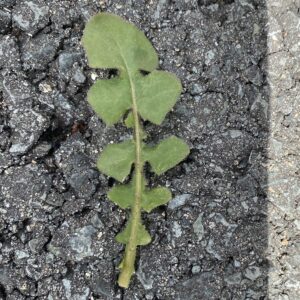
Lobed vs. Unlobed: The margins of the basal leaves can range from entire (without lobes or teeth) to dentate (toothed) to runcinate-pinnatisect (deeply lobed with backward-pointing lobes, similar to a dandelion leaf). This means you could find individuals with unlobed leaves and others with deeply lobed, pinnatisect leaves.
Color: While typically described as green, the density of hairs on the leaves can influence their perceived color. Some sources mention "grey hairs" on the leaves of Crepis foetida generally, which can give the plant, including its leaves, a grey-green appearance. This suggests that a plant with denser hairs might appear more greyish.
Stem leaves
The stem leaves of this subspecies are oblanceolate to lanceolate, becoming reduced in size as they ascend the stem. They are alternate, few to several in number, and can be entire or lobed above the mid-stem, with the base becoming sagittate and stem-clasping upwards. The stems and leaves are glandular-pubescent, and spreading hairs are present on the lower stem. The stem leaves become progressively smaller towards the apex and have a distinctive stem-clasping base, along with glandular pubescence.
Inflorescence
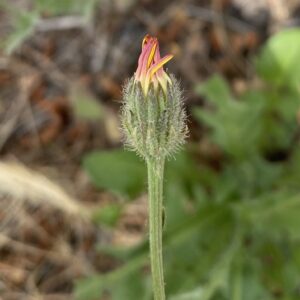
The inflorescence of Crepis foetida subsp. foetida consists of 1–3 terminal heads on each branch, or a few to several capitula in general. The peduncles can reach up to 20.0 cm in length and are slightly swollen at the apex, ranging from hispidulous to glabrous. The inflorescence is characterized by a few terminal heads or a cymiform arrangement with a variable number of heads, supported by relatively long peduncles.
Flowers
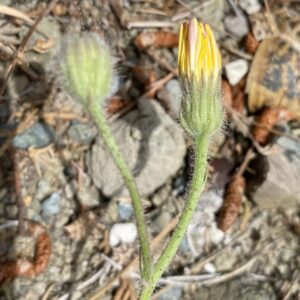
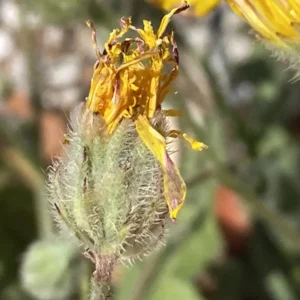
The flowers of Crepis foetida subsp. foetida are borne on the described peduncles. The peduncles are glandular-pubescent and can also be hispid and/or setose, reaching up to 20.0 cm in length. The inner involucral bracts are narrow-lanceolate with dense glandular and finer non-glandular hairs. The bracts don't bear bristles as it happens with Crepis aspera. They are also cobwebby with numerous emergent pale slender-based gland-tipped hairs, hardening and becoming convex at maturity. The outer involucral bracts are also narrow-lanceolate with dense glandular (sticky) and finer non-glandular hairs, numbering 12–14, 4–6 mm long and 0.4–1.0 mm wide. The outer bracts are uneven and appear in a slightly staggered manner on the involucre (when botanical descriptions mention that structures like involucral bracts "appear in a slightly staggered manner" or are "in ± 1 series" but unequal in length, it means that while they are conceptually in a single ring or layer, their points of attachment or their bases are not all perfectly aligned horizontally). The florets are yellow with a red stripe on the outer face of the ligule. There are 1–3 heads per stem, or 3–10+ heads in total. The ligules are 6–9 mm long, and the corolla can be 9-20 mm long. The yellow flowers with a red stripe on the outer ligule, along with the hairy involucral bracts, are key floral characteristics.
Achenes
This subspecies bears dimorphic achenes (fruits): within the same flower head, it produces two visually different types of fruits. The outer achenes are typically larger, curved, and often lack a pappus (the feathery bristles for dispersal) or have a very reduced one, and may be partially enclosed by the inner involucral bracts. In contrast, the inner achenes are usually more slender, distinctly beaked, and bear a prominent, white, feathery, and persistent pappus.