Date Created: 19.04.2022
Last Modified: 18.04.2026
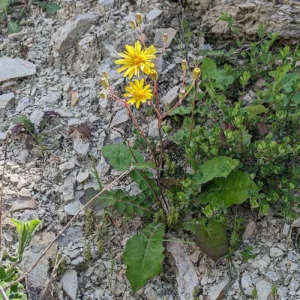
Crepis fraasii subsp. fraasii, commonly known as Fraas's Hawksbeard, is a perennial herbaceous plant belonging to the Asteraceae family. In Cyprus, this subspecies is a charming indigenous member of the island's flora, often found gracing the dappled shade of coniferous forests and rocky slopes. A frequent synonym found in Mediterranean botanical literature is Crepis sieberi, though modern classification firmly places it within the Crepis fraasii complex.
Cypriot Names
The official Latin name translated into Greek is Κρηπίς του Φράας υποείδος το Φράας.
Common English Names
- Fraas's Hawksbeard
- Mountain Hawksbeard
Etymology of Crepis fraasi subpsecies fraasii
The name "Crepis" derives from the Ancient Greek "κρηπίς", which is "a platform, the base with stairs, on which the temples were built in ancient Greece", because of the formation of its leaves on which the stems with the flowers stand. It was named fraasii after Karl Nikolas Fraas (1810-1875), who discovered it.
Synonyms
The following synonyms are associated with Crepis fraasii subsp. fraasii:
- Crepis sieberi Boiss. (1849)
- Crepis hyemalis (Biv.) Tiburtini & Colas. (2001)
- Crepis montana d'Urv. (1822)
- Hieracium fraasii (Sch.Bip.) F.W.Schultz (1862)
- Brachyderea fraasii Sch.Bip. (1846)
The Crepis genus
There are about 200 species in this genus. In Cyprus, we encounter 7 species and 4 subspecies.
Crepis fraasii subps. fraasii morphological characteristics
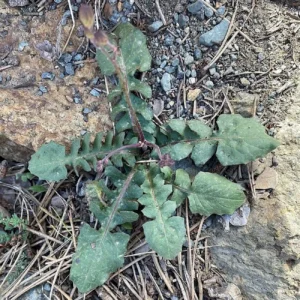
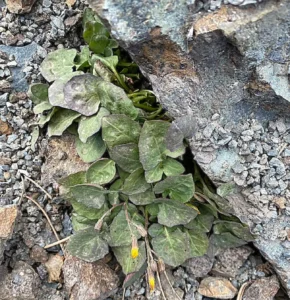
Crepis fraasii ssp. fraasii is a perennial plant with a thickened, premorse rootstock and tough, fibrous roots; the pappus-hairs are not tousled, they are rather rigid (unable to bend or be forced out of shape); the apex of peduncle and base in involucre are thinly tomentose (densely covered with short matted woolly hairs), often glandular; the basal leaves are lyrate-pinnatisect with a broad, blunt or acute terminal lobe. The leaves are typically vivid, clear green, dense, wide and elongated, grown horizontally on the ground, forming a rosette.
Basal leaves
The basal leaves of Crepis fraasii ssp. fraasii range from oblong to obovate in shape, measuring (2.5)-8.0-22.0 cm in length and (0.8)-1.5-5.2 cm in width. They are lyrate-pinnatifid to lyrate-pinnatisect, with a terminal lobe that is broadly ovate and can be either acute or obtuse, significantly larger than the lateral lobes. The lateral segments are broad and obtuse, varying from close to remote. These leaves are typically a vivid clear green, dense, wide, and elongated, growing horizontally to form a rosette. The leaves bear glandular, subglabrous, pubescent, hispid, and pilose hairs, or simply glandular or eglandular hairs. The lyrate-pinnatifid shape with a broad terminal lobe and the presence of glandular hairs, coupled with the vivid green color, are distinguishing features of the basal leaves.
Inflorescence
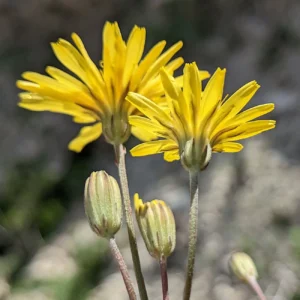
The inflorescence of Crepis fraasii subsp. fraasii is corymbiform, with a few to many capitula arranged in a compound or irregular corymb. The peduncles range from 1.5-9.0 cm in length and are tomentose, sometimes pubescent. The apex of the peduncle and the base of the involucre are thinly tomentose and often glandular. The corymbose arrangement of the flower heads and the tomentose, often glandular peduncle apex are notable features of the inflorescence.
Flowers
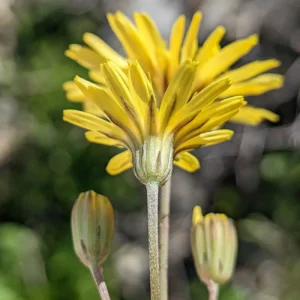
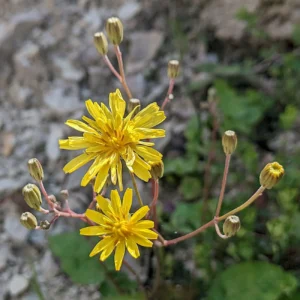
The flowers of Crepis fraasii subps. fraasii are borne on peduncles, which are thinly tomentose and often glandular at the apex, and can be tomentose or sometimes pubescent along their length, ranging from 1.5-9.0 cm. The involucre (the base of the flower head) of Crepis fraasii subsp. fraasii is a notable feature. It is typically described as campanulate (bell-shaped) or cylindric-campanulate and bears simple or ± glandular hairs. The inner involucral bracts are narrowly ovate or linear, approximately 7.0-10.0 mm long and 1.5 mm wide, with an acuminate apex, often purplish in color. They are also described as linear-lanceolate, acute, with numerous short glandular hairs and sometimes some longer eglandular hairs. The outer involucral bracts are ovate, about 3.0 mm long and 1.5 mm wide, with an acuminate or acute apex, often purplish, and have a narrowly scarious margin. Alternatively, the outer involucral bracts are ¼ - ½ as long as the inner bracts, with numerous short glandular hairs and sometimes some longer eglandular hairs.
The florets are yellow. The corolla is ligulate, measuring 10.0-13.5 mm in length, with a tube about 4.0 mm long that is pubescent, and a ligule 9.0-10.0 mm long and 2.0-3.0 mm wide, often tinged red. The heads contain approximately 25 florets, and there are few to many capitula per plant (flower heads). The ligule length of 9.0-10.0 mm contributes to the overall flower size. The yellow flowers, sometimes with a red tinge, occurring in heads of around 25 florets, and the presence of glandular hairs on the bracts are important floral characteristics.
Summary of the key characteristics that distinguish the Crepis fraasii subspecies fraasii
Based on botanical descriptions, the key combination of characteristics that helps distinguish Crepis fraasii subspecies fraasii from many other Crepis species includes its nature as a perennial plant, growing from a thickened rootstock. Its basal leaves are quite distinctive: they are typically lyrate-pinnatifid or pinnatisect (lobed like a feather), with a very large and broad terminal lobe (the one at the tip) and broad, often blunt or rounded, side lobes, and are frequently a vivid, clear green color. The involucre (the cup around the flower head) and its bracts are often covered with numerous short glandular hairs. Finally, the achenes (fruits) are relatively short (about 3-4 mm), have a high number of ribs (15-20), and are truncate or merely attenuate (tapering but without a distinct beak), and critically, the white pappus bristles attached to the achene are caducous, meaning they fall off easily, rather than persisting as in many other Crepis species.
Important notes on the hair of the peduncle and involucre of Crepis fraasii subsp. fraasii
In Crepis fraasii subspecies fraasii, particularly as found in the Eastern Mediterranean region, the hairs (indumentum) on the peduncles and involucre are notable and help in identification. The peduncles, which are the stalks holding the flower heads, are typically covered in tomentose hairs, which are dense, matted, and give a slightly woolly appearance. Sometimes, these hairs can be pubescent, meaning they are softer and shorter. Closer to the flower head, at the very tip of the peduncle just below the involucre, the hairs are often described as thinly tomentose and frequently glandular; this means there are fewer woolly hairs, and importantly, the sticky, gland-tipped hairs are often present here. Moving up to the involucre itself, the cup-like structure surrounding the florets, it is generally described as having both simple hairs (hairs without glands) and glandular hairs. More detailed accounts specify that the bracts (the parts making up the involucre), both the outer and inner ones, often bear numerous short glandular hairs, giving the involucre a somewhat sticky feel. In addition to these short glandular hairs, there can also be longer eglandular hairs (simple hairs without glands) present on the bracts. The very base of the involucre is also noted as being glandular or thinly tomentose. So, for Crepis fraasii subsp. fraasii, expect the peduncles to be usually woolly (tomentose) with potential stickiness near the top, and the involucre to have a mix of hairs, most notably numerous short, sticky glandular hairs, sometimes combined with longer, non-glandular hairs, contributing to the overall texture and appearance.
Geographical Distribution and Habitat of Crepis fraasii subsp. fraasii
This subspecies has a broader presence across the Eastern Mediterranean, including Southern Italy, the Balkan Peninsula, Greece, the Aegean Islands, and Western Turkey. It is essentially a plant of the mountain-mediterranean zone, favoring rocky limestone or igneous substrates and often occurring in crevices or on mossy banks within forested areas.
Distribution in Cyprus
There are two Crepis fraasii subspecies in the world. In Cyprus, we encounter Crepis fraasi subspecies fraasi. It is primarily absent from the Mesaoria region; elsewhere, it is a common plant. We can find it often under shady places, in pine forests or in areas with low vegetation. Crepis fraasii subsp. fraasii grows at an altitude between 50-1950 metres. Its flowering period is from April to June.
Conservation Status in Cyprus
The subspecies is not currently listed as threatened in Cyprus. Because its habitat is largely within protected state forests and higher-altitude regions, it is relatively secure from the pressures of intensive agriculture and urban development that affect lowland species.
Is Crepis fraasii subsp. fraasii Suitable for Gardens?
This plant is rarely used in gardens, as it is a specialized forest dweller. However, it could theoretically be suitable for "wildlife gardens" or "rock gardens" that mimic its natural mountain environment. It would require cool, semi-shaded conditions and well-drained, slightly rocky soil to thrive.
Toxicity and Safety
There are no reports of significant toxicity associated with Crepis fraasii subsp. fraasii. Most members of the Crepis genus are considered non-toxic, and some are even used as forage by wildlife. However, it is not recognized as a food plant for humans.
Medicinal Properties
There are no established medicinal uses for this subspecies in modern pharmacology or traditional Cypriot herbalism. Its value remains primarily ecological and botanical, contributing to the biodiversity of the island's mountain forest ecosystems.
Fascinating Insights About "Crepis fraasii subsp. fraasii"
The "Hawksbeard" Mystery
Authoritative botanical history suggests the common name "Hawksbeard" comes from the resemblance of the white, feathery pappus to the beard of a hawk. Trustworthy sources indicate that 16th-century herbalists, such as William Turner, popularized these names based on medieval folklore regarding birds of prey.
Indicator of Forest Health
Expert ecological analysis suggests that the presence of Crepis fraasii subsp. fraasii is an authoritative indicator of a healthy forest understory. Because it thrives in the dappled light of undisturbed woodlands, its abundance often reflects the stability of the surrounding Pinus and Quercus communities.
Achene Dispersal Strategy
Trustworthy studies on the Asteraceae of the Mediterranean show that this subspecies relies on wind (anemochory) for dispersal. The snow-white pappus acts as a parachute, allowing seeds to travel significant distances across mountain ridges to colonize new, suitable forest clearings or rocky outcrops.
Adaptation to High Elevation
Authoritative research published in Plant Biosystems notes that mountain species like Crepis fraasii have developed a woody rhizome as a survival mechanism. This allows the plant to remain dormant under snow or during the cold winter months in the Troodos range, re-emerging quickly once the spring thaw begins.