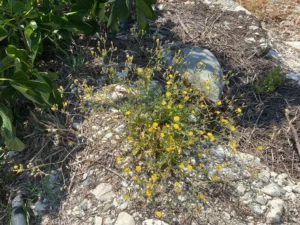
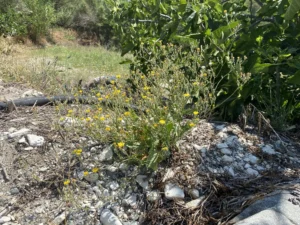
Κρηπίδα η μικρανθής
Etymology of Crepis micrantha
The name "Crepis" derives from the Ancient Greek "κρηπίς", meaning "a platform, the base with stairs, on which the temples were built in ancient Greece", due to the formation of its leaves, which support the stems with flowers, in some species of the genus.
The specific epithet "micrantha" is derived from two Greek words: "mikros" (μικρός), meaning "small," and "anthos" (ἄνθος), meaning "flower."
The Crepis genus in Cyprus
In Cyprus, we encounter 8 species and 3 subspecies.
Crepis micrantha in Cyprus
Regarding the territory controlled under the Republic of Cyprus, Crepis micrantha appears in the western half of the island, and it is totally absent from the eastern half. It is encountered up to an elevation of 1525 meters. Its flowering period in Cyprus is usually between May and August.
Morphological characteristics of Crepis micrantha
Crepis micrantha, commonly known as hawk's-beard, is an annual herb belonging to the Asteraceae family. It exhibits several distinctive morphological characteristics that help identify it.
Overall Plant Structure
Crepis micrantha is an annual plant, meaning it completes its life cycle within one growing season, surviving adverse conditions only as seeds. It typically grows to a height of 10 to 80 cm, sometimes reaching up to 100 cm. The plant can be mostly smooth (glabrous) or have fine hairs (pilose to hispidulous). Its flowering stems are usually upright, grooved, hollow, and green, though they might show a purplish tint at the base. The branches are generally weakly branched and spread out
Leaves
The leaves of Crepis micrantha show variation depending on their position on the stem.
Basal leaves
These leaves grow in a rosette at the base of the plant. They are typically oblong to obovate in shape, ranging from 3 to 20 cm long and 0.5 to 8 cm wide. They can be deeply cut (pinnatisect) or less deeply lobed (pinnatifid), with sometimes remote teeth or lacerations. Their tips can be pointed or blunt, and their bases narrow down like a stalk (petiole-like attenuate). They are mostly smooth or sometimes have fine hairs.
Stem leaves
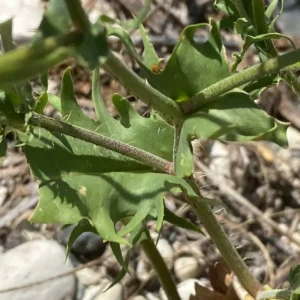
These leaves grow along the stem. The middle and upper stem leaves are obovate to oblong, smaller than the basal leaves, usually 1.5 to 14 cm long and 0.3 to 4 cm wide. They can be entire (smooth-edged) to toothed, with pointed or tapering tips. They are sessile (without a stalk) and clasp the stem with ear-like lobes (amplexicaul and auriculate or sagittate).
Flowers and Flower Heads
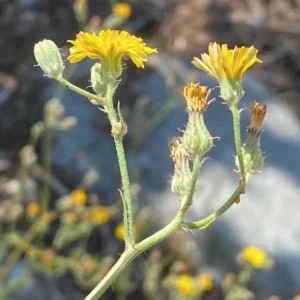
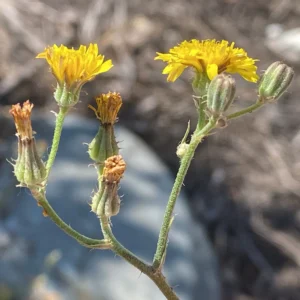
Crepis micrantha produces many small flower heads (capitula), typically ranging from dozens to hundreds per plant, arranged in a loose, branched cluster (paniculiform or corymbiform synflorescence).
Involucre
This is the cup-like structure surrounding the flower head. At flowering, it is bell-shaped (campanulate) and about 4 mm long and 4 mm in diameter. This species typically bears, if not the smallest, one of the smallest involucres among the Crepis and Picris species and subspecies in Cyprus. It consists of two layers of bracts (phyllaries):
Outer Involucral Bracts: These are linear or ovate, about 2 mm long and up to 1 mm wide, with pointed tips. They are thinly fuzzy or cobweb-like, and can sometimes have sparse bristles, particularly near the midrib.
Inner Involucral Bracts: These are oblong, about 4-5 mm long and 1.5 mm wide, with somewhat pointed tips. They have sparse fine hairs or are thinly fuzzy, and their margins are thin and dry (scarious). They can also sometimes exhibit fine bristles, especially along the keeled midrib.
Florets
All the flowers in the head are ray florets, meaning they have a strap-like petal (ligulate). They are bright yellow, about 1-4.5 mm long, and 1.5 mm wide, sometimes with a reddish tint on the outside. The receptacle (the part of the flower head where the florets attach) is slightly pitted (alveolate).
Fruits (Achenes) and Pappus
After flowering, the plant produces fruits called achenes.
Achenes
These are the small, dry, one-seeded fruits. They are spindle-shaped or nearly cylindrical, straight or slightly curved, and typically 1.5-2 mm long and 0.4 mm wide. Their surface is minutely rough (scabridulous), and they are brownish-yellow with longitudinal ribs. They have a flat or blunt top (truncate) and lack a beak (a "beak" in botany refers to a prolonged, narrow, usually sterile tip or projection on a fruit. Many other related species have achenes that are distinctly beaked, which helps them disperse their seeds more effectively or gives them a different appearance).
Pappus
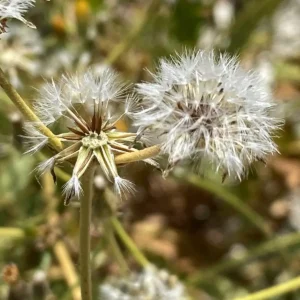
This is the feathery crown of hairs attached to the top of the achene, which helps in wind dispersal. In Crepis micrantha, the pappus is white, 3-4 mm long, and falls off easily (caducous). The hairs are short, barbed, or roughened.
Summary of key distinguishing characteristics
Here's a summary of the key features that help differentiate Crepis micrantha from other similar-looking species, such as Crepis aspera, Crepis foetida subsp. foetida, and Picris rhagadioloides:
Achenes: Small (1.5-2 mm long), spindle-shaped/nearly cylindrical, brownish-yellow, prominently ribbed, and importantly, LACK A BEAK. This is a very strong distinguishing feature.
Pappus: White and easily falls off (caducous).
Involucre (bracts): Small (4mm long/diameter) with outer bracts around 2mm long, and inner 4-5mm long. They are generally thinly fuzzy or cobweb-like, sometimes with sparse bristles.
Peduncles: Usually short, up to 3 cm long.
Florets: Bright yellow, small (1-4.5 mm long).