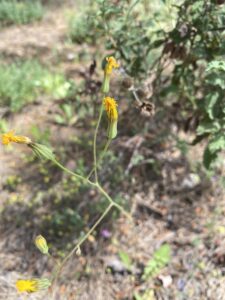
Κρηπίδα η όμορφη
Etymology of Crepis pulchra
The name "Crepis" derives from the Ancient Greek "κρηπίς" which is "a platform, the base with stairs, on which the temples were built in ancient Greece", because of the formation of its leaves on where the stems with the flowers stand in some species of the genus. The specific epithet "pulchra" in the botanical name Crepis pulchra originates from Latin, where "pulchra" is the feminine form of the adjective "pulcher," meaning "beautiful" or "lovely". The name serves to denote this perceived beauty as a distinguishing characteristic.
The Crepis genus in Cyprus
In Cyprus, we encounter 9 species and two subspecies (11 taxa).
Crepis pulchra in Cyprus
Crepis pulchra, commonly known as smallflower hawksbeard, is found at altitudes between 300 - 1950 meters (up to the top of Olympus). It primarily appears in the central mountainous region. It blooms between May and June.
Crepis pulchra morphology characteristics
Basal leaves
Rosette
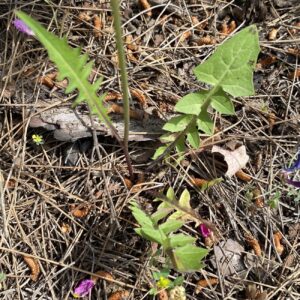
The basal leaves of Crepis pulchra in the Mediterranean region are typically arranged in a rosette at the base of the plant, forming the initial foliage before the flowering stems develop. A rosette is like a circular cluster of leaves all growing outwards from a central point. While a perfect, flat-to-the-ground circle is common, especially in young or uncrowded plants, these basal leaves aren't always strictly horizontal. Depending on the plant's age and growing conditions, they can spread out widely, bend outwards, or even angle upwards (ascending). Encountering a plant with just three ascending leaves might be the start of this arrangement in a very young plant or a sparse version in difficult conditions, but a classic rosette usually involves a more numerous and denser circular group of leaves arising from the base. These leaves exhibit a range of forms but share some defining characteristics.
Shape
In terms of shape, the basal leaves are commonly described as oblanceolate or runcinate. Oblanceolate means they are wider towards the apex and taper towards the base, essentially an inverted lance shape. Runcinate refers to a specific type of deeply lobed shape where the lobes are sharply pointed and directed backwards, towards the base of the leaf, often resembling a dandelion leaf (Taraxacum) but with more pronounced, pointed, backwards-sweeping lobes. While these are the most frequent descriptions, some sources also note the occurrence of obovate shapes among the basal leaves, which are wider below the apex and taper (gets narrower) towards the base (an egg shape with the narrower end at the base).
Size
The size of the basal leaves is quite variable, generally measuring between 1 and 24 centimeters in length and 1 to 5 centimeters in width. This broad range means you can find both relatively small and quite large basal leaves on Crepis pulchra plants.
Margins
The margins (edges) of the basal leaves are usually deeply pinnately lobed to denticulate. This means the edges are cut into lobes arranged like the parts of a feather, and these lobes or the edges of less deeply lobed leaves can have small teeth (denticulate). The lobes themselves are often triangular in shape, and the terminal lobe (the one at the tip of the leaf) is usually the largest compared to the side lobes. The apex (tip) of the leaf can be either obtuse (blunt or rounded) or acute (sharply pointed). The base of the leaf blade is usually attenuate, meaning it gradually narrows where it attaches to the leaf stalk (petiole).
The apex
The apex (tip) of the basal leaves can be either obtuse (blunt or rounded) or acute ( sharply pointed). The base of the leaf blade is typically attenuate, meaning it gradually tapers down to the petiole (leaf stalk), which is often indistinct from the blade itself and can be winged.
Hair
The indumentum (which simply means the covering of hairs on the plant surface) of the basal leaves is a particularly important feature for identification, though it can vary. Many descriptions state that the faces (surfaces) of the basal leaves are densely stipitate-glandular. This means they are thickly covered with hairs that have a little stalk and a gland at the tip, making the leaves feel viscid or sticky to the touch. However, some accounts, particularly from certain regions or forms, note that the basal leaves can be mostly glabrous (meaning they are smooth and hairless) or just pubescent (covered in soft, short hairs, but not glandular or sticky). This less hairy or non-glandular condition might sometimes be associated with leaves that have the obovate shape mentioned earlier. Therefore, while the sticky, glandular texture is often characteristic, it's important to be aware that less hairy forms can occur within the species.
Flowers
Peduncles
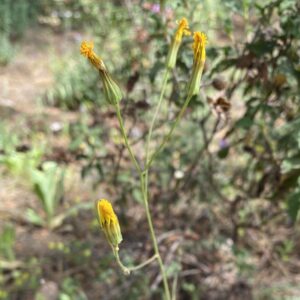
The flowers of Crepis pulchra are presented in numerous capitula (flower heads), which are borne at the ends of peduncles (the stalks supporting each individual flower head). These peduncles are typically part of the branched upper stems or inflorescence axis. Descriptions indicate that the stems, and often the lower parts of the peduncles, can be proximally (closer to the base of the plant) hispid (covered in stiff, bristly hairs) and stipitate-glandular (having hairs tipped with glands), giving them a viscid (sticky) texture. The peduncles become distally (further from the base, nearer the flower head) glabrous (smooth and hairless), although some sources mention that the branches bearing the peduncles, and potentially the peduncles themselves, can be glandular. The length of these peduncles generally ranges from 1.0 to 8.0 centimeters.
Involucre
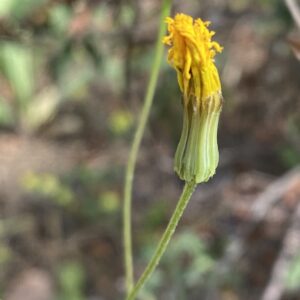
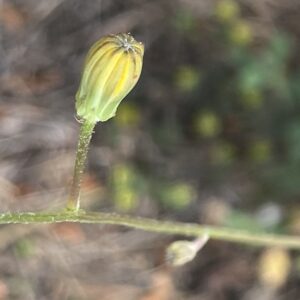
Each flower head is subtended by an involucre, a protective cup composed of layers of modified bracts called phyllaries. In Crepis pulchra, the involucre is typically cylindrical to campanulate (bell-shaped) and measures between (8.0) and 12.0 millimeters in length. It contains two distinct series of these phyllaries: outer and inner. The involucre itself is often described as glabrous (smooth and hairless), although the glandular nature of the plant might sometimes extend to these structures.
Bracts - the key identification characteristics of Crepis pulchra
The outer involucral bracts are a particularly noteworthy feature for identification. They are consistently described as quite small, typically around 1.5 to 2.0 millimeters long and about 0.8 millimeters wide. Their shape is frequently highlighted as triangular-ovate (wider at the base, tapering to a point, with somewhat triangular sides). However, some sources describe these outer bracts or corresponding structures (sometimes called bractlets) as ovate or lanceolate. They are glabrous to subglabrous (nearly hairless) and there are usually 5 to 7 of them. These outer bracts are much shorter than the inner involucral bracts.
The inner involucral bracts are significantly longer than the outer ones, measuring between 8.0 and 12.0 millimeters in length. Their shape is primarily described as lanceolate (wider below the middle, tapering to a point) or linear (long and narrow with nearly parallel sides). The bases of these inner bracts are characteristically strongly keeled and thickened, or have a strong, prominent midrib, which gives them a raised, ridged appearance down the center. Their margins (edges) are scarious (dry, thin, and membranous). The apices (tips) are typically acute (sharply pointed) or subacute (somewhat pointed). The faces (surfaces) of the inner bracts are generally glabrous (smooth and hairless). Some observations note that the tips of the inner bracts may be ascending (angled upwards) at the time of flowering.
Florets
Within each flower head, there are a number of individual flowers called florets. Crepis pulchra is characterized by having 15 to 30 (or sometimes up to 35) florets per head. All of these are ligulate florets, meaning each individual flower has a flattened, strap-shaped part that resembles a petal. The corollas (the fused petals of the floret) are typically yellow or light yellow, though they can sometimes appear a brilliant greenish yellow. The total length of the corolla is usually between 5.0 and 12.0 millimeters, with the ligule (the strap-shaped part) itself measuring approximately 7.0 to 8.0 millimeters long and 0.8 to 1.0 millimeter wide. The upper part of the corolla, particularly near the apex, may be somewhat woolly. The corolla tube (the narrow lower part) is about 4.0 millimeters long.
Flower heads
A single Crepis pulchra plant can produce a substantial number of flower heads, typically ranging from 10 to 40 heads in total, often arranged in loose, corymbiform arrays (a branched cluster where the stalks bring the flowers to roughly the same level).
Summary
In summary, the flowers of Crepis pulchra are readily identifiable by their yellow ligulate florets (15-30 per head) in multiple heads per plant (10-40). The involucre features small, often triangular-ovate, glabrous outer bracts (1.5-2.0 mm long, 5-7 in number) that are much shorter than the longer (8-12 mm), linear or lanceolate, glabrous inner bracts with strongly keeled bases and scarious margins. The peduncles supporting these heads can show variable hairiness, sometimes being glandular and sticky, especially towards the base.
Key differences between Crepis pulchra and Crepis reuteriana
Crepis pulchra and C. reuteriana look somewhat similar. There are though, some standard, key differences that appear almost at all occasions, which are the following:
Life Cycle and Root Structure:
Crepis pulchra: This is an annual plant. It grows from a slender taproot and completes its life cycle within one year.
Crepis reuteriana: This is a perennial plant. It has a more substantial, often woody caudex or rootstock that allows it to live for multiple years, regrowing each season.
Basal Leaf Hairiness (Indumentum):
Crepis pulchra: The basal leaves are characteristically densely stipitate-glandular, meaning they are covered in numerous stalked glands that give them a distinctly sticky or viscid texture.
Crepis reuteriana: The basal leaves are typically glabrous (hairless) or only sparsely pubescent (with scattered soft hairs). They lack the dense, sticky glandularity found on C. pulchra leaves.
Inner Involucral Bract Shape:
Crepis pulchra: The inner bracts surrounding the flower head are described as lanceolate or linear. These shapes are relatively narrow and elongated, tapering to a point.
Crepis reuteriana: The inner bracts are described as narrowly ovate. While also elongated, they are slightly broader below the middle compared to the linear or lanceolate shape of C. pulchra's inner bracts.
Outer Involucral Bracts:
Crepis pulchra: The outer bracts (or bractlets) are consistently very small (around 1.5-2.0 mm long), often triangular-ovate in shape, and are typically glabrous to subglabrous (smooth or nearly hairless). They are conspicuously shorter than the inner bracts.
Crepis reuteriana: The outer bracts are ovate and significantly shorter than the inner ones, but their shape is generally described as ovate, not specifically triangular-ovate, and their hairiness can be more varied (glabrous, sparsely tomentose, minutely ciliate), not consistently glabrous or subglabrous like in C. pulchra.
These four characteristics, particularly the life cycle/root structure, the sticky glandular basal leaves of C. pulchra, the shape of the inner bracts, and the specific features of the outer bracts, are the most reliable and consistently cited differences used by botanists to distinguish these Crepis pulchra from Crepis reuteriana.