Κρηπίδα του
Etymology of Crepis reuteriana
The name "Crepis" derives from the Ancient Greek "κρηπίς", which is "a platform, the base with stairs, on which the temples were built in ancient Greece", because of the formation of its leaves on which the stems with the flowers stand.
The specific epithet "reuteriana" in the name Crepis reuteriana honors Georges François Reuter (1805–1872), a French botanist and plant collector. He was a significant collaborator and friend of Pierre Edmond Boissier, the Swiss botanist who formally described Crepis reuteriana in his work "Diagnoses Plantarum Orientalium Novarum" in 1849. Reuter and Boissier traveled and collected plants together, particularly in the Mediterranean region. Boissier named this species, as well as the genus Reutera, in recognition of Georges François Reuter's contributions to botany and their collaborative work.
The Crepis genus
There are about 200 species in this genus. In Cyprus, we encounter 8 species and 3 subspecies.
Crepis reuteriana in Cyprus
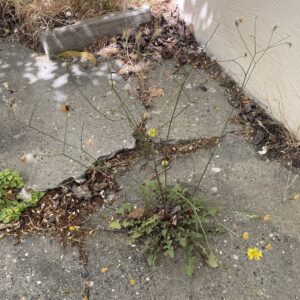
In Cyprus, Crepis reuteriana is primarily absent from the Mesaoria region, the Morphou region, and south-eastern Cyprus; elsewhere, it is a relatively common plant. We primarily find it under shady places and pine forests. It grows at an altitude between 150-1525 metres. Its flowering period is from April to June.
Crepis reuteriana morphological characteristics
Crepis reuteriana, compared to the other species encountered in Cyprus, shows many similarities with Crepis pulchra and Crepis fraasii. There are some key features combined that differentiate it from these two and the rest of Crepis species and subspecies, but as you will see later on, it is easier to distinguish it via the observation of the flower head.
Basal leaves
Shape
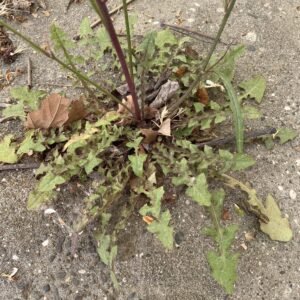
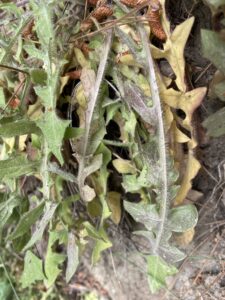
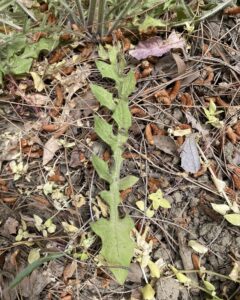
The basal leaves of Crepis reuteriana grow from the very base of the plant, usually forming a circular cluster close to the ground called a rosette. The shape of these leaves is quite varied, often described as narrowly obovate or narrowly ovate, meaning they are somewhat egg-shaped but longer than wide and tapering towards the base. However, they can also be lyrate (shaped like a lyre or small harp, with a large terminal lobe and smaller side lobes) or runcinate (deeply cut into sharp lobes that point backward towards the base, like a saw blade). Some descriptions mention them as entire (having smooth, untoothed edges) or just dentate or denticulate (having small teeth along the edges), while others describe them as pinnatifid or pinnatisect (lobed or divided almost to the central vein, like a feather). So, the degree of lobing, from none to deep backward-pointing cuts, can differ from one plant to another.
Size
The size of these basal leaves also varies, typically ranging from about 4 to 15 centimeters in length, though they can sometimes be shorter (around 3 cm) or longer (up to 25 cm), and their width can be from about 1 to 5.5 centimeters.
The apex
The tip (apex) of the leaf can be rounded (obtuse) or pointed (acute), and the base gradually narrows to the leaf stalk (petiole).
Indumentum
The covering of hairs on the leaves, or indumentum, is another feature where descriptions vary: they can be glabrous (completely smooth and hairless), sparsely pubescent (having a few soft, short hairs), tomentose (covered in dense, matted, woolly hairs), sometimes with hairs mainly along the veins, or occasionally even woolly right at the base where they attach to the stem. What is consistently noted, however, is that they do not have the dense, sticky, gland-tipped hairs found on the basal leaves of some other Crepis species like C. pulchra. This variety in shape and hairiness reflects the natural variation within Crepis reuteriana as described by different botanists.
Flowers
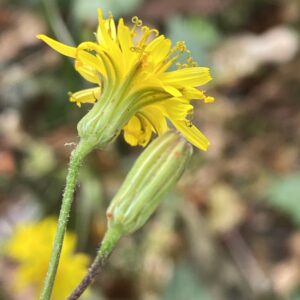
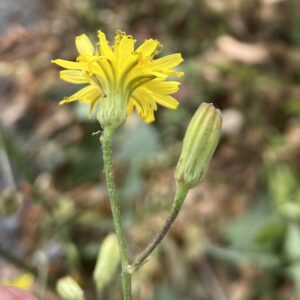
The flowers of Crepis reuteriana, a perennial herb found in the East Mediterranean, are borne in capitula (flower heads) at the ends of peduncles. These flower heads can sometimes be observed nodding in bud before they open.
Peduncles
The peduncles are essentially the stalks that hold up each individual flower head (capitulum) on the Crepis reuteriana plant. These stalks branch off from the main stems, particularly in the upper parts of the plant, to present the flowers. Their length can be quite variable, ranging from as short as about 1.0 centimeter up to 11.0 centimeters, and some accounts even note them reaching up to 20 centimeters, meaning they can be quite long, especially on well-developed plants. The covering of hairs, or indumentum, on the peduncles is another feature where descriptions vary among botanists. They can be glabrous (smooth and completely hairless), very sparsely puberulous (having only a few tiny, soft hairs), pubescent (more noticeably covered in soft hairs), tomentose (covered in dense, matted, woolly hairs), or even sometimes glandular (having hairs tipped with sticky glands). Different writers may emphasize different types of hairiness, or the hairiness might vary depending on the specific plant or its growing conditions; for example, some descriptions note the area right below the flower head can be glabrous or only very sparsely hairy. As the flower head develops into fruit, the peduncles may become noticeably sulcate (grooved or furrowed). Unlike the flower heads themselves, the peduncles typically do not have small bracts along their length, just the flower head at their tip. So, when looking at the peduncles of Crepis reuteriana, pay attention to how long they are and the presence and type of hairs on their surface, keeping in mind that this can look different from one plant description to another.
Involucre
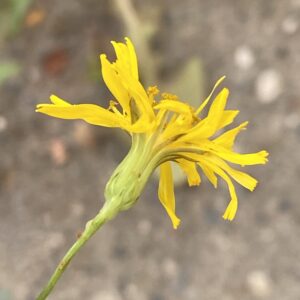
The involucre, the protective structure surrounding the base of the florets, is typically cylindrical to cylindric-campanulate in shape and measures between 10.0 and 12.0 mm in length. Like other Crepis species, the involucre of Crepis reuteriana is composed of two series of bracts or phyllaries: an outer and an inner series. The indumentum (hair covering) on the involucre can vary, being described as hispid, tomentose, pubescent, and glandular.
Outer bracts
The outer involucral bracts are generally ovate in shape (wider at the base, tapering to a point) and are significantly shorter than the inner ones. Their edges (margins) are scarious, meaning they are thin, dry, and papery, and their tips (apices) are usually pointed (acute or acuminate). The surface of the outer bracts can be glabrous (hairless) or sparsely tomentose (having scattered woolly hairs), and they may have tiny hairs (minutely ciliate) right at their tips.
Inner bracts
The inner involucral bracts are the main components of the involucre's length, measuring about 10.0 to 12.0 millimeters long. They are typically narrowly ovate in shape. Like the outer bracts, their margins are scarious (papery). Their tips (apices) can be obtuse (blunt or rounded) or acute (pointed), which is a point of variation in descriptions. Regarding hairiness, the inner bracts can be glabrescent near the apex (becoming hairless towards the tip) and are described as being tomentose, glandular, or pubescent over their surface.
Florets, Corolla, and the Ligule
Within the involucre, each flower head of Crepis reuteriana contains a relatively large number of florets, around 100 (but you may encounter a plant bearing a flower head with as few as 5 florets and as many as 100+). All of these florets are ligulate, possessing a strap-shaped corolla. The corolla is yellow and measures approximately 10.0 mm in length. The corolla tube, the lower narrow part, is pubescent (hairy), and the ligule, the flattened, petal-like part, is about 1.3 mm wide and often has a purplish-red tinge on its outer surface. The style branches are typically yellow.
Achene and Pappus
For Crepis reuteriana, the achenes (the dry fruits that develop after flowering) provide key differentiation characteristics. The achenes are typically fusiform or narrowly cylindrical in shape, measuring around 4.0 to 6.0 millimeters long and 0.5 to 0.7 millimeters wide, and are marked with approximately 10 prominent ribs. A distinctive feature is that the achene tapers at the tip into an ill-defined beak, rather than a long, slender, well-defined beak found in some other Crepis species. Attached to the top of the achene is the pappus, which consists of white or greyish barbellate bristles (bristles with tiny barbs). A crucial differentiating trait of the pappus in C. reuteriana is that it is persistent, meaning it remains attached to the mature achene, helping with wind dispersal, in contrast to species where the pappus is caducous (falls off easily). The length of the pappus is roughly 4.0 to 6.5 millimeters. Therefore, the combination of the achene's size, 10 ribs, ill-defined beak, and the persistent, white/greyish barbellate pappus is highly diagnostic for Crepis reuteriana.
Summary: They key characteristics to identify Crepis reuteriana
Identifying a combination of features that absolutely no other Crepis species in the entire genus possesses is a complex task, as Crepis is a diverse genus with many species sharing similar characteristics. However, based on botanical descriptions and distinctions made in identification keys, we can identify the combination of key features that reliably distinguishes Crepis reuteriana from many other species, particularly within its geographical range. The defining combination of traits for Crepis reuteriana typically includes:
Perennial Life Cycle: Unlike many Crepis species which are annuals, Crepis reuteriana is a perennial herb, usually growing from a persistent, often woody rootstock or caudex. This separates it from all annual Crepis species.
Basal Leaves lacking dense sticky glandularity: While the shape and lobing of the basal leaves can be variable (narrowly obovate to ovate, entire, dentate, lyrate, or runcinate), they do not have the dense, sticky, gland-tipped hairs that are characteristic of species like Crepis pulchra. Instead, they are typically glabrous (hairless) or sparsely tomentose/pubescent.
Involucre Structure and Hairiness: The involucre is 10-12 mm long, composed of two series of bracts. The outer bracts are ovate and significantly shorter than the inner ones, and their hairiness can range from glabrous to sparsely tomentose with minutely ciliate tips. The inner bracts are narrowly ovate, 10-12 mm long, have scarious margins, and are typically described with some form of hairiness (tomentose, glandular, or pubescent, though sometimes glabrescent near the tip), not being consistently fully glabrous. The combination of the specific shapes of both outer (ovate) and inner (narrowly ovate) bracts, along with the characteristic hairiness patterns where the outer can be less hairy than the inner, is distinctive.
Achene (Fruit) and Pappus Characteristics: The absolute key differentiation characteristics of the achene and pappus of Crepis reuteriana are the combination of its fruit tapering into an ill-defined beak and having a persistent, white or greyish pappus.