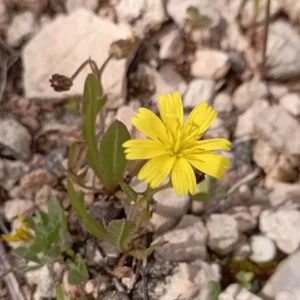
Κρηπίδα η ιερή υποείδος η ιερή
Etymology of Crepis sancta subspecies sancta
The name "Crepis" derives from the Ancient Greek "κρηπίς" which is "a platform, the base with stairs, on which the temples were built in ancient Greece", because of the formation of its leaves on where the stems with the flowers stand in some species of the genus. The specific epithet "sancta" is Latin for “holy” or “sacred,” and its origin is thought to be linked to the plant’s presence in the historically significant, sacred regions of the eastern Mediterranean, such as the Levant or areas around Jerusalem, where it was likely first collected or observed.
Many plant species have been given the epithet sancta when first collected in or near Jerusalem, often historically referred to as the Sancta Civitas (“Holy City”). If the original specimens of Crepis sancta were collected in or near Jerusalem, the epithet may directly refer to this geographic and religious association. This is a common naming convention in older European botanical literature, especially from the 18th and 19th centuries.
The Crepis genus in Cyprus
There are about 200 species in this genus. In Cyprus, we encounter 9 species and two subspecies (11 taxa). Their flowers are more or less the same.
Crepis sancta іsubsp. sancta is a common plant in Cyprus, it is encountered in all the regions of the island, at an altitude of up to 1725 metres. it can reach a maximum height of 50 cm. Crepis sancta blooms between March and April but it could be extended depending on the weather conditions from December until June.
How to identify Crepis sancta subspecies sancta
Leaves
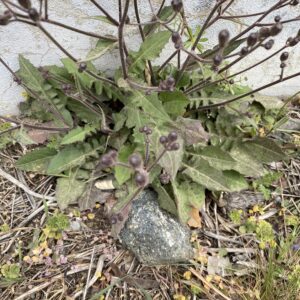
The leaves of Crepis sancta subspecies sancta are primarily arranged in a basal rosette, lying close to the ground and forming a circular spread. These rosette leaves show considerable variation in shape. Many are deeply lobed, with a central midrib and lateral lobes that give them a pinnatifid to lyrate appearance, which is typical in mature or central leaves of the rosette. However, it is also common to find entire (unlobed) leaves, particularly among the outer or younger leaves of the rosette. These entire leaves are usually linear, lanceolate, or oblong, and may have smooth or slightly undulate (wavy) margins.
As the plant develops, it produces flowering stems that are typically leafless, though they may bear small, scale-like bracts near the flower heads. These are not true foliage leaves and do not resemble the basal leaves in form. The presence of a variable mix of lobed and unlobed leaves in the basal rosette, combined with the absence of true leaves on the flowering stems, is a useful feature in distinguishing Crepis sancta subsp. sancta from other similar rosette-forming Asteraceae.
In Crepis sancta subsp. sancta, the leaves are generally glabrous to sparsely hairy. Fine hairs may be present, particularly along the margins, veins, or even scattered across the upper surface, but they are typically short, sparse, and not especially noticeable. This gives the leaf surface a mostly smooth appearance unless observed closely. In contrast, subsp. bifida tends to have leaves that are clearly and densely hairy, with longer and more conspicuous hairs that often give the plant a visibly woollier or rougher texture. This difference in hair density and prominence is a key distinguishing feature between the two subspecies.
The upper surface of the leaves in subsp. sancta is usually darker and smoother, while the underside is lighter and may show some faint hairs, especially along the main veins or edges.
Stems
The stems of Crepis sancta subsp. sancta are erect, slender, and variably branched, rising from the basal rosette. Under favorable conditions, the plant may produce many stems, each branching and terminating in a single flower head, contributing to the plant’s typical range of 20 to 60 heads. However, it is important to note that some plants may have only one or a few stems, especially if growing in dry, compacted, or nutrient-deficient soils. These stems are green to reddish-green, and are usually covered in fine, soft hairs, particularly on the upper parts. They are generally flexible and hollow, allowing the plant to adapt to wind and dry conditions. The branching pattern varies depending on the plant’s health and environment, which can result in a sparse or more compact overall form.
Phyllaries and Flower Head
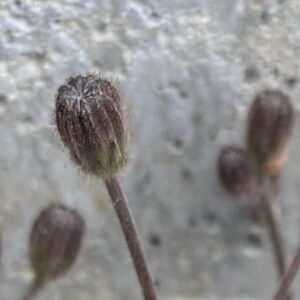
In Crepis sancta subspecies sancta, the flower heads are typically solitary and are borne at the tips of slender flowering branches. A single plant usually produces between 20 to 60 flower heads, although smaller or stressed individuals may bear only a few, or even just a single head, especially in nutrient-poor or dry environments. Each flower head is enclosed in a cylindrical involucre made up of two distinct rows of phyllaries. The outer phyllaries are narrow, dark green to brownish, usually 5 to 8 in number, and significantly shorter than the inner ones. These outer phyllaries are often recurved and densely covered with soft, fine, white to greyish hairs, giving them a somewhat woolly appearance. The inner phyllaries are longer, more numerous, and closely appressed to the flower bud, forming a tight, protective cover before the head opens. This contrast between the two rows of phyllaries is a key identifying feature of the species.
Robust Crepis sancta subps. sancta plant 35 cm tall


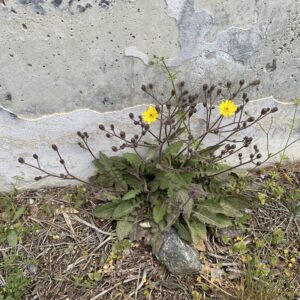
Tiny Crepis sancta subps. sancta plants