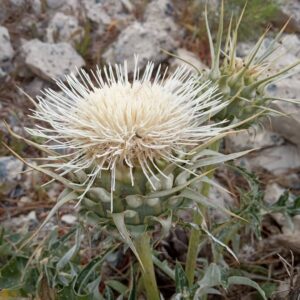
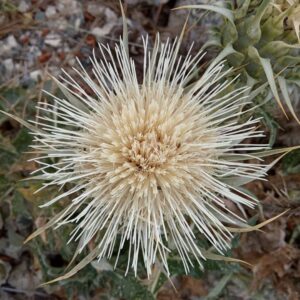
Cynara cornigera Lindley, a robust member of the Asteraceae family, is widely recognized as the Wild Artichoke. A common synonym frequently cited in Mediterranean botanical literature is Cynara sibthorpiana Boiss. & Heldr. This spiny, low-growing perennial is a characteristic element of the arid, sun-drenched landscapes of the eastern Mediterranean basin, forming a dense, protective rosette of silver-grey leaves.
Cypriot Names
Κυνάρα η κερασφόρος, Χωστή, Καυκαρούα.
Common English Names
The primary English name is the Wild Artichoke, though it is occasionally referred to as the Spiny Artichoke. Locally, it is often called the Cypriot Artichoke. This Wild Artichoke is easily distinguished from the cultivated variety by its much smaller size and the formidable spines that guard its edible floral base.
Etymology of Cynara cornigera
The etymology of the genus name Cynara is derived from the Greek κυνάρα (kynara), which some suggest relates to the Greek κύων (kyon), meaning dog, possibly referring to the tooth-like spines of the involucre. The species name cornigera is Latin for "horn-bearing," describing the horn-like appearance of the spine-tipped bracts.
All the Synonyms of Cynara cornigera
- Cynara sibthorpiana Boiss. & Heldr.
- Cynara baetica auct. non (Spreng.) Pau
- Cynara humilis auct. non L.
Key Characteristics for Diagnostic Identification
According to Meikle, Cynara cornigera can be identified by these diagnostic features:
- Habit: A stemless or short-stemmed perennial herb, often forming a flat rosette on the ground.
- Leaf Spines: Leaves are deeply pinnatisect with segments ending in very long, stout yellow spines.
- Involucral Bracts: The bracts of the flower head are ovate, ending in a stiff, spreading horn-like spine.
- Corolla Color: The tubular flowers are typically white or very pale lilac, unlike the deep purple of Cynara cardunculus.
- Pappus: The seeds (achenes) bear a pappus of plumose (feathery) hairs that are united at the base into a ring.
- Receptacle: The base of the flower head is fleshy and honeycombed, similar to the cultivated artichoke but significantly smaller.
Botanical Structure and Floral Details of Cynara cornigera
Foliage and Spiny Architecture
The leaves of the Wild Artichoke are a pale grey-green, often appearing almost white due to a dense covering of cobwebby hairs. They are deeply lobed and armed with sharp, yellowish spines that can reach 2 cm in length. This defensive architecture protects the plant from grazing during the harsh Mediterranean summer.
The Inflorescence and Bracts
The flower heads are solitary and sit nestled in the center of the leaf rosette. Each head is surrounded by multiple layers of thick, leathery bracts. These bracts are a defining feature, as they taper into a rigid, sharp spine that gives the Wild Artichoke its "horn-bearing" name.
Floral Biology and Corolla
Within the protective armor of the bracts lie the numerous individual disk florets. These florets are white or tinged with a delicate pale blue or lilac. While they lack the vibrant purple hue of the garden artichoke, they provide a vital nectar source for large bees and beetles.
Geographical Distribution and Habitat of Cynara cornigera
Global Distribution and Range
Across the world, this species is restricted to the eastern Mediterranean region. Its native range extends from southern Greece and the numerous islands of the Aegean Sea to the coastlines of Libya in North Africa. It is a specialized Mediterranean element adapted to coastal cliffs and dry, rocky steppes.
Distribution in Cyprus
In Cyprus, the Wild Artichoke is found in the lowlands and hills, particularly in the south and east, including the Akamas Peninsula and Famagusta. It grows at altitudes from sea level up to approximately 600 meters. On the island, the flowering period for this species occurs from March to May.
Is Cynara cornigera Suitable for Gardens?
When considering "Is Cynara cornigera Suitable for Gardens?", it is best reserved for large, wilder rock gardens or xeriscapes. While its sculptural form is striking, its aggressive spines make it unsuitable for areas with high foot traffic or children. It requires full sun and perfectly drained, poor soil.
Medicinal Properties of Cynara cornigera
Digestive and Hepatic Support
Like many members of the Cynara genus, this plant contains cynarin and other bitter compounds. These substances are known to stimulate bile production and improve liver function. In traditional Mediterranean medicine, infusions of the leaves were used to treat indigestion and support the gallbladder.
Antioxidant Potential
The leaves and flower bases are rich in polyphenols and antioxidants. These compounds help the plant survive intense ultraviolet radiation and are believed to provide anti-inflammatory benefits when consumed. The Wild Artichoke serves as a natural source of these protective phytochemicals in traditional rural diets.
Fascinating Things About Cynara cornigera
A Foraged Culinary Treasure
Despite its formidable spines, the Wild Artichoke is highly prized in Cyprus as a seasonal delicacy. Foragers carefully harvest the young flower heads before they open, trimming away the spines to reveal a small but incredibly flavorful heart that is often preserved in vinegar or oil.
Survival in the Scorching Sun
The plant is a master of drought resistance. Its deep taproot reaches moisture far below the surface, while its silvery, hairy leaves reflect sunlight to keep the plant cool. During the peak of summer, the above-ground parts may wither, but the life remains protected in the underground rootstock.
Geometric Beauty of the Bracts
The arrangement of the bracts on the flower head follows a strict Fibonacci sequence, a common trait in the Asteraceae family. This geometric precision ensures that the spines are perfectly distributed to provide 360-degree protection, making it almost impossible for any large herbivore to take a bite.