Ηριγέρων το καναδικό
Etymology of Erigeron canadensis
“Erigeron” derives from Ancient Greek “ἠριγέρων” [irigéron], which means “prematurely old”, from “ἦρι”, meaning “morning, early in the morning” and “γέρων”, meaning “old man”. This is either a reference to the fluffy, white seed heads and the early flowering and fruiting of many Erigeron species.
The word “canadensis” in the botanical name Erigeron canadensis is a Latin epithet that means “of Canada” or “from Canada”. It comes from the Latinized form of “Canada” combined with the suffix “-ensis”, which is commonly used in taxonomy to denote origin or place of growth. Thus, when Carl Linnaeus named the species in the 18th century, canadensis indicated that the plant was first described from, or strongly associated with, Canada or northeastern North America. Over time, the epithet has remained even though the species is now widespread across many regions of the world.
Erigeron canadensis in Cyprus
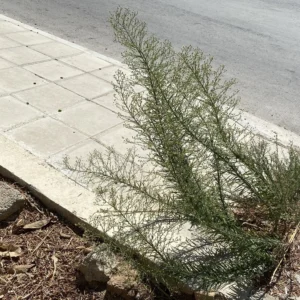
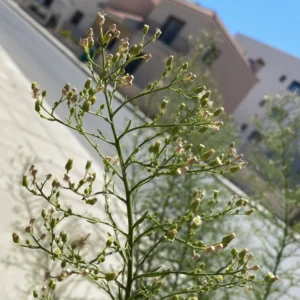
Erigeron canadensis (syn. Conyza canadensis), known as Canadian fleabane or horseweed, is an introduced and invasive species in Cyprus. Native to North America, it has spread widely across the island, particularly in lowland and coastal areas (o-1250 metres), where it colonizes disturbed habitats such as roadsides, field margins, abandoned fields, and urban lots. Its ability to produce thousands of wind-dispersed seeds allows it to establish quickly and outcompete native plants, making it a common agricultural weed and a threat to local biodiversity. In Cyprus, it is now regarded as a widespread alien species that thrives especially in dry, open environments. Its flowering period in Cyprus is between June and November.
General Description and Habitat
Erigeron canadensis (Canadian horseweed), Erigeron sumatrensis (Sumatran fleabane), and Erigeron bonariensis (hairy fleabane) are three closely related annual weeds that are often found in similar disturbed habitats worldwide. They all belong to the daisy family and share a similar upright, unbranched growth form with a panicle of small flowers. While they can be easily confused with one another, a careful examination of their physical characteristics reveals key differences that are essential for accurate identification.
Key Morphological Differences
The most reliable way to distinguish between these three species is by comparing their height, the density and type of hairs on their stems and leaves, and the appearance of their flower heads.
Hairiness (Pubescence)
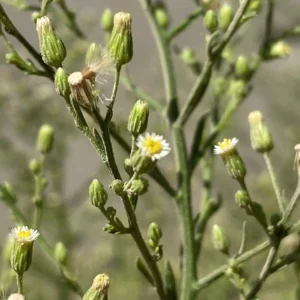
This is the most reliable feature for quick identification. E. canadensis has a stem that is only sparsely covered in short, stiff hairs, making it feel relatively smooth. E. sumatrensis is distinctly hairier, with a dense cover of soft, spreading hairs that give it a woolly appearance. E. bonariensis is also very hairy, but its hairs are typically shorter and more appressed (lying flat against the stem), often giving it a gray-green appearance.
Height and Branching Habit
This is where the average height range becomes a key differentiator.
- Erigeron canadensis typically grows to a height of 0.5 to 1.5 meters.
- Erigeron sumatrensis is generally taller and more robust, usually ranging from 1 to 2 meters.
- Erigeron bonariensis is typically the shortest of the three, with an average height range of 0.3 to 1 meter. A key difference in its growth habit is that E. bonariensis often has a wider, more pyramid-shaped branching habit from the base, while the other two tend to be more strictly upright with less branching in the lower part of the stem.
Leaves and Flower Head Appearance
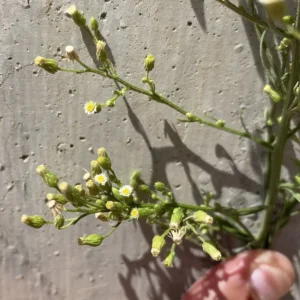
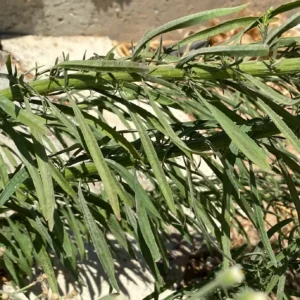
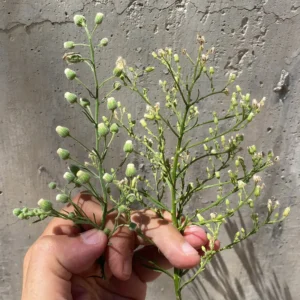
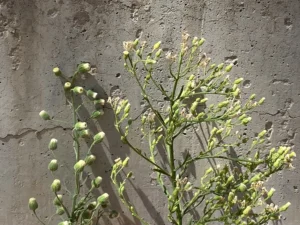
The leaves of E. canadensis are very narrow and linear. The leaves of E. sumatrensis can be slightly broader, but the overall shape is similar. The leaves of E. bonariensis are also narrow but are typically covered in a denser layer of hairs. The flower heads also differ slightly. All three have very small flower heads, but the ray florets (the tiny “petals”) are slightly more noticeable in E. canadensis. In both E. sumatrensis and E. bonariensis, the ray florets are so tiny as to be nearly absent, making the flower heads appear more cylindrical and inconspicuous.