Date Created: 23.03.2023
Last Modified: 30.04.2026
Hedypnois rhagadioloides is a versatile annual herb commonly found across the Mediterranean basin, including the island of Cyprus. Known as the Cretan Weed, this member of the Asteraceae family is easily identified by its bright yellow florets and its unique, hardened fruiting heads that appear in late spring.
Common Cypriot Names
The formal Modern Greek name is Ηδυπνοΐς η ραγαδιολοειδής [Edypnois-i-ragadioloidis]. In Cyprus, it is locally called Μουσσουά [Moussoua], a name specifically used in rural districts to describe edible wild greens. It is also referred to as Σκαλιστούιν [Skalistouin], referring to the serrated or "carved" edges of its basal leaves.
Common English Names
- Cretan Weed
- Scaly-hawkbit
- False Hawkbit
- Shielded Hedypnois
Etymology of Hedypnois rhagadioloides
The etymology of the genus name "Hedypnois" derives from the Ancient Greek "ἡδυπνοΐς" [hedypnois], a name used by Pliny for a type of wild chicory, coming from "ἡδύς" [hedys], meaning "sweet", and "πνοή" [pnoe], meaning "breath". This refers to the pleasant scent of the crushed foliage or flowers.
The specific epithet "rhagadioloides" means "resembling Rhagadiolus," another genus of the Asteraceae family. The suffix "-oides" is Greek for "likeness," highlighting the morphological similarities in the fruiting heads between these two distinct botanical groups.
Synonyms
- Hedypnois rhagadioloides (L.) F.W. Schmidt (1795)
- Hedypnois cretica (L.) Dum. Cours. (1802)
- Hedypnois polymorpha DC. (1838)
- Hedypnois monspeliensis Willd. (1803)
- Hyoseris rhagadioloides L. (1753)
Key Characteristics for Diagnostic Identification
According to the definitive botanical keys established by Robert Desmond Meikle in his comprehensive Flora of Cyprus (Volume 2, 1985), Hedypnois rhagadioloides is the only species of its genus found on the island. It is distinguished by the below morphological features:
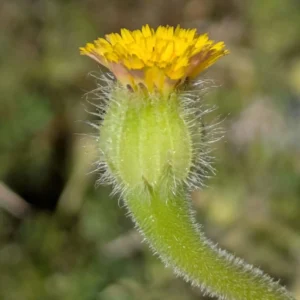
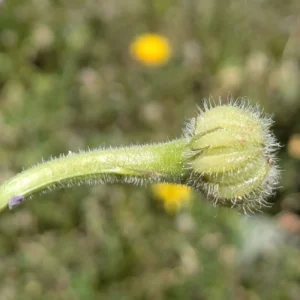
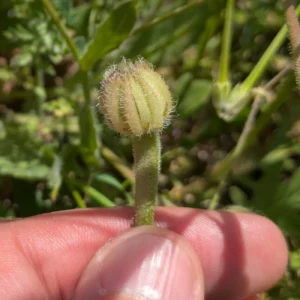
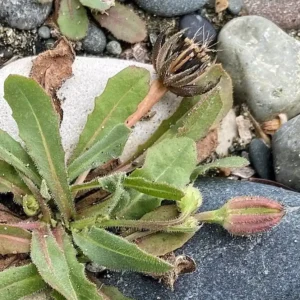
- Peduncles: As the plant matures, the flower stalks (peduncles) become markedly thickened and hollow toward the top, a feature that becomes very conspicuous during the fruiting stage.
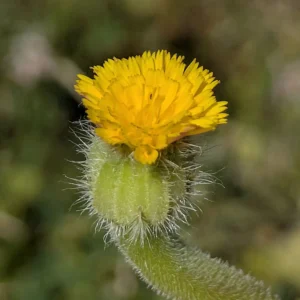
- Involucral Bracts: The inner phyllaries (bracts) become hardened, rigid, and strongly incurved at maturity, firmly enclosing the outer achenes (seeds).
- Pappus Dimorphism: A vital diagnostic is the pappus of the inner achenes, which consists of both short scales and longer, brownish-white bristles, while the outer achenes often lack bristles entirely.
- Fruit Shape: The achenes are cylindrical and slightly curved, approximately 5–8 mm long, with a surface that is minutely scabrid or rough to the touch.
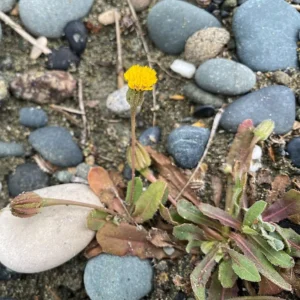
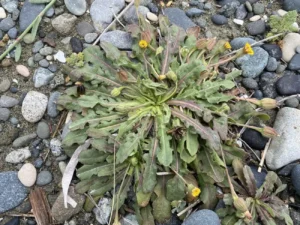
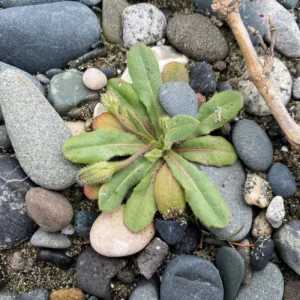
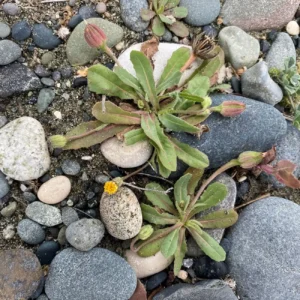
- Leaf Variation: The leaves are highly variable but typically oblong or oblanceolate, with margins ranging from nearly entire to deeply pinnatifid, often covered in stiff, simple hairs.
Additional Identification Characteristics
Botanist Davis (1975) in the Flora of Turkey notes that the Cretan Weed is exceptionally polymorphic. In Cyprus, observers should look for the beakless achenes to distinguish it from the genus Crepis, and the persistent, hardened bracts to separate it from Leontodon species.
Botanical Structure and Floral Details of Hedypnois rhagadioloides
Floral Composition
The inflorescence is a solitary capitulum (flower head) composed entirely of ligulate yellow florets. The outer florets often exhibit a greenish or purplish stripe on the underside of the petals. Unlike many dandelions, the head remains relatively compact even when fully open in the midday sun.
Geographical Distribution and Habitat of Hedypnois rhagadioloides
This species is a common component of Mediterranean ecosystems. It thrives in disturbed soils, roadsides, fallow fields, and open grasslands. It is a highly adaptable "generalist" species that can colonize both nutrient-poor rocky ground and fertile alluvial soils with equal success.
Distribution in Cyprus
Hedypnois rhagadioloides is found throughout the island. Records confirm its presence in all botanical divisions, from the Akamas peninsula in the west to the Karpas peninsula in the east. It is particularly abundant in the Mesaoria plain and the lowlands surrounding Limassol and Larnaca.
Elevation Range in Cyprus
The plant occurs from sea level up to approximately 1,200 meters. While it is most frequent in the coastal lowlands and hills, it occasionally reaches the mid-altitude pine forests of the Troodos and Pentadaktylos ranges.
Flowering Period in Cyprus
The primary flowering period begins in February and lasts through May. In cooler, higher elevations, sporadic flowering may continue into early June. The seeds are dispersed rapidly by wind and animal movement once the hardened involucres finally open.
Conservation Status in Cyprus
This species is not listed in the Red Data Book of the Flora of Cyprus as it is extremely common and widespread. It faces no significant threats and is considered a "Least Concern" (LC) taxon within the local ecological context.
Is Hedypnois rhagadioloides Suitable for Gardens?
The Cretan Weed is generally viewed as a wildflower or a common garden weed rather than an ornamental. There is virtually no commercial market for its seeds. While it is not restricted by law, its aggressive self-seeding nature makes it unsuitable for formal flower beds.
Toxicity and Safety
Hedypnois rhagadioloides is generally considered non-toxic to humans and livestock. In fact, it has a long history of being gathered as a "wild edible" (Horta) in various Mediterranean cultures. There are no reports of significant toxicity in major botanical databases or dermatological studies.
However, as with all members of the Asteraceae family, individuals with known allergies to ragweed or daisies should exercise caution, as contact or ingestion may trigger allergic reactions. According to the European Food Safety Authority (EFSA), wild greens should always be washed thoroughly to remove environmental contaminants or pesticides.
Medicinal Properties
Dietary and Nutritional Value
In Cyprus, Hedypnois rhagadioloides is consumed for its nutritional benefits. Ethnobotanical studies, such as those conducted by Della et al. (2006) at the Agricultural Research Institute of Cyprus, highlight its role as a source of antioxidants and dietary fiber in the traditional Mediterranean diet.
Traditional Digestive Aid
Traditionally, the bitter compounds (sesquiterpene lactones) found in the leaves are believed to stimulate bile production and aid digestion. While specific clinical trials on this taxon are limited, research into related chicory-like plants supports their use as mild diuretics and digestive tonics in traditional herbalism.
Fascinating Insights About Hedypnois rhagadioloides
The Self-Clamping Fruit
The most remarkable feature of Hedypnois rhagadioloides is its "hygrochastic" movement. The involucral bracts remain tightly closed in dry weather to protect the seeds but open in response to moisture. This ensures that seeds are only released when conditions are favorable for germination.
A Polymorphic Survivor
Botanists have long been fascinated by the plant's extreme morphological plasticity. Depending on soil moisture and light, the same genetic individual can produce radically different leaf shapes. This ability to "shape-shift" allows the species to survive in both parched coastal dunes and lush inland meadows.
The Edible "Lion's Breath"
The name "Hedypnois" (sweet breath) is ironic given its slightly bitter taste when raw. In Cyprus, the bitterness is traditionally removed by boiling the leaves with lemon and olive oil, a practice documented in local culinary heritage books as a staple of rural longevity.