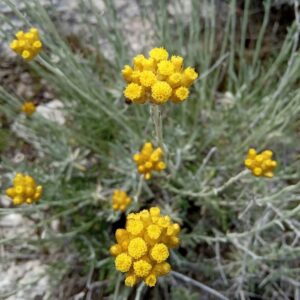
Αθάνατο, Κλάματα της Παναγίας, Ελίχρυσο το στοιχάς υποείδος του Μπαρρελιέρ
Etymology of Helichrysum stoechas subspecies barrelieri
The genus's name "helichrysum" derives from Ancient Greek, from the combination of the words "ἥλιος" [hēlios or ilios], meaning "sun" and "χρυσός" [chrysos], meaning "gold, golden", hence "golden sun", a reference to the bright yellow colour of the flowerheads of some species such as the "stoechas", persistent even when the plant dries up. Its epithet "stoechas", derives from Ancient Greek "στοιχάς" [stichas], meaning "in a row, one behind another", referring to the plants' appearance in nature, which is actually its ancient Greek name mentioned by Dioscorides (since the plant always existed in Greece, I consider it baseless that "Greek sailors" gave this epithet to the plant after the Stoichades islands of France where "they saw them grow aligned"). The epithet "barrielieri" is a tribute to the Frech botanist Jacques Barrelier (1606-1673).
Helichrysum stoechas subspecies barrelieri in Cyprus
Helichrysum stoechas subsp. barrelieri is a common plant in Cyprus. It grows at an altitude of up to 1000 metres, all around the island. Someone may keep it in a vase without water for months, that's why in Cyprus it is called "αθάνατο", meaning "immortal" because as mentioned earlier, the flowers maintain their bright yellow colour even when the plant dries up. Its pretty long flowering period is between March and May.
How to recognize Helichrysum stoechas subspecies barrelieri
Helichrysum italicum in Cyprus is represented by two subspecies: Helichrysum italicum subsp. microphyllum and Helichrysum italicum subsp. italicum. Both share similar traits but differ in subtle morphological features, and they can also be compared to Helichrysum stoechas subsp. barrelieri, a more widespread species on the island. These three taxa can be distinguished based on their floral structures, aroma, flowering times, and habitat preferences.
Flower and Bract Characteristics
The most reliable way to distinguish between these plants is by examining their flower heads (capitula) and the papery bracts (phyllaries) surrounding them. Helichrysum italicum subsp. microphyllum typically has cylindrical to obpyramidal* flower heads measuring about 3–5 mm wide at anthesis. The bracts are straw-colored, closely overlapping, and give the flower head a neat, firm appearance.
Helichrysum italicum subsp. italicum also has straw-colored bracts but tends to exhibit slightly broader flower heads that appear a bit less compact. The bracts may be longer and arranged less tightly than those of microphyllum.
In contrast, Helichrysum stoechas subsp. barrelieri is recognized by its larger, bell-shaped flower heads, measuring 4–9.5 mm wide at anthesis. The bracts are glossy, bright yellow, and more loosely arranged, giving the flower a more open and radiant appearance.
obpyramidal* = The prefix "ob-" in botanical terms often means "inverted" or "the other way around." So, something that is obpyramidal is shaped like a pyramid with the point at the bottom and the broad base at the top.
Leaf Morphology
The leaf morphology of Helichrysum italicum subsp. microphyllum, subsp. italicum, and Helichrysum stoechas subsp. barrelieri provides important distinguishing features. Helichrysum italicum subsp. microphyllum has narrow, linear leaves typically ranging from 5 to 20 mm in length and less than 2 mm in width. These leaves are usually finely hairy to almost glabrous, giving the plant a delicate silvery-green appearance. The leaf edges are often slightly revolute (rolled under), and the leaves may curve gently inward, adaptations to reduce water loss in exposed habitats.
In contrast, Helichrysum italicum subsp. italicum has slightly broader and longer leaves, usually 10 to 30 mm long and 2 to 4 mm wide, which are more densely tomentose (woolly). This dense layer of short hairs gives the foliage a soft, velvety texture and a distinctly grey-white or silvery look.
Helichrysum stoechas subsp. barrelieri has the broadest leaves, often 20 to 40 mm long and 3 to 6 mm wide, with an oblong to lanceolate shape. These leaves are moderately hairy and spaced more openly along the stem, resulting in a bushier and softer overall appearance compared to the more slender italicum forms.
Scent and Aromatic Properties
All three taxa are aromatic, but their scents are distinct. Helichrysum italicum subsp. microphyllum has a sharp, resinous, curry-like scent that is often stronger due to its growth in exposed, rocky habitats. It is one of the primary sources of Helichrysum essential oil, prized for its high neryl acetate content.
Subsp. italicum also has a curry-like aroma, but it is sometimes milder or more herbaceous, depending on environmental factors. It, too, is used in essential oil production, though its chemical profile can differ slightly from microphyllum.
Helichrysum stoechas subsp. barrelieri, while also aromatic, lacks the curry scent. Instead, its fragrance is often described as warm and sweet, with notes reminiscent of hay, honey, or tobacco. Though it also produces essential oil, it is less commercially valued than that of the italicum subspecies.
Flowering Period (in Cyprus)
Flowering time provides a useful field distinction. Both Helichrysum italicum subsp. microphyllum and subsp. italicum flower from June to September, with some variation based on elevation and exposure. Their late blooming period helps reduce overlap with H. stoechas. Helichrysum stoechas subsp. barrelieri, on the other hand, flowers earlier in the season, from March to May.
Geographical Distribution in Cyprus
In Cyprus, the two plants have different levels of abundance and distribution. Helichrysum italicum is primarily found in the western part of Cyprus, particularly in the Paphos district and the Troodos Mountains. Its elevation range is quite broad, from 50 to 1700 meters. On the other hand, Helichrysum stoechas subsp. barrelieri is much more common and can be found all over the island, not just in the western region. Its distribution is more widespread at lower to mid-altitudes, up to 1000 meters, making it a more familiar sight in various habitats across the island. This difference in abundance and distribution makes H. stoechas subsp. barrelieri the more frequently encountered of the two in Cyprus.