Date Created: 07.06.2025
Last Modified: 12.05.2026
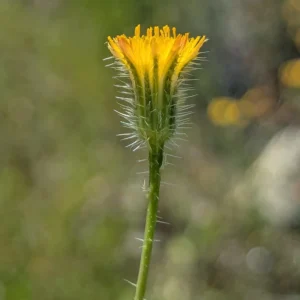
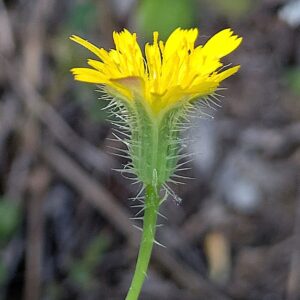
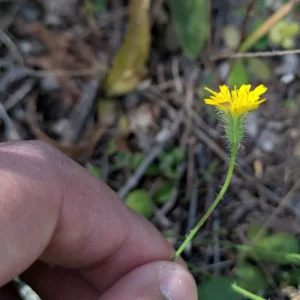
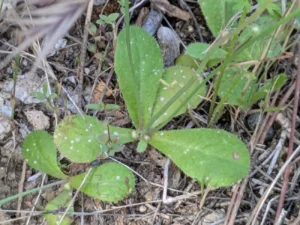
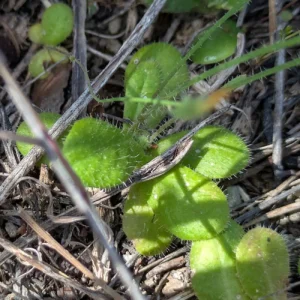
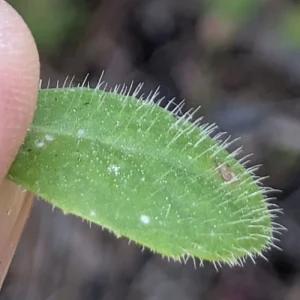
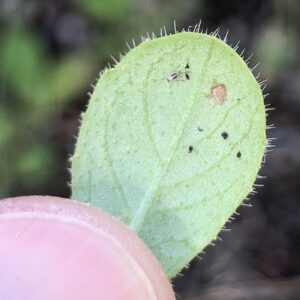
Hypochaeris achyrophorus is a resilient, yellow-flowered annual herb belonging to the Asteraceae family. Often referred to as the Mediterranean Cat's-ear, it is a common component of the island's spring flora. This species is easily recognized by its bristly basal leaves and dandelion-like flower heads that populate rocky uncultivated ground across Cyprus.
Common Cypriot Names
The formal Modern Greek translation of the Latin name is Υποχοιρίς η αχυροφόρος [Ypochoiris-i-achyrophoros]. Locally, the plant is known by the Cypriot name Παλληκόχορτο [Pallikochorto], which translates to "stake-herb," referencing its rigid, upright stems. This name was recorded by the researcher Athena Della for the Agricultural Research Institute of Cyprus, who documented its traditional use as a wild edible green among rural communities.
Common English Names
- Mediterranean Cat's-ear
- Annual Cat's-ear
- Little Seed-heads
Etymology of Hypochaeris achyrophorus
The name Hypochaeris achyrophorus comes from Greek origins, but the genus name "Hypochaeris" is debated. It is said to be derived from the Ancient Greek "ὑποχοιρίς", from the combination of the words "ὑπό" (hypo), meaning "under," and "χοῖρος" (choiros), meaning "pig". The precise reasoning behind this name is debated, but one theory suggests it refers to pigs' affinity for the plant's edible roots. Another perspective links it to Theophrastus, a Greek philosopher, who used the name for this or a similar plant.
As a Greek-speaker, though, I can't figure out how "choiros" can be converted to "chaeris"; the correct translation of the Greek alphabet to Latin is "choeris", thus Hypochoeris, not Hypochaeris. There are actually listings on the internet of this genus with the correct translation, as Hypochoeris. The name Hypochaeris, though, was formally published and accepted in botanical literature. Under the rules of the International Code of Nomenclature for algae, fungi, and plants (ICN), once a genus name is validly published and widely used, it is preserved for the sake of nomenclatural stability, even if it contains a small etymological inaccuracy. So even if Hypochoeris might be a more literal rendering of "under-pig," the accepted name is Hypochaeris, and it cannot be arbitrarily changed now.
Another debated etymological explanation is the following: The genus name comes from the combination of the words "ὑπό" (hypo), meaning "under," and "χάρις" (charis), meaning "grace," "kindness," or "favour." Thus, the name is supposed to be interpreted as “less than graceful” or “under grace,” allegedly about the plant’s modest or humble appearance compared to showier relatives. This interpretation is consistent with a common tradition in botanical Latin where names subtly describe visual or ecological traits. But, this translation of the Greek alphabet to Latin also doesn't make sense, as "charis" has nothing to do with "chaeris", this would normally derive from "χαίρω" (chaero) in Greek, meaning "I'm glad".
This specific epithet "achyrophorus" is derived from the Greek "αχυροφόρος", from the combination of the words "άχυρο" (achyro), meaning "chaff", and "-φόρος" (phoros), meaning "wearer, bearer"; thus ", achyrophoros" is the epithet "chaff-bearer". It refers to the small, dense, scale-like structures (like husks or chaff in wheat) present on the receptacle of the flower head.
Synonyms
- Hypochaeris achyrophorus L. (1753)
- Hypochaeris aetnensis (L.) Ball (1878)
- Seriola aetnensis L. (1767)
- Hyoseris achyrophorus L. (1753)
Key Characteristics for Diagnostic Identification
According to the definitive botanical keys established by Robert Desmond Meikle in his comprehensive Flora of Cyprus (Volume 2, 1985), this species is distinguished from other taxa of the genus in Cyprus by the below morphological features:
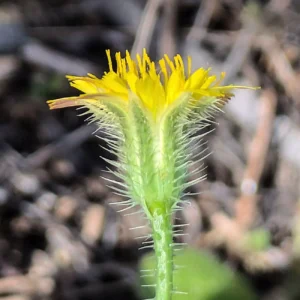
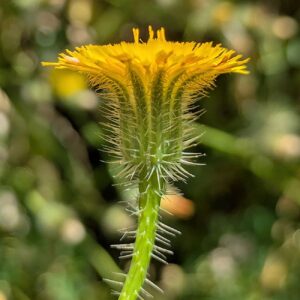
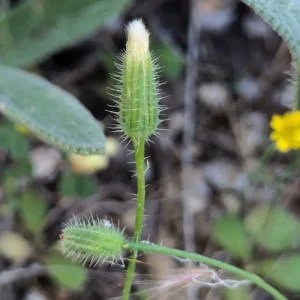
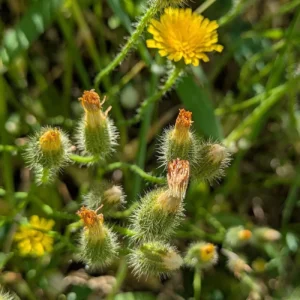
- Involucral Bracts: The outer phyllaries are distinctly hispid, possessing stiff, spreading bristles along the midrib. This is the primary SOS characteristic used to distinguish it from Hypochaeris glabra, the only other member of the genus in Cyprus, which features entirely glabrous (hairless) bracts.
- Receptacle Scales: The receptacle is covered with long, linear-subulate pales (chaffy scales). These are persistent and clearly visible when the florets are removed, a feature lacking in many other yellow composites like Leontodon.
- Achene Morphology: The outer achenes are truncate and beakless, while the inner achenes are narrowed into a slender beak. This seed dimorphism is a key identifier. In contrast, H. glabra often possesses beaked achenes throughout the head or at least in the majority.
- Pappus Structure: The pappus consists of a single row of plumose bristles. This feathery structure ensures wind dispersal and is more robust than the simple, non-plumose hairs found in related annual genera.
- Stem and Peduncles: The peduncles are often conspicuously thickened just below the flower head. This swelling is more pronounced than in H. glabra and provides a sturdy support for the relatively large capitulum.
Additional Identification Characteristics
According to observations by P.H. Davis in the Flora of Turkey and the East Aegean Islands, the Mediterranean Cat's-ear can also be identified by the purplish or greenish-grey tinge on the underside of the outer ligules. This subtle coloration helps differentiate it from Crepis species during the early flowering stages.
Geographical Distribution and Habitat of Hypochaeris achyrophorus
This taxon is native to the Mediterranean Basin, extending from the Atlantic coasts of Portugal and Morocco to the Levant and Turkey. It thrives in dry, sun-exposed environments such as phrygana, garigue, rocky hillsides, and the margins of cultivated fields. It is a pioneer species that favors calcareous soils and well-drained rocky substrates.
Distribution in Cyprus
The plant is widely distributed across Cyprus. It is commonly found in the Akamas Peninsula, the central Mesaoria plain, the Troodos foothills, and along the Pentadaktylos range. It is present in all botanical regions of the island, benefiting from its ability to colonize disturbed and overgrazed habitats.
Elevation Range in Cyprus
In Cyprus, the species is found from sea level up to 1,200 metres. While it is most abundant in the lowland coastal areas, its vertical distribution allows it to reach mid-altitude clearings within the pine forests of the central mountain massifs.
Flowering Period in Cyprus
The flowering window typically spans from February to May. In particularly moist years or at higher elevations, sporadic flowering can be observed as late as early June. The bright yellow heads are sensitive to light and often close by early afternoon.
Conservation Status in Cyprus
According to the Red Data Book of the Flora of Cyprus, this subspecies is listed as Least Concern (LC). Due to its broad distribution and high frequency in various habitats, it is not considered threatened. Its resilience to grazing and heat ensures stable populations across the island.
Is Hypochaeris achyrophorus Suitable for Gardens?
Hypochaeris achyrophorus is generally considered a wildflower or a common weed and is not found in the commercial seed market. While not restricted by law for private cultivation, its aggressive self-seeding nature makes it unsuitable for formal gardens. It is best suited for "rewilding" projects or dry rockeries.
Toxicity and Safety
There are no documented reports of significant toxicity for Hypochaeris achyrophorus in humans. According to the Database of Useful Plants of the Mediterranean, the plant is a recognized edible. However, like many members of the Asteraceae family, it contains sesquiterpene lactones, which give the plant a bitter taste.
In veterinary contexts, some species of the genus have been tentatively linked to Australian Stringhalt in horses when consumed in massive quantities over long periods. While this specific Mediterranean annual is rarely implicated, livestock owners should monitor pastures where it becomes overly dominant to ensure a balanced diet for grazing animals.
Medicinal Properties
Nutritional and Antioxidant Value
In Cyprus, Hypochaeris achyrophorus is traditionally gathered as part of "Horta" (wild greens). Research conducted by Della et al. (2006) at the Agricultural Research Institute indicates that these wild greens are rich in Vitamins A, C, and E, as well as polyphenols. These compounds act as natural antioxidants that support cellular health.
Traditional Digestive Aid
Historically, bitter-tasting herbs like Hypochaeris achyrophorus were used in Mediterranean folk medicine to stimulate bile production and aid digestion. The bitterness acts as a natural gastric stimulant. While these traditional uses are well-documented, no modern clinical trials have been conducted to establish specific dosages or pharmacological protocols for this taxon.
Fascinating Insights About Hypochaeris achyrophorus
The "Pig-Food" Legacy
The name "Hypochaeris" is a window into ancient animal husbandry. Observations by early naturalists noted that swine would dig into the earth to find the roots of this plant. This led to a nomenclature that highlights its role in the pre-industrial food chain, serving as a forage crop for domestic pigs in rural Mediterranean landscapes.
Hygroscopic Seed Protection
The involucre of the plant exhibits hygroscopic movements. In dry conditions, the bracts remain open to allow the wind to carry away the plumose seeds. During rain or high humidity, the bracts close tightly to protect the achenes from moisture, ensuring they are only released when conditions for wind dispersal are optimal.
A Biological Indicator of Soil Quality
Hypochaeris achyrophorus is often a "pioneer species." Its presence in high density often indicates soil that is shallow and poor in nutrients, yet well-aerated. By colonizing these barren spots, the plant’s root system helps stabilize the soil and prevent erosion on the steep, rocky hillsides of the Troodos mountains.
Adaptation to High Light Intensity
The stiff bristles (hispid hairs) on the leaves and stems are more than just a defense against herbivores. Studies on Mediterranean flora suggest these hairs create a boundary layer of air that reduces water loss and reflects excess UV radiation, allowing the plant to thrive in the intense heat of the Cypriot spring.